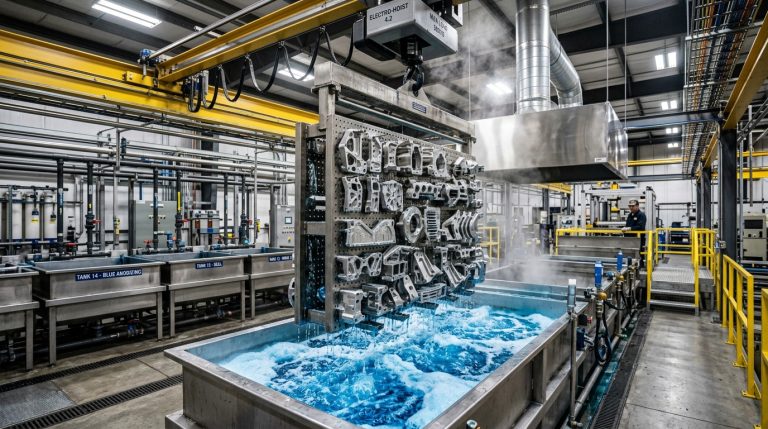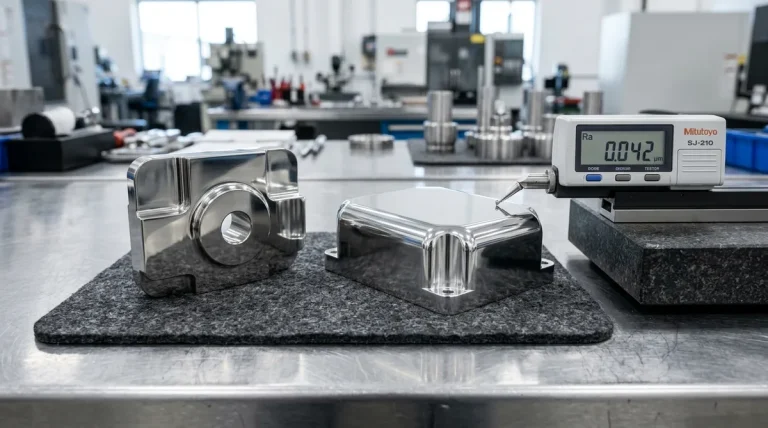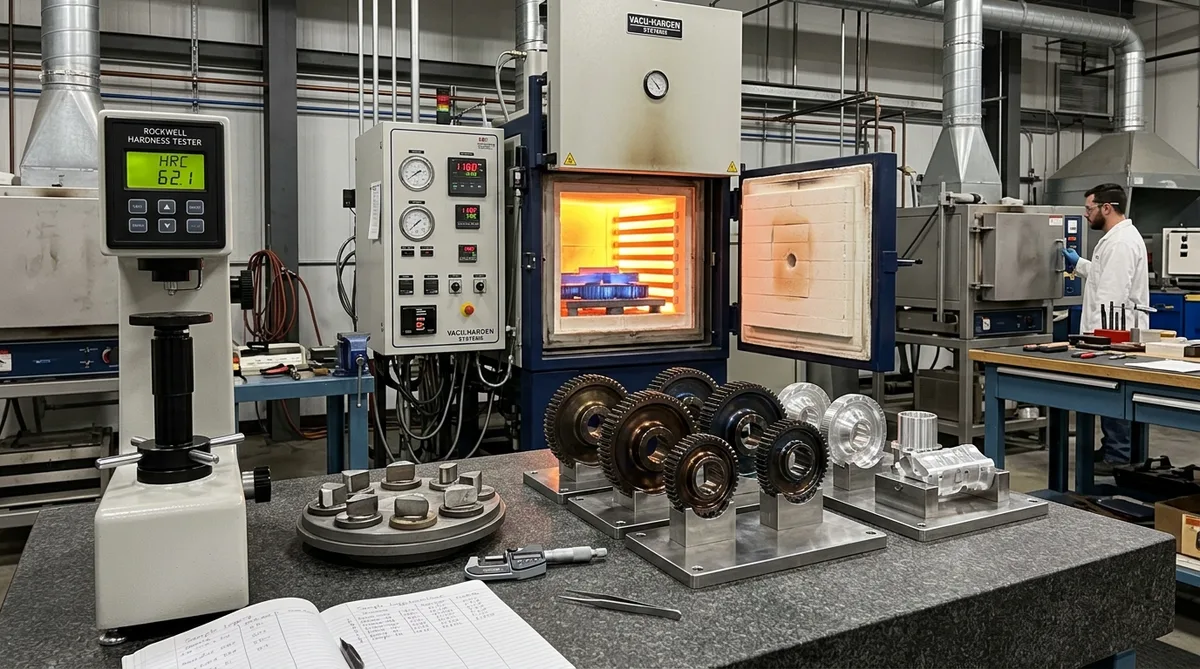
Precise metallurgical control through heat treatment for CNC machining transforms raw alloy billets into high-end structural components capable of withstanding extreme dynamic fatigue, frictional abrasion, and high impact stresses. However, improper thermal cycling can introduce severe quench distortion, volumetric phase expansion, and micro-cracking that destroy tight drawing tolerances. At our in-house facility, our materials engineers combine vacuum furnaces, controlled-atmosphere nitriding, and cryogenic stabilization with advanced precision CNC machining services and functional surface finishing processes to guarantee dimensional stability within ±0.005mm.
Core Thermal Mechanisms: Transforming Microstructures
Heat treatment alters the crystalline arrangement of metallic grains without melting the workpiece:
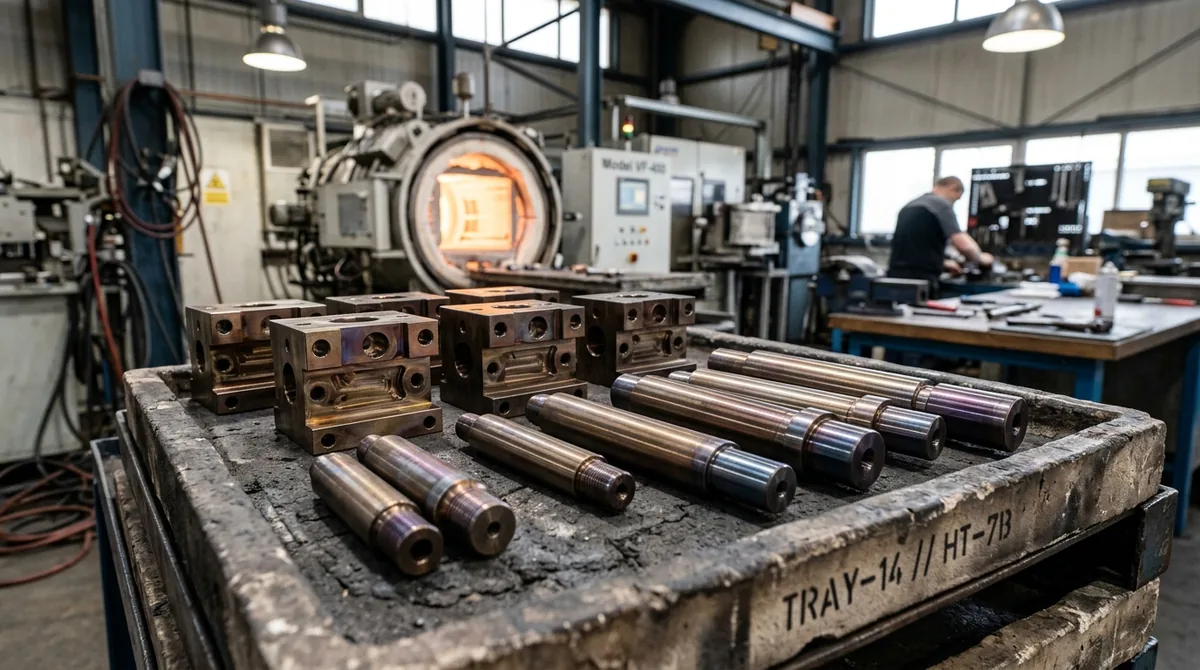
- Austenitizing & Martensitic Quenching: Heating carbon steels above the upper critical transformation temperature (Ac3) converts ferrite and pearlite into face-centered cubic (FCC) austenite. Rapid quenching in oil, polymer, or pressurized nitrogen freezes carbon atoms in solution, distorting the lattice into hard, highly stressed body-centered tetragonal (BCT) martensite.
- Tempering for Fracture Toughness: Reheating as-quenched martensite between 150°C and 650°C precipitates sub-microscopic carbides, relieving internal quenching stresses and trading excess hardness for essential fracture toughness and ductility.
- Stress Relief Annealing: Soaking rough-machined billets at 550°C to 650°C followed by slow furnace cooling relaxes residual machining stresses, preventing warping during subsequent finish milling.
Precipitation Hardening in Aerospace Aluminum Alloys (T6 / T651)
Unlike steels that harden through phase transformation, 6000 and 7000 series aluminum alloys harden via solid-state precipitation:
- Solution Heat Treating: Soaking aluminum at 470°C to 530°C dissolves alloying elements (magnesium, silicon, copper, and zinc) into a homogeneous solid solution.
- Rapid Water Quenching: Dropping parts into agitated water within 5 seconds locks solute atoms into a supersaturated solid solution (SSSS) at room temperature.
- Stress Relieving by Stretching (T651): Mechanically stretching the quenched plate by 1% to 3% permanent set neutralizes thermal quenching stresses, ensuring billet stability during heavy pocket milling.
- Artificial Aging (Precipitation): Reheating at 120°C to 175°C for 8 to 24 hours precipitates coherent Guinier-Preston (GP) zones and sub-microscopic Mg2Si or MgZn2 particles, locking dislocation glide planes and doubling tensile strength.
Surface Hardening: High Wear Shell with Ductile Core
When components endure combined high sliding friction and cyclic shock loads, surface case hardening outperforms through-hardening:
| Surface Hardening Method | Process Temperature | Typical Case Depth | Surface Hardness | Thermal Distortion Level |
|---|---|---|---|---|
| Gas / Vacuum Carburizing | 880°C – 950°C | 0.5 – 2.5 mm | 58 – 62 HRC | Moderate to High (requires post-grind) |
| Gas / Plasma Nitriding | 500°C – 540°C | 0.1 – 0.6 mm | 65 – 72 HRC (1000+ HV) | Minimal (no phase change or quench) |
| Carbonitriding | 800°C – 870°C | 0.2 – 0.8 mm | 60 – 64 HRC | Moderate |
| Induction Hardening | Localized HF heating | 1.0 – 5.0 mm | 54 – 60 HRC | Localized; excellent for shaft journals |
Heat Treatment Selection Matrix for Machining Alloys
The following engineering guide summarizes standard thermal cycles and target hardnesses across popular engineering materials:
| Alloy Grade | Category | Standard Thermal Process | Target Hardness | Key Mechanical Advantage |
|---|---|---|---|---|
| AISI 4140 / 42CrMo | Alloy Steel | Quench & Temper (845°C → Oil → 560°C) | 28 – 34 HRC | High torsional fatigue strength and toughness |
| AISI D2 / SKD11 | Cold Work Tool Steel | Vacuum Quench + Double Temper | 58 – 62 HRC | Extreme abrasive wear resistance for stamping dies |
| AISI S136 / Stavax | Stainless Mold Steel | Vacuum Austenitize (1020°C) + Deep Freeze | 48 – 52 HRC | Optical mirror polishability and corrosion defense |
| Aluminum 6061 | Wrought Aluminum | Solution Treat + Stretch + Artificial Age (T6) | 95 – 100 HB (15 HRC) | Double tensile yield strength with low density |
| Aluminum 7075 | Aerospace Aluminum | T651 Solution & Age Hardening | 150 – 160 HB (32 HRC) | 500+ MPa yield strength comparable to structural steel |
| 17-4PH Stainless | Precipitation Hardening | H900 Age Hardening (480°C × 1h air cool) | 40 – 45 HRC | High strength with zero quench distortion |
DFM Rules: Preventing Distortion & Quench Cracking
Achieving micron tolerances on heat-treated parts requires integrating manufacturing rules into CAD models:
- Maintain Symmetrical Section Thickness: Severe transitions between thin walls and thick bosses cause uneven cooling rates during quenching, generating residual stresses that warp the part. Incorporate generous transitional tapers.
- Generous Fillet Radii: Sharp 90-degree internal corners concentrate quench stresses, frequently causing spontaneous quench cracking. Specify fillet radii of at least R ≥ 1.0 mm on all internal corners.
- Rough Machining Stock Allowance: High-temperature hardening induces volumetric thermal expansion (up to 0.1% in steels). Leave 0.3 mm to 0.5 mm of grinding stock on critical bearing journals and mating datum faces for final grinding after hardening.
Frequently Asked Questions
Why do machined steel parts distort during heat treatment?
Distortion occurs due to uneven thermal expansion during rapid heating/quenching and the volumetric phase transformation from austenite to martensite (which expands volume by approximately 4%). To minimize distortion, parts should be vacuum heat-treated, preheated in stages, and allowed generous transitional radii in design.
What is the difference between case hardening and through hardening?
Through-hardening heats and quenches the entire cross-section of a medium-to-high carbon steel part, resulting in uniform hardness throughout but lower fracture toughness. Case hardening infuses carbon or nitrogen into low-carbon steel surfaces, creating a hard, wear-resistant outer layer (58-62 HRC) while preserving a ductile, shock-absorbing inner core.
Why is cryogenic deep freezing used after quenching tool steels?
Conventional room-temperature quenching often leaves 5% to 15% unstable retained austenite trapped within the microstructure. Sub-zero cryogenic treatment (-80°C to -196°C) forces retained austenite to convert completely into stable martensite, eliminating long-term dimensional drift in precision gauges and mold tooling.
Upgrade Your Component Durability with Expert Heat Treating
From vacuum hardening tool steels and carburized shafts to T6 aluminum precipitation aging, our in-house machining and thermal processing cells deliver tight tolerances and optimal mechanical strength. Upload your 3D CAD models (STEP / IGES) today for an instant DFM manufacturability evaluation and quote.
Upload CAD Files for Heat Treating & Machining →