Industrial HP Multi Jet Fusion (MJF) 3D Printing Services
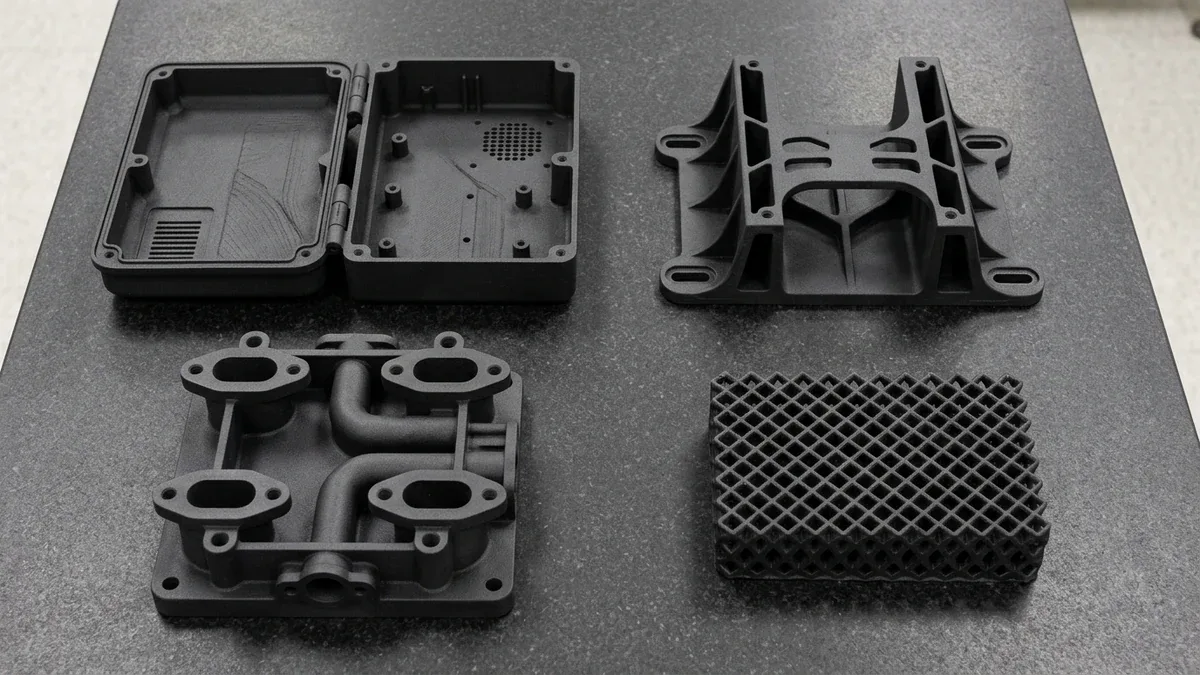
At AS Prototypes, we deliver industrial-grade HP Multi Jet Fusion (MJF) 3D printing services for mission-critical prototypes and serial functional production parts. Utilizing genuine HP Jet Fusion 5200 and 4200 platforms, our additive manufacturing process yields near-isotropic mechanical properties (tensile modulus up to 1,700–1,800 MPa), dense low-porosity structure, and complex lattice geometries without sacrificial support structures. From high-ductility PA12 nylon enclosures and oil-resistant PA11 hinges to flexible TPU elastomeric dampers, our facility maintains repeatable as-printed dimensional accuracy of ±0.20 mm per 100 mm (±0.002″/in) with rapid 4- to 8-business-day ex-factory production turnaround.
How HP Multi Jet Fusion Works: Powder Bed Fusion Technology
Unlike single-point laser sintering or filament extrusion, HP Multi Jet Fusion employs a planar thermal-inkjet powder fusion mechanism:
- 1. Precision Powder Recoating: A precision bi-directional recoater deposits an ultra-consistent 80-micron (0.08 mm) layer of polyamide nylon powder across the pre-heated build bed maintained at near-melting temperature.
- 2. Dual Functional Agent Jetting: Thermal inkjet printheads travel across the powder bed, jetting two liquid agents simultaneously: a Fusing Agent that absorbs infrared light where particles must melt, and a Detailing Agent along boundaries to cool edges and prevent thermal bleed.
- 3. Full-Pass Infrared Fusing: High-intensity infrared lamps sweep across the bed. Particles printed with fusing agent melt uniformly into a solid, fully dense cross-section, while unfused powder remains loose to act as continuous self-support.
HP MJF vs. SLS 3D Printing: Engineering Head-to-Head Comparison
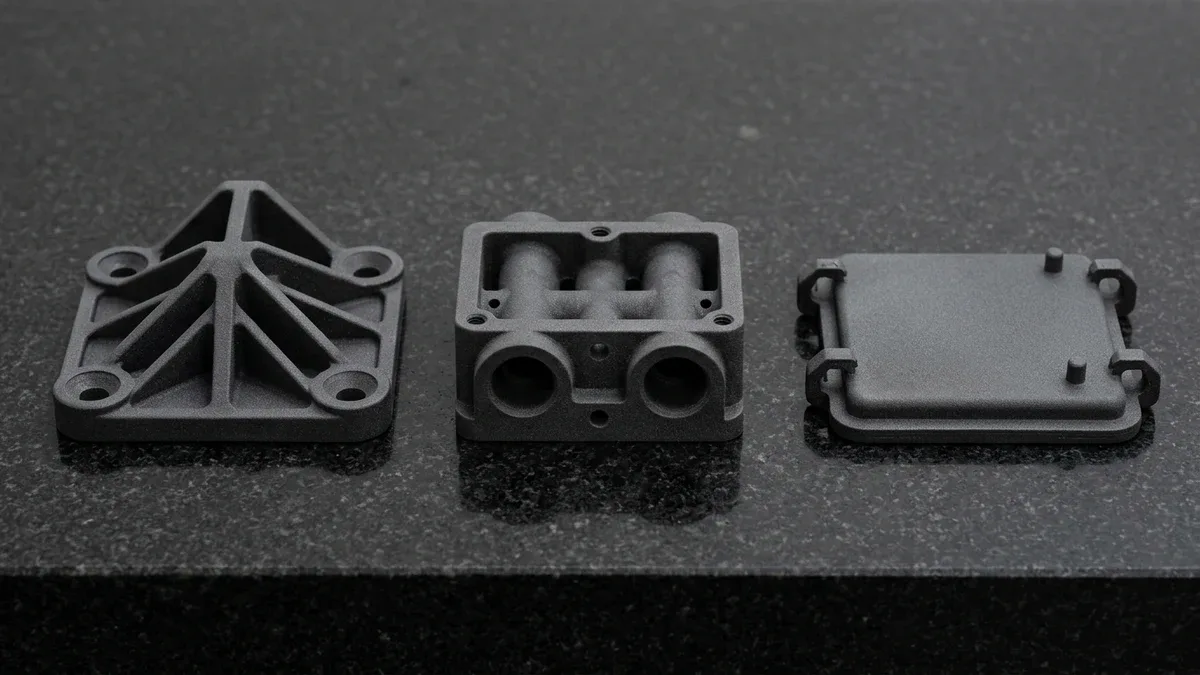
While both technologies operate on powder bed fusion without sacrificial supports, MJF delivers superior density, isotropy, and surface edge crispness:
| Engineering Parameter | HP Multi Jet Fusion (MJF) | Selective Laser Sintering (SLS) |
|---|---|---|
| Z-Axis Tensile Strength | 95% – 98% of XY plane (Near-Isotropic) | 75% – 85% of XY plane (Anisotropic weakness) |
| Density & Porosity | 99.5%+ dense; airtight & watertight out of machine | Porous micro-structure; requires sealant for fluids |
| Surface Roughness (As-Printed) | Ra 4.0 – 5.5 μm (finer bead texture) | Ra 6.0 – 9.0 μm (rough granular texture) |
| Dimensional Tolerance | ±0.20 mm per 100 mm (±0.002″/in) | ±0.20 mm per 100 mm (±0.002″/in) |
| Min. Feature Resolution | 0.5 mm (sharper edge transitions via Detailing Agent) | 0.8 mm (limited by laser spot thermal halo) |
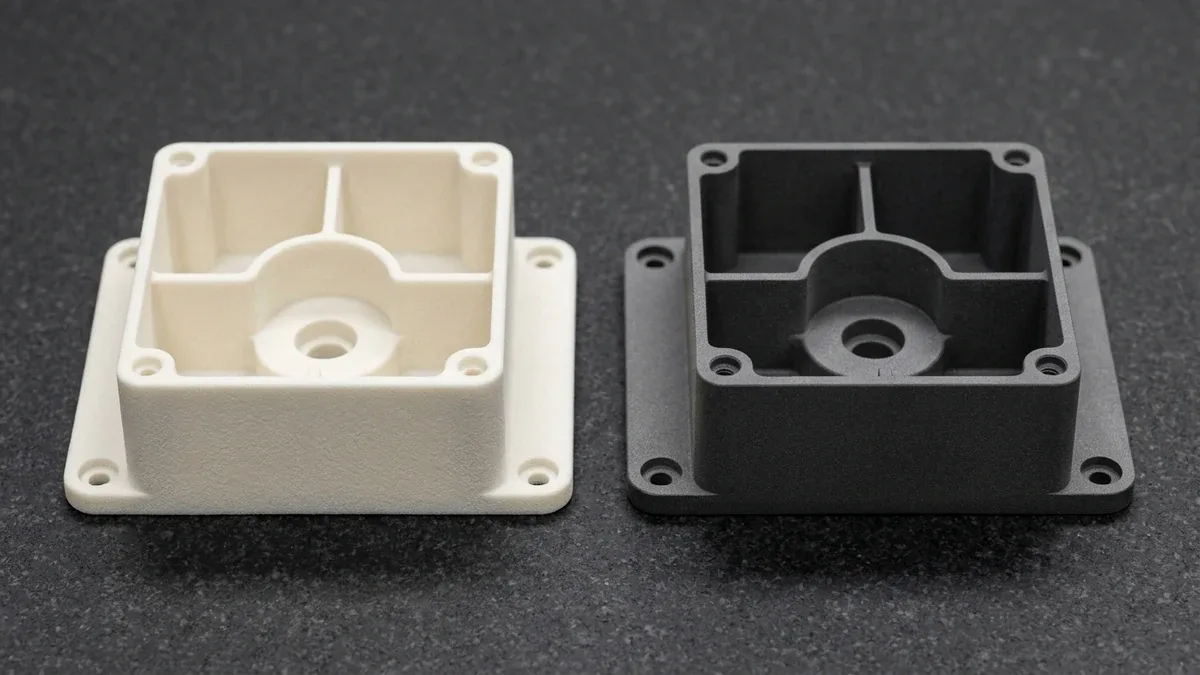
| Standard Base Color | Graphite grey to deep black (dyed) | Natural chalky white to light grey |
MJF Engineering Materials Matrix & Mechanical Properties
We source 100% genuine HP OEM polyamide powders and engineering elastomers for verified mechanical repeatability:
| Material Grade | Tensile Strength | Tensile Modulus | Elongation at Break | HDT (@ 0.45 MPa) | Primary Applications |
|---|---|---|---|---|---|
| HP 3D HR PA12 | 48 – 52 MPa | 1,700 – 1,800 MPa | 18 – 22% | 175°C | Functional housings, brackets, snap-fit enclosures, ducting |
| HP 3D HR PA11 | 50 – 54 MPa | 1,500 – 1,600 MPa | 40 – 50% | 182°C | High-impact components, living hinges, crash-resistant parts |
| HP 3D PA12-GB (Glass Beads) | 30 – 34 MPa | 2,800 – 3,000 MPa | 5 – 7% | 173°C | High-stiffness enclosures, pump housings, dimensionally stable jigs |
| BASF / HP TPU | 8 – 10 MPa | 65 – 75 MPa | 250 – 300% | Shore 85A–90A | Vibration dampers, gaskets, shoe outsoles, flexible ducting |
Practical DFM Guidelines for HP Multi Jet Fusion (8-Point Engineering Table)
Optimizing your 3D CAD geometry specifically for HP Multi Jet Fusion infrared thermal absorption and powder bed packing lowers per-part nesting cost and guarantees accurate mechanical assembly:
| Design Feature | Minimum Threshold | Recommended Target | MJF Thermal Physics & Shop-Floor DFM Guidance |
|---|---|---|---|
| 1. Supported Wall Thickness | ≥ 0.80 mm (0.031 in) | 1.50 – 2.50 mm (0.059 – 0.098 in) | Ensures complete infrared fusing agent penetration and structural rigidity during automated glass-bead depowdering. |
| 2. Freestanding Cantilever Walls | ≥ 1.20 mm (0.047 in) | 2.00 – 3.00 mm (0.079 – 0.118 in) | Add 0.8 mm root fillets where thin walls meet thicker bases to prevent thermal stress concentration during cool-down. |
| 3. Hollow Coring & Max Wall Mass | ≤ 5.0 mm Solid Sections | Core to 2.0 – 3.0 mm Shell | Carbon-black fusing agent absorbs intense IR energy; coring out thick solid blocks prevents localized thermal sink marks and warpage. |
| 4. Powder Escape Drain Holes | ≥ 2 Holes × Ø3.0 mm | ≥ 2 Holes × Ø5.0 mm (0.197 in) | Position drain ports at opposing ends of hollow manifolds or cored housings so densely packed MJF powder cake can be evacuated. |
| 5. Print-in-Place Articulated Joints | ≥ 0.50 mm (0.020 in) | 0.60 – 0.80 mm (0.024 – 0.031 in) | Detailing agent jets around boundaries to sharpen edges, but a 0.50 mm minimum radial gap is required to prevent thermal cake fusion. |
| 6. Mating Assembly Clearance | ≥ 0.20 mm per Side | 0.30 – 0.40 mm per Side | Provides smooth slip-fit assembly across housing lips and telescoping tubes while accommodating ±0.20 mm per 100 mm tolerance. |
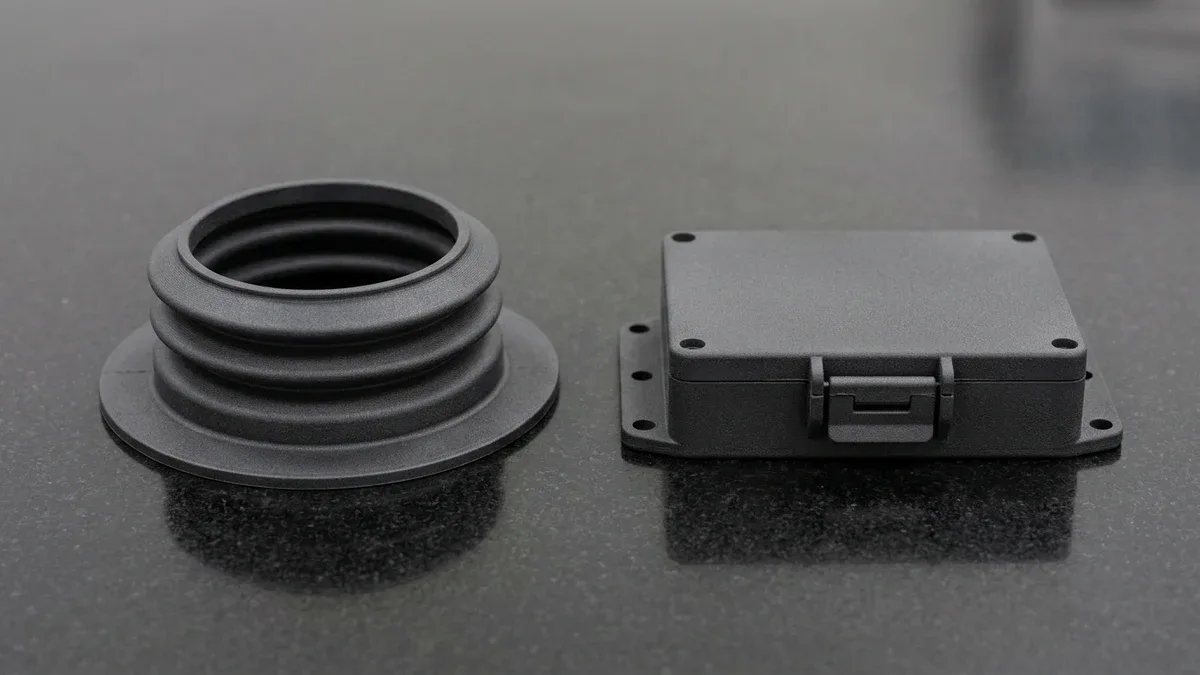
| 7. Cantilever Snap-Fit Latches | ≥ 1.20 mm Beam Base | Tapered Beam + R ≥ 1.0 mm Root | Taper the snap beam thickness by 30%–40% toward the hook tip to distribute bending strain evenly across the PA12 or PA11 matrix. |
| 8. Embossed & Engraved Details | ≥ 0.80 mm Depth/Height | ≥ 1.0 mm Stroke Width | Detailing agent preserves crisp crispness on recessed serial numbers, fluid flow arrows, and connector port labels after bead blasting. |
Advanced Post-Processing & Chemical Vapor Smoothing
Transform raw grey MJF nylon into injection-molded quality components with functional surface finishes:
- Automated Chemical Vapor Smoothing (AMT PostPro): Our vapor smoothing chamber exposes MJF PA12 components to controlled organic solvent vapors that liquefy and redistribute microscopic surface peaks. This completely seals surface micro-porosity, drops roughness to Ra < 1.0 μm, increases elongation at break, and makes parts 100% impermeable to fluids, oils, and gases.
- Deep Black Immersion Dyeing (ColorFAST): Raw MJF parts exhibit a distinctive natural mottled graphite-grey appearance. We perform high-temperature black dyeing that penetrates deep into the nylon matrix, ensuring scratch resistance and a uniform deep matte-black finish that will not flake or peel.
- Precision Bore Reaming & Heat-Set Brass Inserts: For repeatable fastener torque and dowel alignment, we ream critical locating bores and install heat-set or ultrasonic knurled brass threaded inserts (M2 to M8). When metal-grade tolerances of ±0.010–±0.020 mm are required on rigid housings, our engineers transition your CAD directly to precision CNC machining.
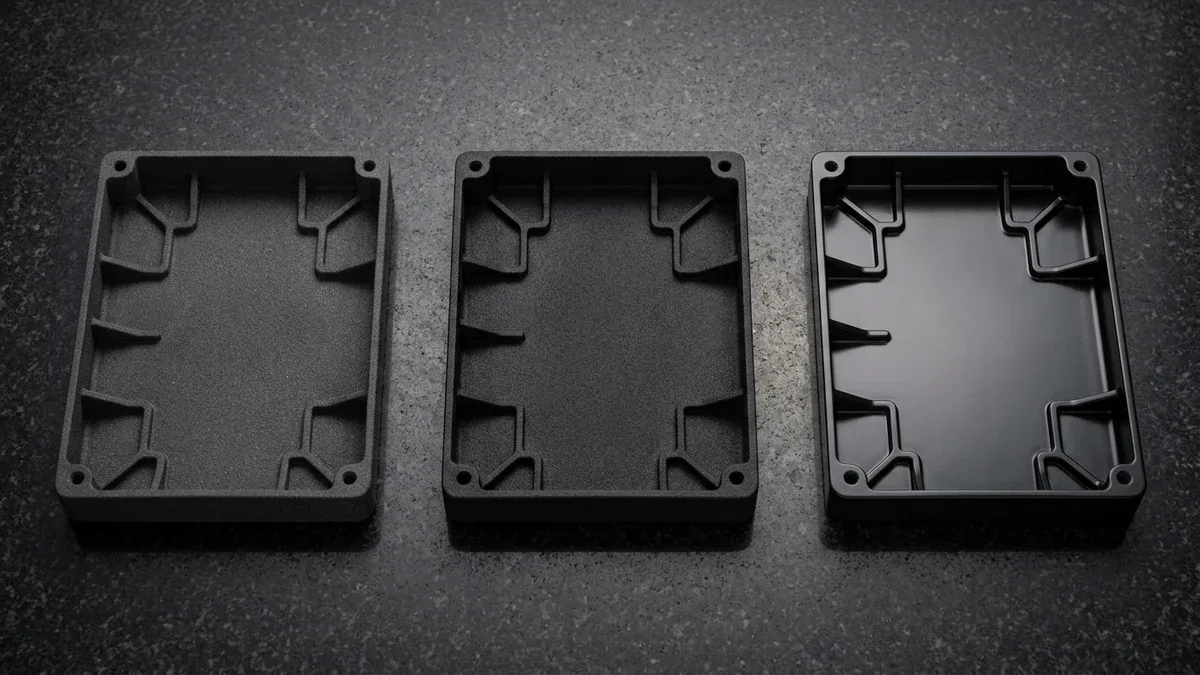
| RFQ Finishing Code | Post-Processing Workflow | Surface Roughness (Ra) | Appearance & Primary Use Case |
|---|---|---|---|
| Level 1: Natural Bead-Blasted | Automated unpacking + glass-bead depowdering | Ra 3.5 – 5.0 μm | Mottled charcoal-grey matte · Internal brackets, jigs & hidden structural mounts |
| Level 2: Deep Matte-Black Dyed | Bead blasting + pressurized hot-bath black acid dyeing (0.3–0.5 mm penetration) | Ra 3.5 – 5.0 μm | Uniform jet-black matte · Industry-standard finish for 85%+ of functional MJF parts |
| Level 3: Vibro-Tumbled & Dyed | Ceramic media rotary vibratory tumbling + deep black dyeing + satin sealer | Ra 2.2 – 3.2 μm | Smooth low-friction satin black · Wearable frames, moving latches & handheld covers |
| Level 4: AMT PostPro Vapor Smoothed | Automated organic solvent-vapor reflow + deep black dyeing | Ra 0.8 – 1.5 μm | Injection-molded semi-gloss sheen · 100% watertight/airtight manifolds & washable medical shells |
Pearl River Delta Turnaround Schedule & Export Packaging
| Order Scope | Batch Size | Shop-Floor Lead Time | Quality & Dimensional Verification |
|---|---|---|---|
| Rapid Functional Prototyping | 1 – 10 pcs | 4 – 8 Business Days | Digital caliper, thread gauge check & optical inspection |
| Nested Batch Production | 10 – 200 pcs | 7 – 12 Business Days | Sampling dimensional inspection & fit-check verification |
| Bridge Manufacturing | 200 – 2,000+ pcs | 7 – 30 Business Days | Batch 2.5D optical vision (VMS), Go/No-Go pin gauge, and mating fit-up verification on critical datum features |
| Chemical Vapor Smoothed Batch | Any volume | + 24 hours | Fluid immersion leak check & Ra surface roughness test |
*Turnaround schedules represent ex-factory manufacturing and QC inspection completion. International express air transit (DHL/FedEx/UPS) requires an additional 3 – 5 business days. For serial batch production economics and automated vapor smoothing workflows, see our 3D printing mass production engineering guide.
Cross-Industry HP Multi Jet Fusion Applications
Custom intake manifolds, cooling fan ducts, sensor mounting brackets, and lightweight interior trim components with high heat and fuel resistance. Explore our automotive parts service.
Custom vacuum suction gripper heads, lightweight cable conduit brackets, and compliance fingers engineered for automated assembly lines. See our robotics automation capabilities.
Rugged field diagnostic enclosures with molded-in snap fits, integrated battery compartments, and threaded fastener bosses. Review our electronics solutions.
Biocompatible patient-customized prosthetic sockets, ergonomic surgical rehabilitation braces, and diagnostic equipment shells. Learn about our medical device manufacturing.
Frequently Asked Questions (FAQ)
Q1: How does HP MJF compare to traditional injection molding for low-volume production?
Q2: Can HP Multi Jet Fusion parts hold pressurized liquids or air without leaking?
Q3: Does HP MJF require support structures during the build process?
Q4: What is the primary difference between HP PA12 and PA11 materials?
Ready to Manufacture End-Use Nylon Parts with HP Multi Jet Fusion?
Upload your 3D CAD models (STEP, IGES, or STL) to receive an instant DFM engineering review and competitive pricing within 24 hours. Benefit from responsive in-house manufacturing speed and secondary machining precision.