SELECTIVE LASER SINTERING • FUNCTIONAL NYLON • ZERO SUPPORT STRUCTURES • PRODUCTION 3D PRINTING
Custom SLS 3D Printing Services: Functional Nylon Prototypes
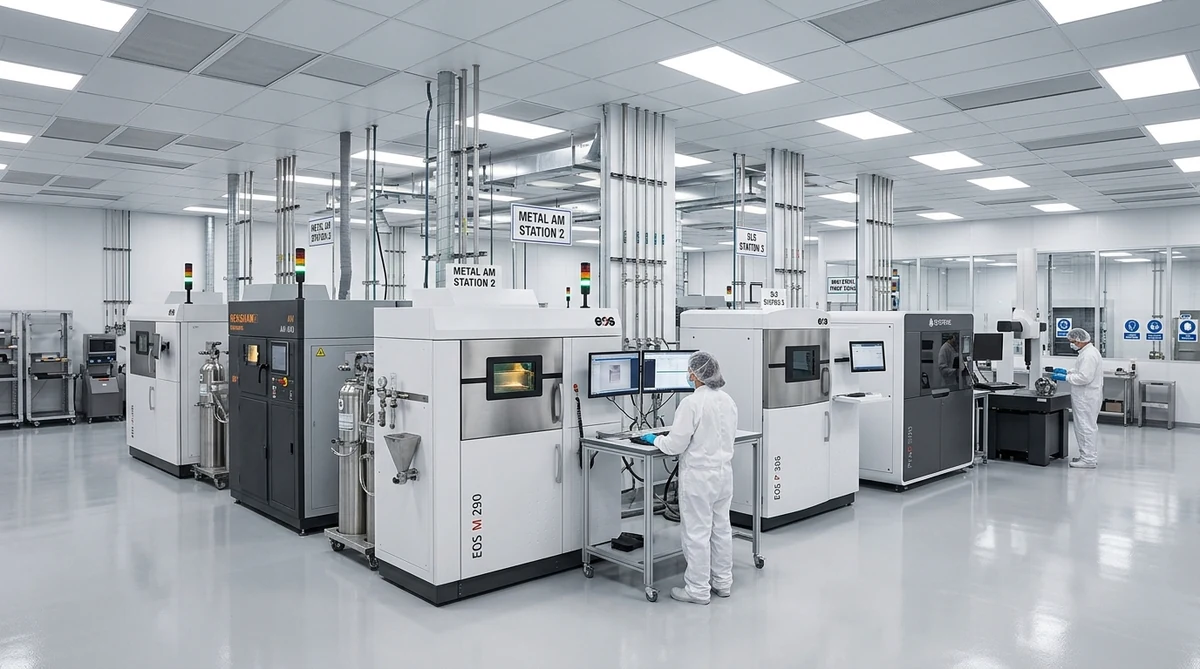
SLS Nylon Fleet
Industrial Selective Laser Sintering
Self-Supporting Powder Bed
Tough PA11 & PA12 Nylon
±0.20 mm Precision Tolerances
Fast 4–8 Business Days Production Turnaround
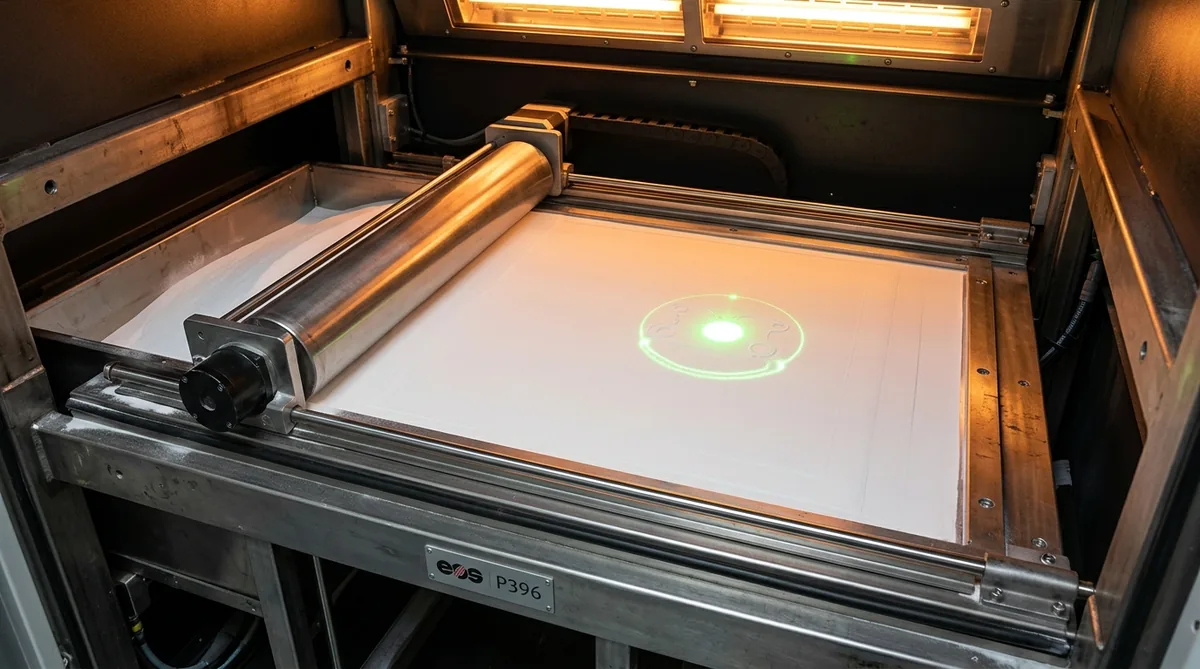
Selective Laser Sintering (SLS) uses a high-power CO2 laser to fuse microscopic polymer and composite powders layer-by-layer on a bed of powder. Because the unsintered powder surrounds and supports the parts during the build process, SLS requires zero physical support structures. At AS Prototypes, we manufacture robust end-use production parts, complex lattice geometries, living hinges, snap-fits, and airtight fluid ducts in engineering-grade polyamides.
Part Tolerance
±0.20 mm
Or ±0.3%
Tensile Strength
Up to 52 MPa
Injection-molded strength
Max Build Volume
550 × 550 mm
Height up to 500 mm single-piece
Turnaround Time
4 – 8 Business Days
Rapid prototypes & batches
Selective Laser Sintering (SLS) Working Principle
SLS additive manufacturing builds components inside an enclosed nitrogen-inerted powder bed heated just below the polymer melting point. A precision CO2 laser scans each cross-section, sintering and fusing the polymer particles into a dense solid geometry. As each layer completes, a roller coats a fresh micro-layer (typically 100 μm) of powder across the build chamber.
- Zero Support Structures: The surrounding powder cake acts as continuous natural support, allowing complete design freedom for internal channels, deep undercuts, and nested interlocking assemblies.
- Near-Homogeneous Mechanical Performance (80%–85% Z-Axis Tensile Retention): Delivers dense, impact-resistant thermoplastic components rivaling traditional injection-molded parts.
- High-Density Batch Nesting: Multiple parts can be stacked throughout the 3D build volume in a single run, dramatically cutting unit production costs.
SLS Engineering Thermoplastics & Material Specifications
| Material Designation | Tensile Strength | Elongation at Break | Heat Deflection (HDT @ 0.45MPa) | Standard Tolerance | Key Engineering Applications |
|---|
| Nylon PA 12 (Polyamide 12) | 48 – 50 MPa | 15% – 20% | 163°C | ±0.20 mm (or ±0.3%) | General functional prototyping, snap-fit assemblies, complex ducting, consumer electronics enclosures |
| Nylon PA 11 (Bio-based) | 48 – 52 MPa | 35% – 45% (High Ductility) | 180°C | ±0.20 mm (or ±0.3%) | High-impact components, living hinges, automotive crash-tested interior brackets, sports equipment |
| PA 12-GF (Glass-Filled) | 51 – 55 MPa | 8% – 10% (High Stiffness) | 166°C – 175°C | ±0.25 mm (or ±0.3%) | High thermal and mechanical stiffness components, pump impellers, wind-tunnel scale models |
| TPU / Elastomeric Polymer | 18 – 25 MPa | >250% (Shore 88A – 92A) | 110°C | ±0.30 mm | Seals, vibration dampening isolators, flexible bellows, custom ergonomic grips, footwear midsoles |
| CastForm Polystyrene | 20 – 24 MPa | 2% – 4% | 90°C (Low Ash Burnout) | ±0.25 mm | Direct investment casting sacrificial patterns, aerospace turbine prototyping, zero-tooling foundry tooling |
SLS Powder Material Performance Classes
Nylon PA 12Balanced Strength
All-around engineering thermoplastic with balanced tensile strength, chemical resistance, and long-term environmental stability. Ideal for functional housings, brackets, and ductwork.
Nylon PA 11High Ductility
Derived from castor oil, PA 11 delivers extreme elongation at break (up to 45%) and superior impact resistance. Excellent for living hinges, automotive clips, and wearable prosthetics.
Glass-Filled (PA 12-GF)High Modulus
Reinforced with glass beads for enhanced structural stiffness, elevated heat deflection (up to 175°C), and exceptional dimensional stability under sustained thermal loads.
TPU ElastomerShore 88A / 92A
Rubber-like thermoplastic polyurethane with high elasticity, shock absorption, and fatigue resistance. Used for flexible bellows, gaskets, vibration isolators, and non-slip pads.
Flame-Retardant NylonUL 94 V-0
Specially formulated self-extinguishing polyamide meeting aerospace and transportation flammability standards for avionics enclosures and aircraft cabin components.
CastForm Polystyrene<0.02% Ash
Specialized polystyrene powder designed for rapid sacrificial patterns. Eliminates hard tooling and autoclave wax injection for complex titanium and steel foundry castings.
Mechanical Performance & Advanced Post-Processing
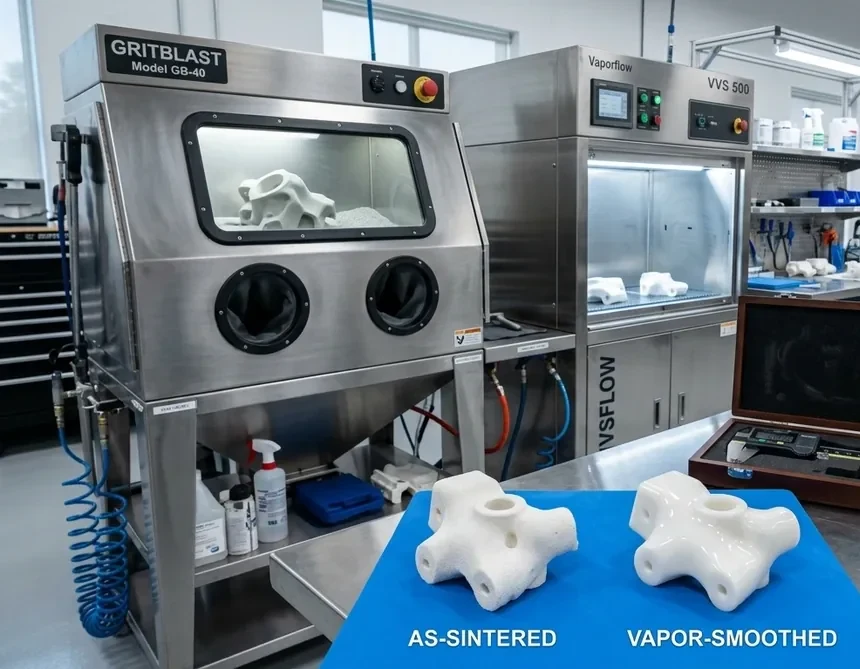
Raw SLS prints feature a matte, granular sugar-like tactile finish (Ra 8~12 μm). At AS Prototypes, we offer comprehensive in-house post-processing to transform as-printed nylon into sealed, cosmetic, and production-ready parts:
- Automated Chemical Vapor Smoothing: Seals surface micro-porosity using controlled solvent vapor, creating airtight, washable, and fluid-tight surfaces with Ra down to 1.5 μm.
- Vibro-Tumbling & Media Blasting: Eliminates residual unsintered powder and smooths outer surfaces for clean tactile handling.
- Deep Dyeing (Black / Custom Colors): Color penetrates 0.3~0.5 mm below the surface, resisting scratching and flaking unlike superficial spray coats.
- Mechanical Testing Validation: Tensile, flexural, and fatigue stress-strain testing performed in-house.
Explore all in-house surface finishing capabilities →
Target Industry Solutions & High-Performance Applications
Lightweight complex environmental control ducting, avionics mounts, UAV airframes, and flight-ready interior brackets.
Custom intake manifolds, cooling ducts, fluid reservoirs, wire harness clips, and low-volume exterior trim components.
Custom robotic end-effector grippers with internal vacuum passages, cable tracks, and protective motor enclosures.
Patient-matched orthotic braces, prosthetic socket frames, surgical instrument handles, and lightweight rehabilitation devices.
Design for Additive Manufacturing (DfAM) for SLS
RULE 01
Wall Thickness
Design structural walls between 0.8–1.0 mm. Small non-structural ribs can be 0.6 mm, but avoid excessively thick solid walls (>4.0 mm) to prevent thermal sink marks.
RULE 02
Powder Escape Holes
Hollow components must include at least two Ø3.0–5.0 mm drain holes to evacuate un-sintered nylon powder from the internal cavity during post-processing.
RULE 03
Mating Clearances
Provide a minimum clearance gap of 0.5–0.7 mm between mating parts for free-moving pre-assembled hinges, ball joints, and captive sliding mechanisms.
RULE 04
Living Hinge Radii
Maintain hinge thickness between 0.3–0.5 mm when using PA 11. Add generous blend radii (R ≥ 1.0 mm) at all transitions to eliminate stress concentrations.
Frequently Asked Questions (FAQ)
Q1: How does SLS compare to SLA and FDM 3D printing?
SLS produces highly durable, functional end-use nylon parts without requiring support structures, making it superior for complex geometries and rugged mechanical assemblies. In contrast,
SLA resin 3D printing delivers higher cosmetic smoothness and optical transparency, while FDM is typically used for basic low-cost concept prototypes.
Q2: Why does SLS 3D printing not require support structures?
During the SLS printing process, the entire build volume is filled with tightly packed microscopic nylon powder. As the laser sinters each cross-section, the un-sintered loose powder surrounding the part remains in place, acting as continuous 3D support for overhangs, bridges, and deep undercuts. After cooling, parts are simply unpacked and bead-blasted clean.
Q3: Are SLS nylon parts strong enough for end-use production applications?
Yes. SLS parts printed in PA 11 and PA 12 exhibit tensile strengths up to 50–52 MPa, high elongation at break, and chemical resistance comparable to standard injection-molded parts. They are widely deployed as end-use ducting in aerospace, custom brackets in automotive racing, and wearable orthotic devices.
Q4: Can SLS nylon parts be sealed to make them airtight or watertight?
Yes. While as-printed SLS parts have slight micro-porosity, our automated chemical vapor smoothing process completely liquefies and seals the outer micro-surface, rendering components 100% airtight and waterproof for fluid tanks, coolant manifolds, and pressurized air ducts.
Ready to Print Functional Prototypes & Production Runs with SLS?
AS Prototypes delivers high-performance selective laser sintering in PA11, PA12, and composite powders. With zero tooling investments, complex internal channels, living hinges, and rapid 24-hour quoting, our engineering team helps you accelerate from concept to production.
🔒 Strict NDA Confidentiality
● ±0.20 mm Precision Standard
✓ Zero Tooling / Zero Supports
◆ Fast 4–8 Business Days Production