PRECISION WIRE EDM • CNC SINKER • FAST HOLE DRILLING • WIRE & SINKER EDM

Precision Wire EDM & Sinker Electrical Discharge Machining Services

Electrical Discharge Machining
±0.002 mm Ultra-Precision
Slow Wire & Sinker EDM
Hardened Steels up to 72 HRC
Ra 0.2 μm Mirror Finish
Zero Mechanical Stress
AS Prototypes delivers specialized Electrical Discharge Machining (EDM) solutions for ultra-precision tooling, hardened alloy fabrication, and complex 3D micro-geometries. Utilizing advanced multi-axis slow wire cutting, high-definition sinker EDM, and fast micro-hole drilling, we achieve tolerances down to ±0.002 mm (±0.00008″) and mirror finishes down to Ra 0.2 μm with zero mechanical cutting stress.

Core EDM Machining Capabilities & Technologies

1. Multi-Axis Slow Wire EDM (4/5-Axis Precision Cutting)

Wire Electrical Discharge Machining (Wire EDM) utilizes a continuously traveling, spool-fed micro brass or zinc-coated wire electrode (Ø0.10 mm to Ø0.25 mm) submerged in chilled deionized water. High-frequency electrical discharges between the wire and the workpiece erode microscopic particles along the programmed path with sub-micron positioning feedback.

  • Independent U/V Axis Tapers: True 4-axis and 5-axis kinematic interpolation cuts precision draft angles and complex tapers up to ±30°.
  • Sub-Millimeter Corner Radii: Delivers sharp internal corners down to R0.05 mm (0.002″), impossible with conventional rotational milling tools.
  • Zero Cutting Force: Zero physical tool contact eliminates mechanical deflection, safely machining fragile thin walls down to 0.1 mm without burrs.
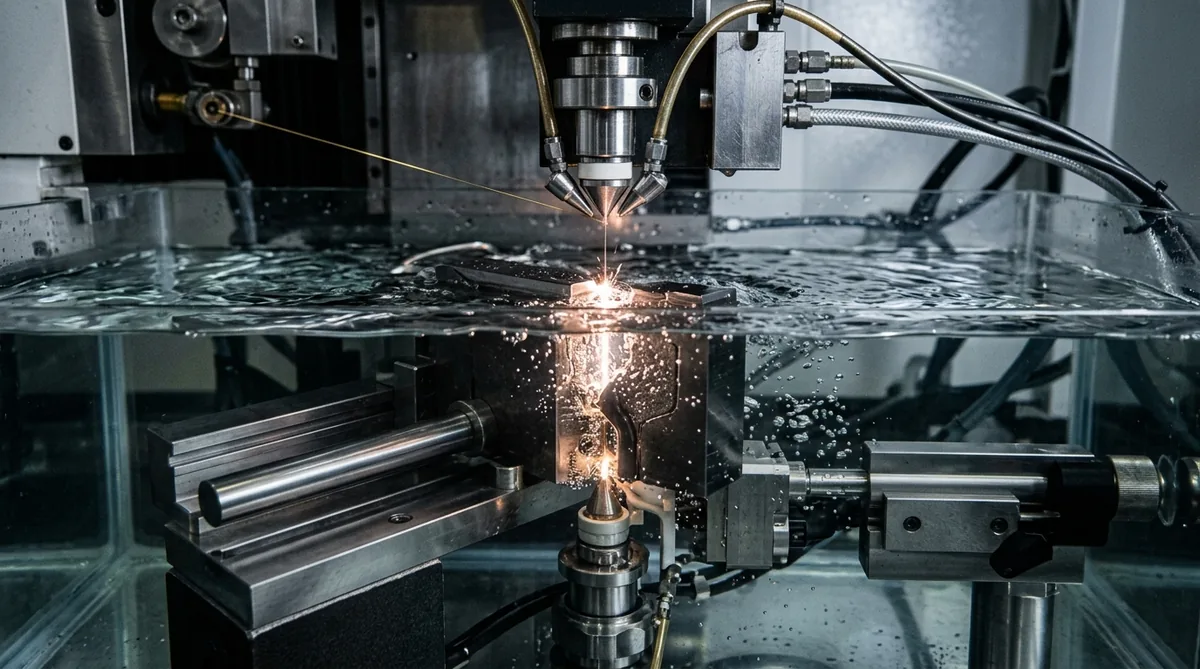
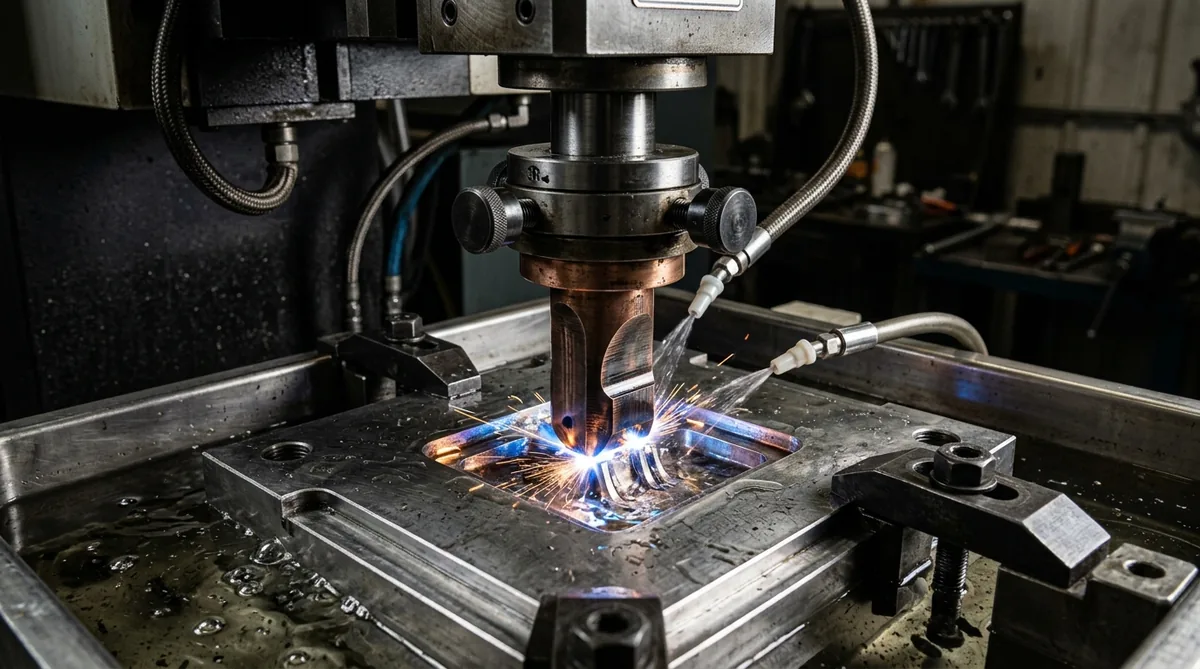
Submerged High-Precision Wire EDM Cutting Hardened D2 Tool Steel

Figure 1: Submerged slow wire EDM cutting hardened D2 tool steel die with high-pressure deionized flushing.

2. CNC Sinker / Die-Sinking EDM (Precision Cavity Eroding)
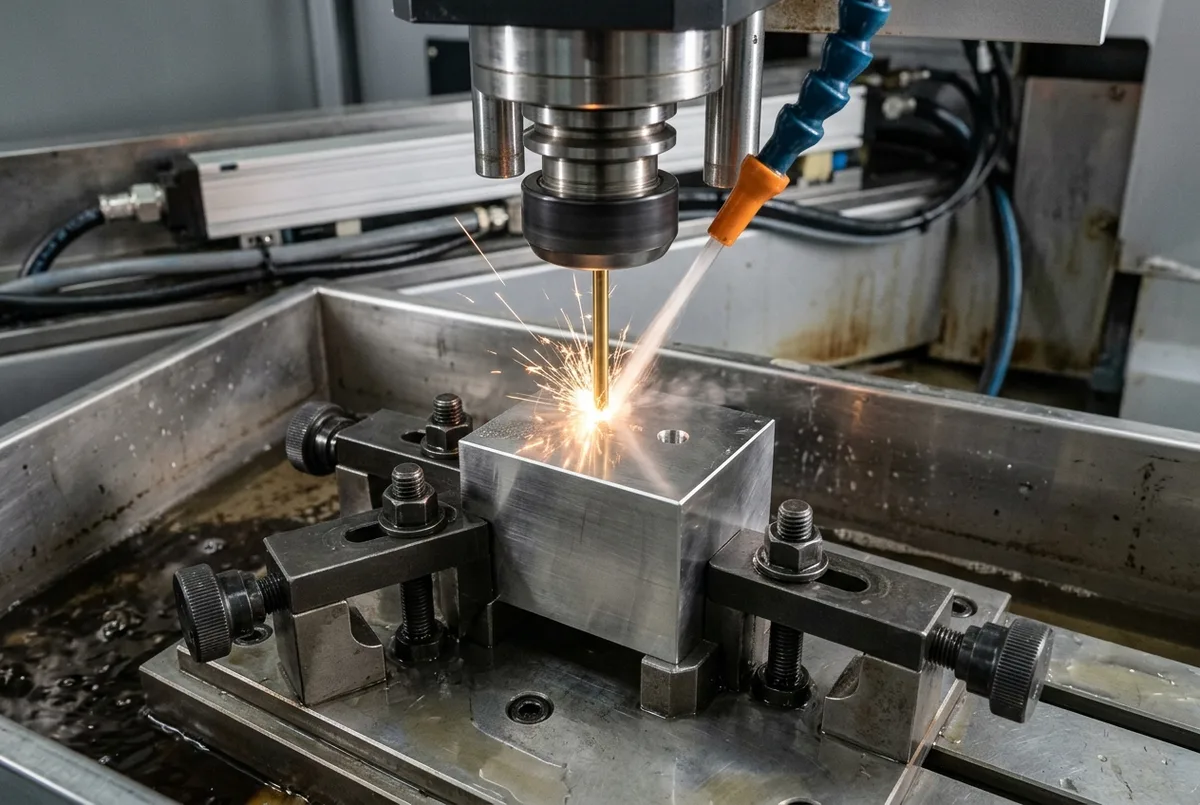
Sinker EDM Copper-Tungsten Electrode Spark Eroding Mold Steel Cavity

Figure 2: Copper-tungsten electrode spark eroding a precision plastic injection mold cavity in dielectric hydrocarbon oil.

Also known as cavity-type or ram EDM, die-sinking EDM uses custom CNC-machined 3D electrodes submerged in dielectric hydrocarbon oil. By transferring the inverse 3D electrode geometry into the workpiece via millions of controlled microscopic spark craters, Sinker EDM creates intricate blind cavities, sharp internal corners, and deep structural ribs that cannot be accessed by end mills.

  • Electrode Engineering: In-house high-speed CNC milling of ultra-fine grain isostatic graphite and electrolytic tough pitch (ETP) copper electrodes.
  • Multi-Axis CNC Orbiting: Programmable spherical, planetary, and lateral spark erosion cycles ensure uniform spark gap expansion and precision side-sparking.
  • VDI 3400 Mold Texturing: Spark erosion delivers calibrated uniform spark matte textures conforming to VDI 12 to VDI 27 without manual polishing.

3. Fast Small-Hole Drilling EDM (Micro Deep-Hole Spark Erosion)

Small-hole EDM drilling utilizes high-speed rotating tubular brass or copper electrodes (Ø0.15 mm to Ø3.0 mm) with high-pressure deionized water flushed directly through the core. This specialized spark process rapidly pierces ultra-deep micro holes through hardened materials at speeds up to 60 mm per minute without mechanical drill bit breakage.

  • Extreme Depth-to-Diameter Ratios: Pierces deep straight holes with aspect ratios up to 100:1 (e.g., Ø0.3 mm holes drilled 30 mm deep).
  • Curved & Angled Surface Penetration: Enters sharply angled, convex, or spherical surfaces directly without tool wandering or burrs.
  • Key Applications: Wire EDM start holes, turbine blade cooling holes, fuel injection orifices, and miniature hydraulic vent ports.
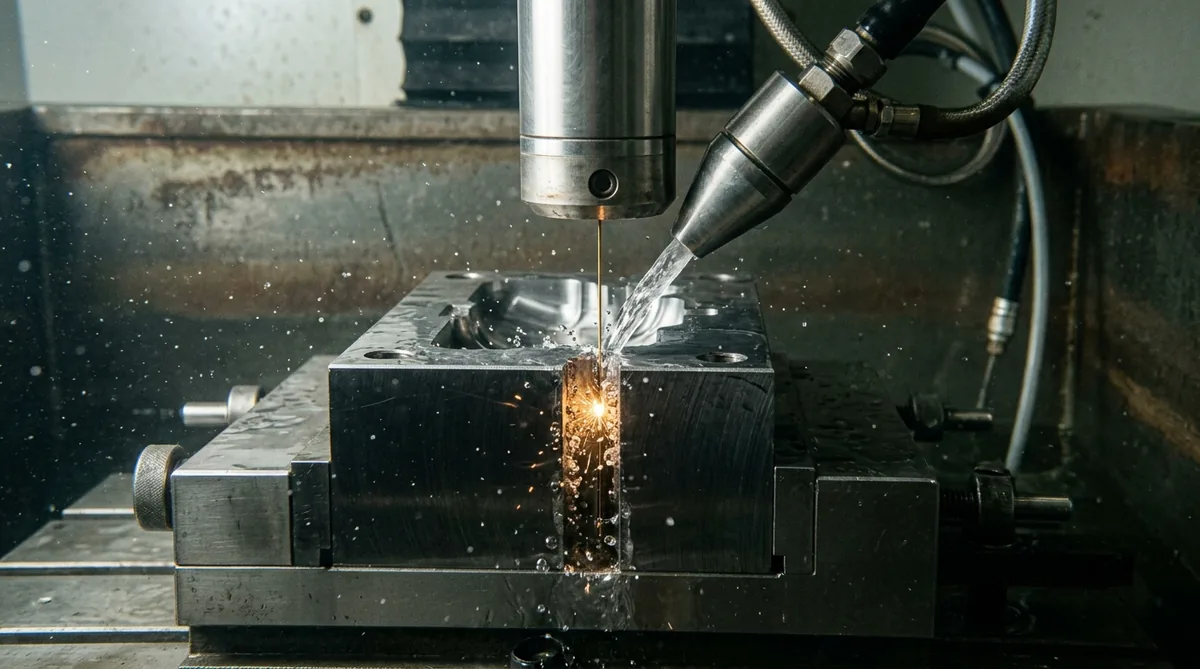
Fast Small Hole Drilling EDM Micro Deep Hole Erosion

Figure 3: High-speed small-hole drilling EDM eroding starter holes and micro cooling channels.

EDM Processes & Precision Capabilities Matrix

EDM ProcessTooling & DielectricAchievable TolerancesSurface Finish (Ra / VDI)Typical Tooling & Applications
Slow Wire EDM (4/5-Axis)Ø0.10–0.25 mm Brass wire; Chilled deionized water±0.002 mm (±0.00008″)Ra 0.2 ~ 0.4 μmExtrusion dies, punches, gear profiles, aerospace flexures, surgical cutters
CNC Sinker / Die-Sinking EDMHigh-density graphite & ETP copper; Hydrocarbon dielectric oil±0.005 mm (±0.0002″)Ra 0.2 ~ 0.8 μm (VDI 12–18)Plastic injection mold cavities, blind keyways, internal splines, textured tooling
Fast Hole Drilling EDMØ0.15–3.0 mm Rotating tubular brass/copper; Deionized flushing±0.010 mm (±0.0004″)Ra 1.6 ~ 3.2 μmWire EDM start holes, turbine blade film cooling holes, hydraulic vent orifices
Hardened Metal CapabilityPost-heat-treatment cutting up to 72 HRC; Zero thermal distortionSub-micron repeatabilityUniform spark matte finishTungsten Carbide, Inconel 718, D2 / SKD11, Titanium Grade 5, Hastelloy

Metallurgy & Recast Layer (White Layer) Elimination

During electrical discharge erosion, spark plasma temperatures reach 8,000°C to 12,000°C. While dielectric flushing rapidly evacuates molten metal, a microscopic layer resolidifies onto the cut boundary—known as the recast layer or white layer. At AS Prototypes, our engineers employ a calibrated Multi-Pass Skim Cut Protocol to restore metallurgical integrity:
STEP 01 • ROUGHING

High-Energy Rough Cut

Removes bulk material rapidly with high peak pulse current, leaving a calibrated 0.05 mm stock allowance and controlled initial recast layer.
STEP 02 • SEMI-SKIMS

Progressive Semi-Skims

Progressively reduces pulse duration and discharge energy, stripping away 85% of primary recast layer while rectifying wire bow deflection.
STEP 03 • MIRROR FINISH

Nanosecond Mirror Skims

Operates with high-frequency micro-pulses in the sub-micron range, removing residual white layer below 1 μm and achieving Ra 0.2 μm surface integrity.

Workable Materials: From Hardened Tool Steels to Superalloys

Because EDM cuts via thermoelectric spark erosion rather than mechanical shearing, material hardness does not dictate machining difficulty or tool wear. We routinely process fully hardened alloys up to 72 HRC, eliminating the risk of post-machining heat treatment distortion:
Tool & Die Steels48–65 HRC
D2, SKD11, DC53, A2, O1, S7, H13, M2, M42. Stamping punches, blanking dies, and mold cores.
SuperalloysHeat-Resistant
Inconel 625, Inconel 718, Hastelloy C-276, Waspaloy, Stellite. Flawless contouring without work-hardening.
Tungsten Carbides68–72 HRC
Tungsten Carbide (WC-Co), Molybdenum, Tantalum. Micro-fine wire cutting of wear plates and nozzles.
Titanium & ConductivesAdvanced
Titanium Ti-6Al-4V, Conductive Silicon Carbide (SiSiC), PCD. Biocompatible surgical cutters and aerospace brackets.

Design for Manufacturing (DFM) Guidelines for EDM

01. START HOLES

Starter Hole Integration

Enclosed internal cutouts require pre-drilled wire threading holes located ≥ 1.5 mm from finished edges to avoid witness marks.
02. CORNER RADII

Minimum Inside Radius

Inside corners equal wire radius + spark gap. Ø0.20 mm wire yields R0.12 mm corners; Ø0.10 mm wire achieves sharp R0.05 mm (0.002″).
03. FLUSHING VENTS

Flushing Channels

For deep sinker cavities, design small flushing or vent holes into electrode or workpiece to evacuate debris and prevent secondary arcing.
04. THIN WALLS

Wall Thickness & Ratio

Zero mechanical cutting force, but flushing pressure and electrostatic forces require thin walls ≥ 0.20 mm for deflection stability.

Process Comparison: Wire EDM vs. Sinker EDM vs. 5-Axis CNC Milling

Machining FactorSlow Wire EDMCNC Sinker EDM5-Axis CNC MillingPrecision Grinding
Material Hardness LimitUnlimited (Up to 72 HRC)Unlimited (Up to 72 HRC)Typically ≤ 45 HRCHardened metals (up to 68 HRC)
Smallest Inside RadiusR0.05 mm (0.002″)Sharp 90° (Near-zero, R < 0.03 mm)Limited by cutter (R0.4+ mm)Limited by wheel profile
Geometric CapabilityThrough-cuts, contours, tapersComplex 3D blind cavities & ribsOpen 3D contoured surfacesFlat faces, cylinders & tapers
Mechanical Cutting ForceZero (Thermal spark erosion)Zero (Thermal spark erosion)Moderate to high shear forceModerate abrasive friction
Achievable Tolerances±0.002 mm±0.005 mm±0.010 mm ~ ±0.015 mm±0.002 mm

Metrology, CMM Inspection & Quality Control

Precision EDM parts demand rigorous dimensional verification. At AS Prototypes, our dedicated climate-controlled inspection lab provides comprehensive metrology validation for every production run:
Zeiss CMM Metrology0.5 μm
Contact scanning touch-probe CMM verifies complex 3D pitch diameters, true position, and geometric tolerances down to 0.5 μm.
Optical Comparators50x / 100x
Telecentric optical profile projectors measure micro-slot widths, sharp corners, and pitch contours non-destructively.
Surface ProfilometryVDI 3400
Contact stylus roughness testers measure Ra, Rz, and calibrated VDI 3400 spark erosion textures for mold cavities.
FAIR Documentation100% Verified
First Article Inspection Reports with complete 100% bubble drawings and raw material mill test certificates (MTC).

Frequently Asked Questions (FAQ)

Q1: What is the minimum internal corner radius achievable with Wire EDM?
Using ultra-fine wire (Ø0.10 mm to Ø0.25 mm) with calibrated spark gap offsets, AS Prototypes routinely achieves tight inside corner radii down to R0.05 mm (0.002″). Standard wire cutting with Ø0.20 mm brass wire achieves R0.12 mm corners, completely bypassing the corner radius limitations of conventional milling cutters.
Q2: How does AS Prototypes eliminate the recast layer (white layer) on EDM parts?
We employ a multi-pass skim cut protocol (typically 1 rough cut followed by 3 to 5 finishing skim cuts) with progressively reduced spark energy and nanosecond pulse durations. This systematically strips away the thermally altered white layer, restoring base metal integrity and achieving mirror-like finishes down to Ra 0.2 μm for aerospace and medical applications.
Q3: Can Electrical Discharge Machining process non-conductive materials like plastics or standard ceramics?
No. Electrical Discharge Machining strictly requires electrical conductivity to generate spark erosion. While non-conductive plastics and pure oxide ceramics cannot be EDM machined (we recommend CNC Machining or Precision Grinding for those), any conductive or semi-conductive material can be processed regardless of hardness, including tungsten carbide, conductive silicon carbide, and PCD.
Q4: When should I choose Sinker EDM instead of 5-Axis CNC Milling?
Sinker EDM is superior when your design requires: (1) sharp 90° inside corners without radius fillets, (2) narrow, deep ribs with draft angles < 0.5°, (3) complex blind cavities in pre-hardened tool steels (exceeding 55 HRC), or (4) calibrated spark erosion textured surfaces (VDI 3400). For open 3D contoured profiles with generous corner radii, 5-Axis CNC Machining is typically faster and more cost-effective.

Ready to Manufacture Precision EDM Parts & Tooling?

Upload your 3D CAD files (STEP, IGES, DXF) to receive an immediate engineering review, DFM consultation, and fast quote within 24 hours. AS Prototypes guarantees standard ±0.005 mm baseline tolerances (down to ±0.002 mm on critical micro-features), comprehensive Zeiss CMM metrology (available upon request), and expedited global delivery.
🔒 Strict NDA Confidentiality
● ±0.002 mm Ultra-Precision Standard
✓ In-House Zeiss CMM Inspection (Available Upon Request)

High-Precision Submerged Wire EDM Machine Cutting Hardened D2 Tool Steel Mold Insert with Coaxial Deionized Dielectric Flushing

Sodick submerged slow wire EDM cutting a hardened tool steel mold insert holding ±0.002 mm precision.

⚡ Upload CAD & Get a 24h Quote →