SLA 3D Printing Services: Custom Clear & Resin Prototypes
Stereolithography (SLA) cures liquid photopolymer resin layer by layer using solid-state 355 nm ultraviolet (UV) lasers. At AS Prototypes, our in-house SLA 3D printing services combine 50 – 100 μm resolution with 800 × 800 × 550 mm monolithic vats across our industrial 3D printing fleet—delivering smooth cosmetic housings, clear microfluidic manifolds, and polyurethane vacuum casting master patterns.
Stereolithography (SLA) Technology & Working Principle
Industrial top-down stereolithography focuses a solid-state 355 nm UV laser onto a temperature-regulated vat of liquid photopolymer resin, where XY galvanometer scanners trace outer boundaries with a fine 0.08 – 0.15 mm contour beam and cross-hatch interiors with a broader 0.50 mm fill beam.
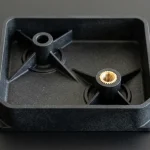
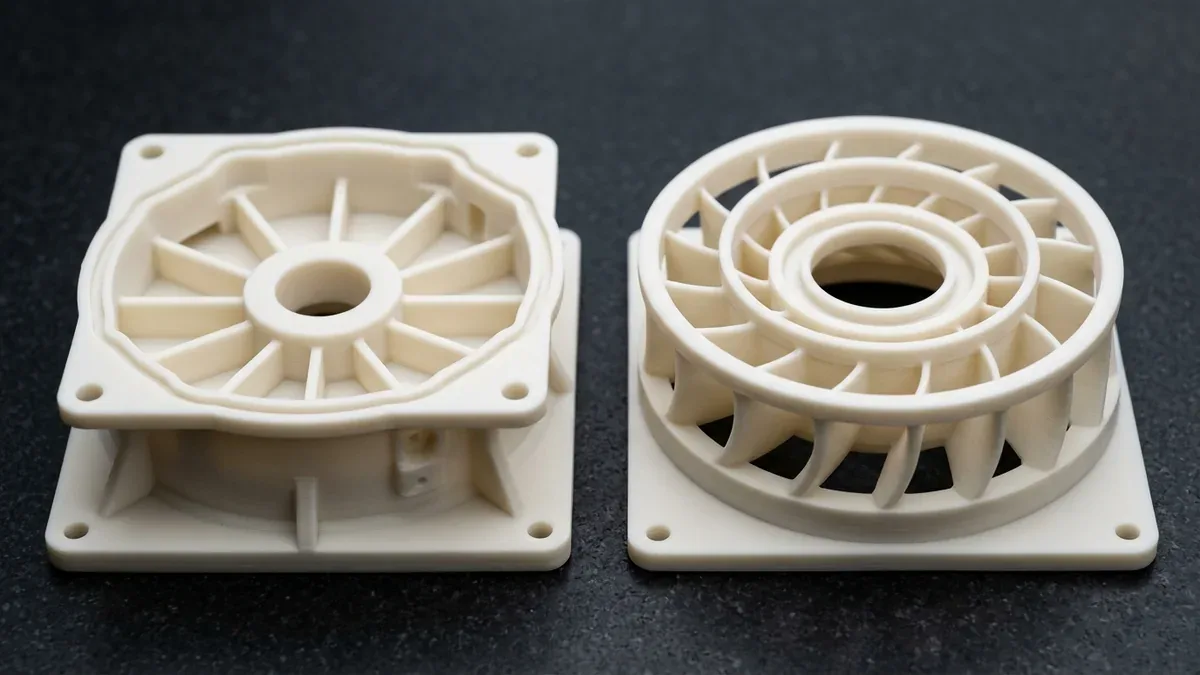
As demonstrated in the matte ivory photopolymer components shown here, molecular cross-linking produces watertight, near-isotropic prototypes featuring crisp radial stiffening ribs, continuous O-ring sealing grooves, and curved aerodynamic stator vanes down to 0.8 mm thickness.
- Calibrated Layer Resolution Tiers: Our four in-house Kings and UnionTech SLA-800 Pro systems run at 100 μm (0.004″) for large-format enclosures and 50 μm (0.002″) for high-detail cosmetic housings, stator vanes, and microfluidic blocks, while sub-50 mm micro-features requiring 15 – 25 μm (0.0006″ – 0.001″) layers route to our micro-nano 4K DLP 3D printing platform.
- Three-Tier Surface Roughness Control: As-printed vertical walls achieve Ra 1.2 – 2.5 μm (47 – 98 μin); progressive wet micro-sanding and glass-bead blasting produce a uniform matte Ra 0.6 – 1.0 μm (24 – 39 μin); #2000-grit wet polishing plus UV-resistant acrylic clear coating yields Ra 0.1 – 0.2 μm (4 – 8 μin) optical clarity.
- Isotropic Fit & Master Pattern Stability: Low-shrinkage formulations (<0.05%) hold ±0.15 mm (±0.006″) on compact features under 100 mm, ensuring leak-free flange seating and accurate silicone mold masters for polyurethane vacuum casting.
SLA Photopolymer Resins & Engineering Specifications
| Resin Category | International & Shop-Floor Grades | Tensile & Flexural Specs (MPa / ksi) | Heat Deflection Temp., HDT (@ 0.46 MPa) | Surface Roughness (Ra μm / μin) | Recommended Application / When to Choose |
|---|---|---|---|---|---|
| Standard Rigid ABS-Like (Ivory / White) | Somos Imagine 8000 / Ledo 6060 / Accura 25 | Tensile: 45–55 MPa (6.5–8.0 ksi) Elongation: 12% – 20% | 55°C – 65°C (131°F – 149°F) | As-Sanded: Ra 0.8–1.5 μm (32–59 μin) | Workhorse industrial SLA resin for multi-part enclosures, pump and fan housings, architectural models, and indoor form-and-fit validation up to 800 mm. |
| Tough & Impact-Resistant (ABS / PP-Like) | Somos Taurus / Accura Xtreme / High-Tough 9400 | Tensile: 48–52 MPa (7.0–7.5 ksi) Notched Izod: 40–45 J/m | 68°C – 75°C (154°F – 167°F) | Matte Blasted: Ra 0.8–1.2 μm (32–47 μin) | Functional snap-fit latches, automotive interior bezels, brackets, and rugged mechanical assemblies requiring improved elongation and impact resistance. |
| Optically Clear (PC / PMMA-Like) | Somos WaterShed XC 11122 / Accura ClearVue | Tensile: 50–60 MPa (7.3–8.7 ksi) Light Transmission: >88% | 54°C – 60°C (129°F – 140°F) | Polished + Clear Coat: Ra 0.1–0.2 μm (4–8 μin) | Microfluidic manifolds, flow visualization blocks, automotive headlamp lenses, light pipes, and transparent medical fluid reservoirs with low moisture absorption. |
| High-Temp Ceramic-Filled Composite | Somos PerFORM / Accura PEAK / HT 8228 | Tensile: 75–80 MPa (10.9–11.6 ksi) Modulus: ~10,000 MPa (1,450 ksi) | 130°C – 268°C (266°F – 514°F Thermal Cure) | Sanded Matte: Ra 0.6–1.0 μm (24–39 μin) | Wind tunnel aerodynamic models, high-stiffness centrifugal impellers, under-the-hood thermal ducts, electrical connectors, and rapid bridge injection mold inserts. |
| Silicone Tooling Master Pattern Resin | Ultra-Low Shrinkage High-Definition SLA Resin | Linear Shrinkage: <0.05% Flexural Modulus: 2,600 MPa | 60°C – 65°C (140°F – 149°F) | Polished Gloss: Ra 0.10–0.20 μm (4–8 μin) | Precision master patterns for polyurethane vacuum casting where zero visible layer lines and ±0.10 mm (±0.004″) master accuracy are required before pouring Room-Temperature Vulcanizing (RTV) silicone molds. |
| Sacrificial Investment Casting Resin | QuickCast® Antimony-Free Castable Resin | Burnout Residual Ash: <0.01% Internal Hexagonal Void Build | 52°C – 60°C (126°F – 140°F) | As-Printed / Light Sand: Ra 1.0–1.8 μm (39–71 μin) | Direct sacrificial patterns printed with self-draining cellular interiors for lost-wax ceramic shell investment casting of metal impellers and manifolds without wax tooling. |
Core Industrial SLA Applications & Process Comparison
Hardware engineering teams across automotive, medical device, and consumer electronics sectors rely on industrial SLA when surface smoothness, optical clarity, or monolithic 800 mm scale cannot be achieved by powder-bed or filament 3D printing:
| Comparison Criterion | Industrial SLA (Photopolymer) | SLS Nylon (PA12) | HP MJF (PA12) | Vacuum Casting (SLA Master) |
|---|---|---|---|---|
| Surface Finish & Detail | Ultra-Smooth (Ra 0.1–1.5 μm); razor-sharp edges & 0.35 mm text | Matte granular powder texture (Ra 3.2–6.3 μm); media-tumbling optional | Fine satin matte gray/black (Ra 2.5–4.5 μm); uniform edge definition | Replicates SLA master finish (high-gloss Ra 0.1–0.2 μm to VDI 3400 / Mold-Tech texture) |
| Optical Transparency | Yes — Water-clear >88% transmission (WaterShed XC 11122) | No — Opaque white or dyed black nylon only | No — Opaque charcoal gray or dyed black nylon only | Yes — Optically clear UV-stable PMMA/PC-like polyurethane resins |
| Max Single-Piece Build | 800 × 800 × 550 mm (31.5″ × 31.5″ × 21.7″) monolithic | Up to 400 × 400 × 450 mm without support structures | Up to 380 × 284 × 380 mm without support structures | Up to 1,000+ mm in large RTV silicone molds |
| UV & Mechanical Fatigue | Indoor / short-term functional; thermoset creeps under sustained load or outdoor UV unless painted | Excellent living-hinge fatigue, chemical resistance & thermal stability | High isotropic toughness & functional snap-fit durability | Production-grade ABS, PC, PP & Shore A rubber overmolding |
| Recommended Batch Volume / When to Choose | 1 – 10 cosmetic, optical, or large-format prototypes | 1 – 50 functional self-supporting nylon brackets & ducts | 10 – 200+ functional batch production housings | 10 – 100+ showroom or bridge-production assemblies (Low-Volume Bridge Production Guide →) |
Evaluating resin surface fidelity against sintered PA12 toughness and snap-fit fatigue limits? Review our detailed SLA vs. SLS prototype selection guide →
SLA Design for Manufacturability (DFM) Guidelines
Designing photopolymer parts within industrial SLA process boundaries prevents recoater blade collisions, resin trapping, and post-cure warpage. Reference these Design for Manufacturability (DFM) guidelines before uploading your 3D Computer-Aided Design (CAD) files (STEP / IGES / STL):
| Design Feature | Minimum / Recommended Threshold (mm / in) | Shop-Floor Engineering Rationale & Recommended Use Case |
|---|---|---|
| Supported Wall Thickness | ≥ 0.6 mm (0.024″) min 1.2 – 2.5 mm recommended | Walls anchored to adjacent ribs on at least two edges can print down to 0.6 mm; for enclosures exceeding 150 mm, maintain ≥ 1.5 – 2.5 mm walls to resist recoater shear and handling deflection. |
| Unsupported Cantilevered Walls | ≥ 1.2 mm (0.047″) min ≥ 1.5 mm recommended | Free-standing tabs, flanges, and guide vanes below 0.8–1.0 mm can flex during recoater blade passes or curl during UV thermal post-curing. Add 0.8 mm fillets or gussets at root junctions. |
| Minimum Hole & Micro-Channel Bore | ≥ Ø0.5 mm (0.020″) Z-axis ≥ Ø1.2 mm internal routing | Capillary surface tension traps viscous liquid resin inside tiny bores. Orient critical micro-apertures vertically (parallel to Z) and specify ≥ Ø1.2 mm for curved internal microfluidic channels so isopropanol (IPA) solvent flushes completely. |
| Hollow / Cored Shell & Drain Holes | 2.0 – 3.0 mm shell wall ≥ 2 holes of ≥ Ø4.0 mm | Closed hollow cavities trap uncured liquid resin and create hydraulic suction cupping during vat platform descent. Always place at least two ≥ Ø4.0 mm vent/drain holes at the lowest Z-elevation points. |
| Embossed & Engraved Typography | ≥ 0.35 mm height/depth ≥ 0.40 mm stroke width | Recessed (engraved) characters should be ≥ 0.40 mm wide to prevent resin meniscus bridging during laser curing; raised (embossed) text ≥ 0.35 mm tall reproduces razor-sharp edges at 50 μm layer heights. |
| Mating & Assembly Clearances | 0.20 mm (0.008″) sliding fit 0.10 mm (0.004″) press / bond | Allow 0.10 – 0.15 mm radial clearance for snug press-fit or epoxy-bonded step joints, 0.20 – 0.30 mm per side for sliding enclosure covers, and ≥ 0.50 mm clearance for pre-assembled moving mechanisms. |
| Threaded Bosses & Fasteners | Brass Inserts for M2 – M6 Direct print ≥ M8 coarse | Direct-printed resin threads below M6 strip under repeated screw torque. Design smooth cored pilot bosses with ≥ 2.0 mm wall thickness to accept knurled brass threaded inserts (heat-set or two-part epoxy bonded). |
| Cosmetic A-Surface Orientation | Upward-facing Z-orientation | Break-away lattice supports leave micro-nubs on downward-facing overhangs (<30° from horizontal) requiring manual sanding. Annotate critical cosmetic A-surfaces and optical windows on your 2D drawing so our Computer-Aided Manufacturing (CAM) engineers orient them upward. |
SLA Surface Finishing Grades & Secondary Post-Processing
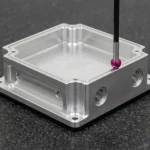
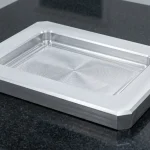
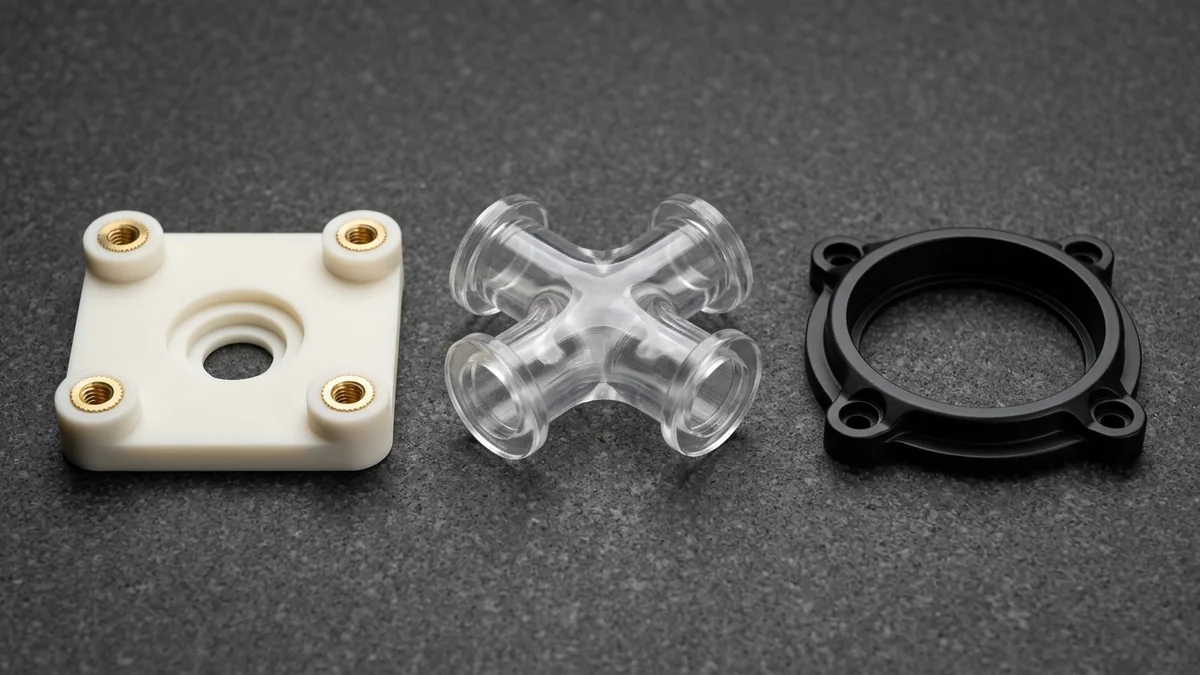
After dual-stage ultrasonic IPA washing and calibrated 355/405 nm UV thermal curing, AS Prototypes provides four standardized surface finish levels—as illustrated in the brass-inserted mount, clear four-way fluidic manifold, and matte-black painted lens bezel shown here:
- Level 1 — Standard As-Printed (Ra 1.2 – 2.5 μm / 47 – 98 μin): Support structures are flush-sheared and contact nibs are lightly dressed. Retains subtle micro-layer contours with 4 – 8 business days ex-factory turnaround for internal brackets and fit checks.
- Level 2 — Smooth Matte Sanded & Bead-Blasted (Ra 0.6 – 1.0 μm / 24 – 39 μin): Progressive manual wet sanding from #400 to #1000 grit followed by fine glass-bead blasting removes all layer lines, delivering a uniform satin matte ivory surface ready for flush heat-set brass inserts.
- Level 3 — Optical Clear / Master Pattern Polish (Ra 0.1 – 0.2 μm / 4 – 8 μin): Because thermoset SLA resins cannot be solvent-vapor polished, optical clarity on Somos WaterShed XC 11122 is achieved via #2000-grit wet polishing, micron diamond buffing, and enclosed dust-free spray-booth application of UV-resistant optical acrylic clear lacquer (plus syringe-cleared internal channels; 7 – 12 business days ex-factory).
- Level 4 — Showroom Color, Material & Finish (CMF) & Hardware Assembly: Conductive primer, custom Pantone/RAL automotive polyurethane (PU) painting (matte, gloss, or Mold-Tech texture), silk-screen graphics, nickel/copper Electromagnetic Interference (EMI) shielding, and flush-mounted knurled brass threaded inserts (7 – 12 business days ex-factory).
Large-Format 800 mm Builds, Mating Enclosures & Why AS Prototypes
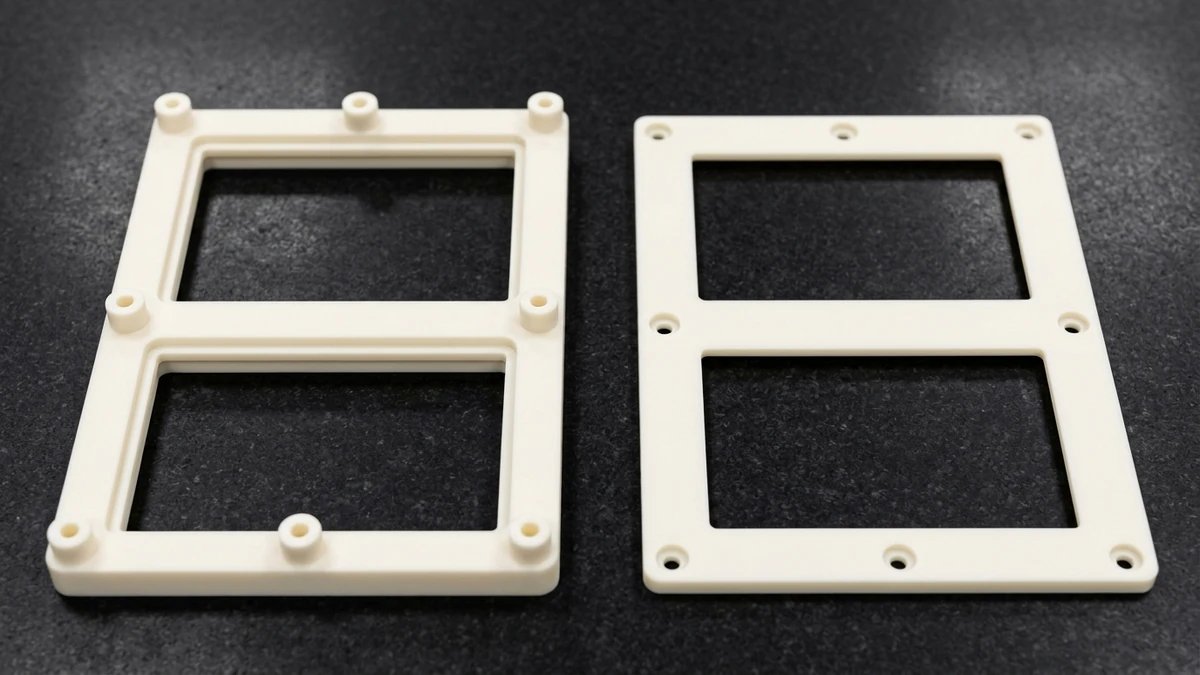
Operating four in-house Kings and UnionTech SLA-800 Pro systems with 800 × 800 × 550 mm (31.5″ × 31.5″ × 21.7″) monolithic build envelopes, we co-print mating multi-part housings inside the same temperature-stabilized photopolymer vat to maintain uniform <0.05% linear cure shrinkage across shared parting lines.
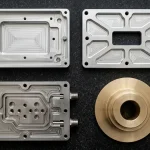
As demonstrated in the 1:1 mating instrument enclosure pair shown here, co-curing a dual-bay ribbed structural carrier frame alongside its stepped dual-window front bezel preserves consistent 0.20 mm (0.008″) perimeter rabbet lip clearance, concentric screw-boss alignment, and warp-free flatness prior to steel mold tooling.
Metrology & Quality Inspection for Photopolymer Parts
Photopolymer parts require specialized non-contact dimensional verification so thin 0.8 – 2.5 mm resin walls, micro-louvers, and elastomeric snap-fits are never deflected by mechanical probes during inspection:
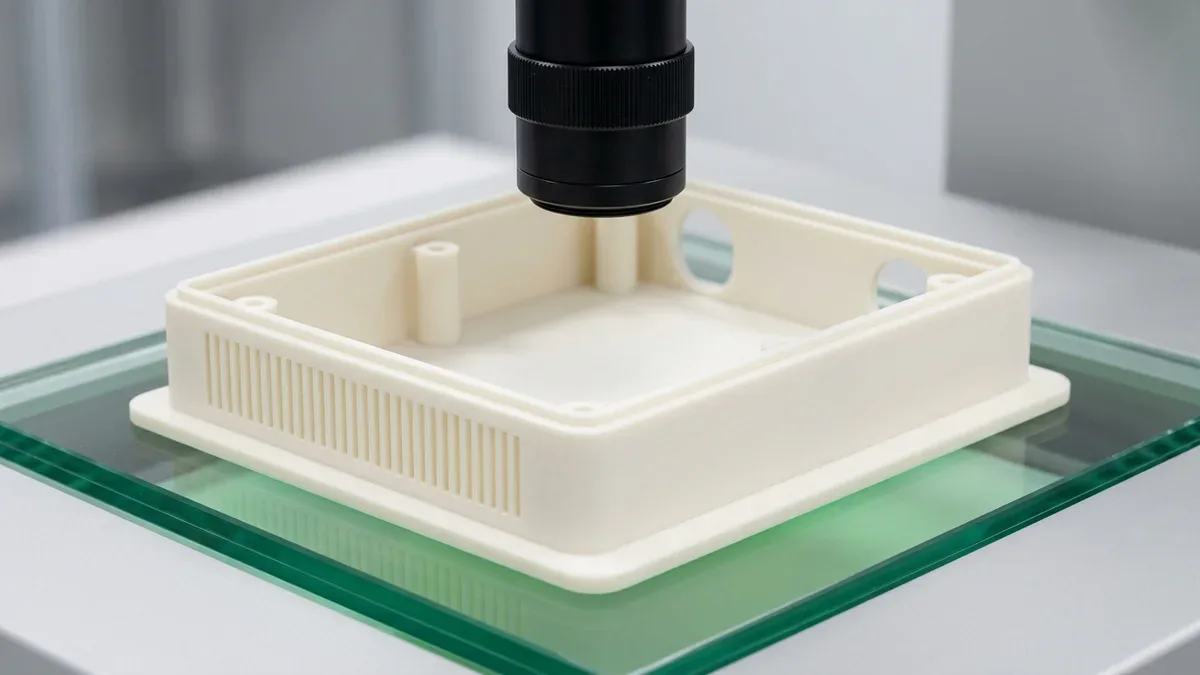
- Non-Contact 2.5D Optical Vision Metrology (VMS): High-resolution telecentric lens projection on green-backlit glass stages verifies hole-to-hole pitches, louver slot widths, and perimeter step tolerances within ±0.003 mm optical repeatability.
- Mating Assembly Fit-Up & Pin Gauge Verification: Multi-part enclosures (such as mating dual-bay ribbed carrier frames and stepped dual-window instrument bezels) undergo physical trial assembly, go/no-go pin gauging on post-reamed bores, and flatness checks on granite surface plates.
- Witness-Coupon Roughness & FAI Documentation: Contact stylus profilometry (ISO 4287) is conducted on co-processed sacrificial resin witness coupons—preventing stylus scratch marks on deliverable clear-coated optical windows—alongside collimated visual clarity checks and full First Article Inspection (FAI) reports upon request prior to ex-factory release.
Explore our 3D printing dimensional tolerances & inspection guide →
Frequently Asked Questions (FAQ)
Q1: What dimensional tolerances and layer resolutions do your industrial SLA printers hold?
Q2: How do you achieve glass-like optical clarity on clear SLA resin parts?
Q3: How does SLA compare to SLS and MJF 3D printing for functional prototypes?
Q4: What is the maximum single-piece build size for industrial SLA printing at AS Prototypes?
Q5: Why is SLA the preferred process for polyurethane vacuum casting master patterns?
Need Micron-Accurate SLA Prototypes, Clear Microfluidics, or Master Patterns?
Upload your 3D CAD files (STEP, IGES, STL) to receive a comprehensive DFM review and custom engineering quote within 24 hours. Our in-house industrial SLA fleet builds single-piece housings and 1:1 mating enclosures up to 800 mm with ±0.15 mm / ±0.20% dimensional accuracy and 4–8 business days ex-factory turnaround (7–12 business days for painted or clear-coated finishes; excludes 3–5 days international air transit).