Industrial FDM 3D Printing Services: ABS, PC & Functional Prototypes
At AS Prototypes, our in-house additive manufacturing workshop operates production-grade Fused Deposition Modeling (FDM) systems engineered to produce rugged, end-use functional prototypes and durable production components. By combining actively heated build chambers, high-temperature dual-extrusion heads, and soluble support technology, we transform standard and engineering thermoplastics into mission-critical hardware with typical ±0.20 mm per 100 mm (±0.002″/in) tolerances and reliable 4- to 8-business-day ex-factory production turnaround.
Production-Grade Engineering Thermoplastics for Real-World Loads
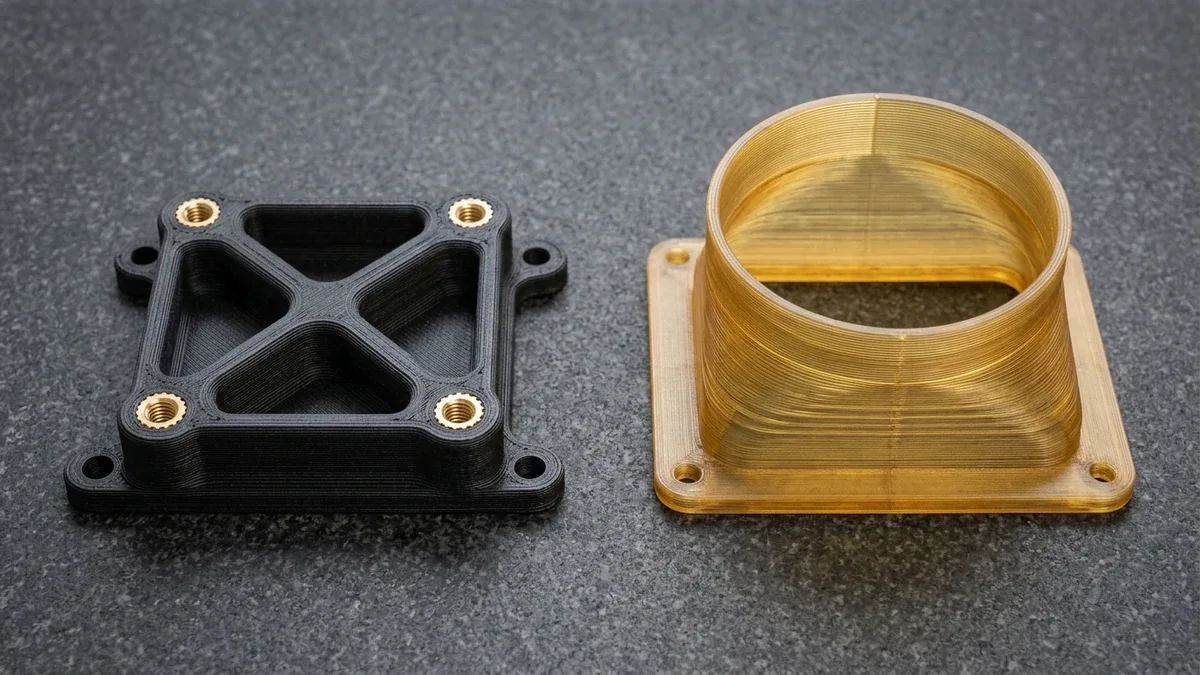
Unlike cosmetic resin models, FDM additive manufacturing delivers high mechanical strength, impact absorption, and long-term thermal endurance. Our industrial printers utilize genuine thermoplastic filaments—including ABS, Polycarbonate (PC), ASA, PETG, and carbon-fiber reinforced nylon (PA-CF)—ensuring your prototypes mirror the mechanical behavior of injection-molded production parts:
- Heated Build Envelopes up to 600 × 600 × 800 mm: Large-format single-piece builds eliminate assembly seam lines and adhesive bonding weaknesses.
- Soluble Dual-Extrusion Supports: Soluble alkali-release supports (SR-30) and high-temp dissolvable BVOH preserve pristine internal air channels, undercuts, and fine surface details without mechanical tooling gouges.
- Calibrated Servo Drives & Hardened Nozzles: Calibrated servo drives and hardened nozzles hold repeatable as-printed tolerances of ±0.20 mm per 100 mm (±0.002″/in).
- Fast 4–8 Business Day Ex-Factory Turnaround: Accelerate your physical testing cycle with 24-hour engineering DFM review, live machine scheduling, and 4–8 business days ex-factory production (plus 3–5 days international air transit via DHL/FedEx/UPS).
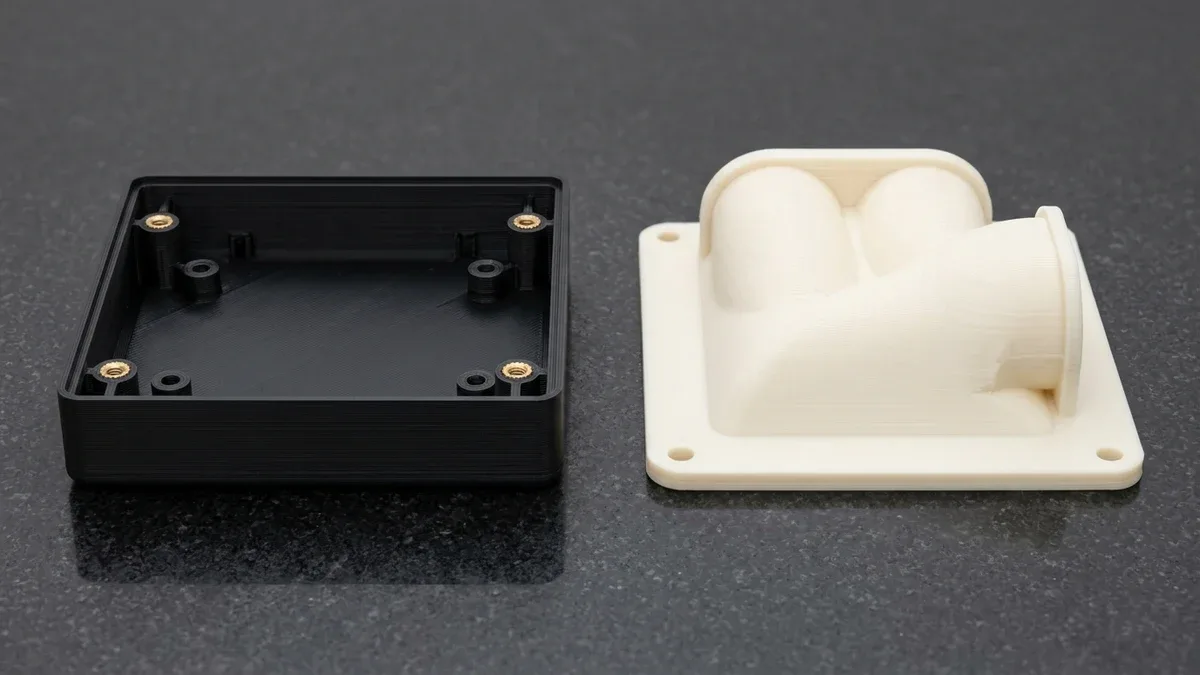
Industrial Engineering Thermoplastics Material Portfolio
Selecting the correct polymer chemistry is critical for functional mechanical validation. We stock virgin-grade raw thermoplastic filaments to match your project’s specific thermal, mechanical, and environmental requirements:
| Thermoplastic Material | Tensile Strength | Flexural Modulus | Heat Deflection (HDT @ 0.45 MPa) | Impact Resistance | Key Mechanical Characteristics | Primary Industrial Applications |
|---|---|---|---|---|---|---|
| ABS (Production Grade) | 40 – 44 MPa | 2.2 – 2.4 GPa | 86°C – 94°C | High (Izod 16 kJ/m²) | Durable, excellent impact resistance, ideal for secondary acetone vapor smoothing & threaded insert installation | Electronic housings, handheld device enclosures, snap-fit prototypes, automotive interior trims |
| PC (Polycarbonate) | 65 – 72 MPa | 2.4 – 2.6 GPa | 130°C – 138°C | Very High (Izod 28 kJ/m²) | Exceptional mechanical toughness, structural rigidity, superior heat deflection under continuous load | Under-hood automotive components, functional machine guards, high-load structural brackets |
| ASA (UV-Resistant) | 42 – 46 MPa | 2.1 – 2.3 GPa | 92°C – 98°C | High (Izod 15 kJ/m²) | Outstanding UV weatherability and color stability, non-yellowing, resistance to outdoor degradation | Outdoor sensor enclosures, marine equipment housings, commercial lighting fixtures, drone shells |
| PETG (Glycol-Modified) | 45 – 50 MPa | 2.0 – 2.2 GPa | 70°C – 75°C | Moderate-High (Izod 12 kJ/m²) | Low shrinkage, excellent layer adhesion, water-tight pressure integrity, good chemical resistance to dilute acids | Fluid containment reservoirs, liquid manifolds, transparent test fixtures, chemical pump prototypes |
| PA-CF (Carbon Fiber Nylon) | 98 – 110 MPa | 6.5 – 7.8 GPa | 150°C – 165°C | High Stiffness (Izod 11 kJ/m²) | Reinforced with chopped high-modulus carbon fibers, minimal thermal expansion, aluminum-like stiffness-to-weight ratio | Robotic end-of-arm tooling (EOAT), drone arms, lightweight aerospace brackets, replacement aluminum tooling |
| ULTEM 9085 (PEI Aerospace) | 68 – 72 MPa | 2.2 – 2.5 GPa | 153°C – 165°C | High (Izod 11 kJ/m²) | Flame-retardant (FAR 25.853 / UL94 V-0), high strength-to-weight ratio, exceptional thermal and chemical resistance | Aerospace ducting, aircraft cabin interior components, flame-retardant electrical housings, under-hood brackets |
| TPU 95A (Elastomer) | 32 – 38 MPa | 0.15 – 0.20 GPa | 55°C – 60°C | Extreme (>450% Elongation) | Elastic, wear-resistant, high tear resistance, absorbs dynamic shock and mechanical vibrations | Protective shock bumpers, sealing gaskets, non-marring gripper jaws, ergonomic grip overmolds |
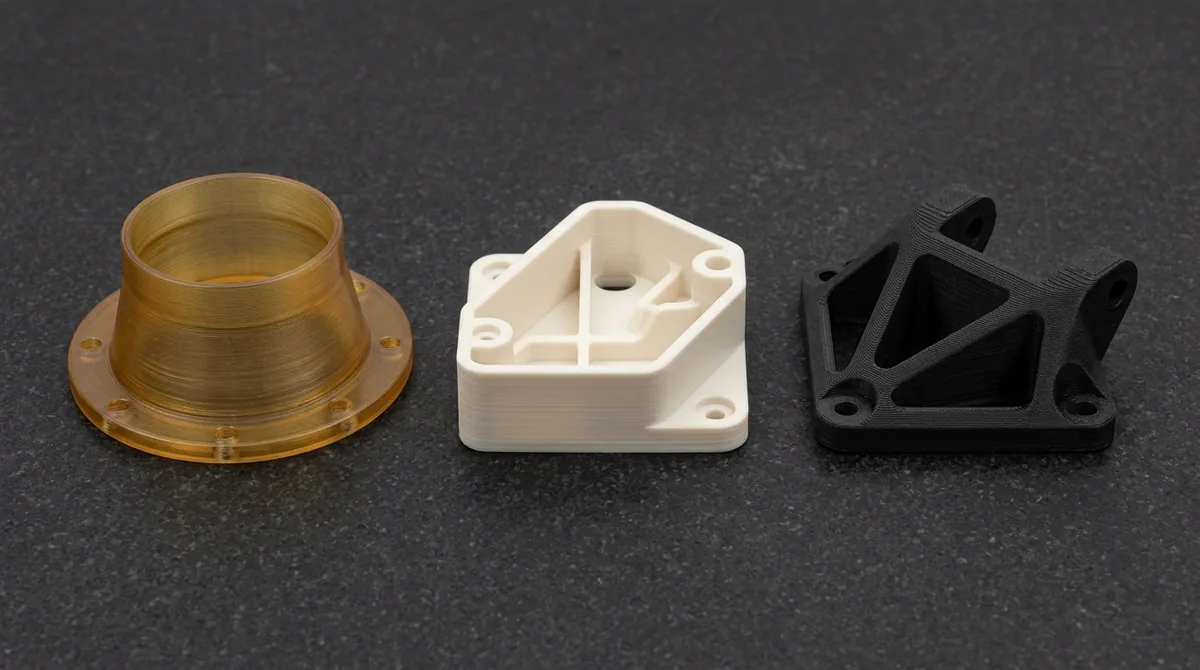
DFM Engineering Guidelines for Industrial FDM Production (8-Point Table)
Optimizing your 3D CAD models for heated-chamber fused filament deposition maximizes inter-layer shear strength, prevents corner curling, and guarantees repeatable hardware assembly:
| Design Parameter | Minimum Threshold | Preferred CAD Target | Extrusion Toolpath Physics & DFM Recommendation |
|---|---|---|---|
| 1. Vertical Wall Thickness | ≥ 1.20 mm (3 Perimeters) | 1.60 – 3.20 mm (4–8 Perimeters) | Design wall thickness as an exact multiple of the 0.40 mm nozzle extrusion width so the slicer lays continuous contour loops without micro-voids. |
| 2. Anisotropic Load Orientation | Z-Strength = 55%–70% of XY | Align Tension Along XY Plane | Inter-layer Z bond relies on thermal diffusion; orient brackets and snap-fit cantilevers so primary bending and tensile forces run parallel to XY layers. |
| 3. Self-Supporting Overhangs | ≥ 45° from Horizontal | Chamfer Lower Edges at 45° | Replacing bottom 90° ledges with 45° chamfers eliminates sacrificial support material and improves bottom-surface cosmetic smoothness. |
| 4. Horizontal Holes & Teardrops | ≥ Ø2.0 mm (+0.20 mm Offset) | Teardrop Crown on Bores > Ø8 mm | Horizontal circular bores sag slightly at the 12 o’clock crown; apply a +0.20 mm diametrical offset or precision drill/ream critical dowel holes after printing. |
| 5. Heat-Set Brass Insert Bosses | Boss OD ≥ 2.0 × Insert OD | ≥ 3 Perimeter Shells Around Bore | Specify 3 to 4 solid perimeter shells around tapered insert holes so molten ABS/PC flows cleanly into the brass knurls without splitting the boss wall. |
| 6. Soluble Support Evacuation | ≥ Ø5.0 mm Access Ports | Dual-Port Flow-Through Path | Enclosed cavities printed in ABS/PC use soluble SR-30 support filament dissolved in heated agitated alkaline baths; provide flow-through access ports. |
| 7. Large Flat Base Plates (>200 mm) | ≥ 3.0 mm Base + Corner Radii | AddR ≥ 5.0 mm Corner Fillets + Ribs | Sharp 90° base corners concentrate thermal shrinkage stress; generous corner radii and bottom stiffening ribs prevent peel-up on large-format builds. |
| 8. Mating Assembly Clearance | ≥ 0.30 mm per Side | 0.40 – 0.50 mm per Side | Accounts for visible extrusion bead ridges (Ra 10–25 μm) and ±0.20 mm per 100 mm dimensional tolerance across interlocking enclosure halves. |
Hardware Integration: Brass Inserts, Snap-Fits & Enclosures
Prototypes are built to be assembled, tested, and disassembled repeatedly. We integrate standard mechanical hardware directly into FDM components:
- Heat-Set Threaded Brass Inserts & Fasteners: Tapping threads directly into 3D printed thermoplastic can cause thread stripping under moderate torque. We install high-tensile brass heat-set threaded inserts (M2, M2.5, M3, M4, M5, M6) using calibrated temperature-controlled thermal presses. The surrounding ABS or PC reflows into the insert’s diagonal diamond knurls, yielding pull-out and rotational torque resistance comparable to molded bosses.
- Functional Cantilever Snap-Fit Joints: For electronic clamshells and battery access covers, we design cantilever snap-fits with permissible strain margins (ε ≤ 1.5% for ABS, ≤ 2.0% for PC) and lead-in entry angles of 30°. By printing latches parallel to the build platform, layer lines resist deflection bending without risk of delamination fracture.
- Hybrid Assembly Integration: Need to combine additive plastics with CNC machined aluminum datums or molded silicone seals? Explore our full suite of precision CNC machining services and vacuum casting technologies to build complete multi-process functional assemblies.
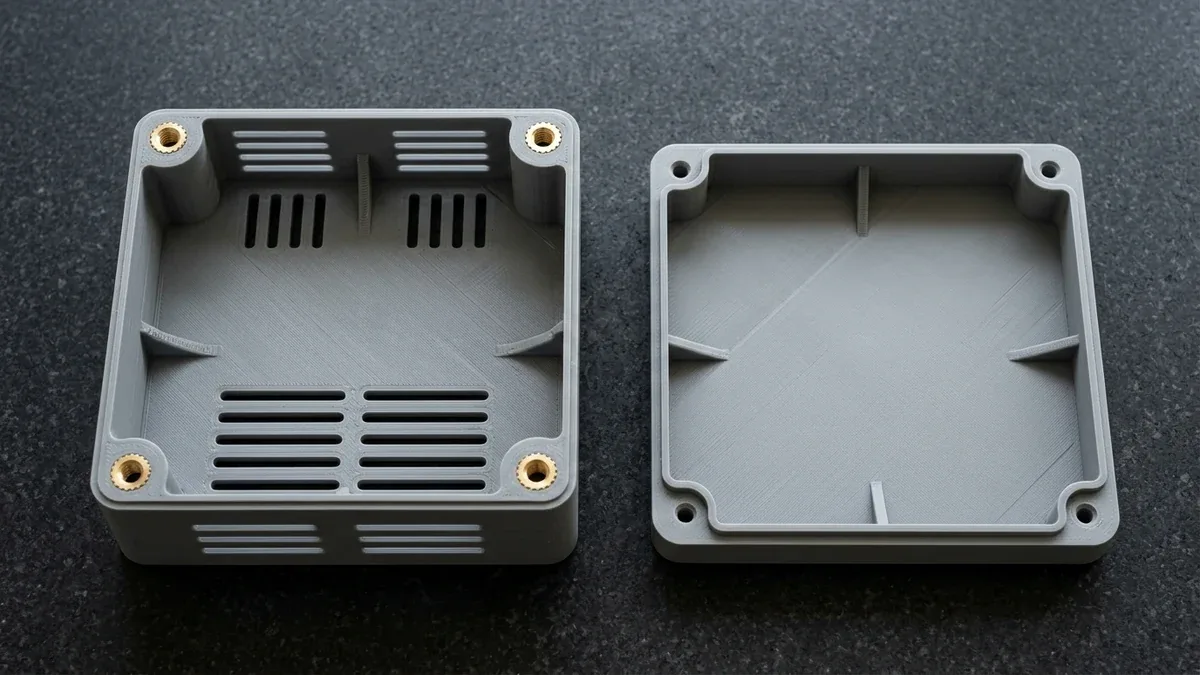
Industrial Surface Finishing & Secondary Operations
Depending on whether your parts are destined for rugged internal mechanical testing or client-facing investor demonstrations, we provide tailored post-processing options:
Support structures are removed via ultrasonic wash or precision hand breakaway. Parts undergo light glass bead blasting to reduce visible layer lines, producing a uniform matte satin finish ideal for functional shop-floor jigs and internal mechanisms.
Controlled acetone vapor reflows the outer micro-grooves of ABS components. This process yields a high-gloss, injection-molded appearance, seals micro-porosity for air/fluid-tight integrity, and increases outer surface impact resistance. Mandatory Post-Vapor Annealing (60°C–80°C) is conducted to relieve solvent-induced internal stresses and prevent micro-cracking.
Multi-stage hand sanding, high-build acrylic primer application, and automotive-grade polyurethane topcoating matched to your specified Pantone or RAL color codes with matte, satin, or gloss clear coats. Explore our surface finishes.
| RFQ Finishing Code | Post-Processing Workflow | Surface Roughness (Ra) | Added Lead Time & Primary Use Case |
|---|---|---|---|
| Level 1: Soluble-Washed Standard | Agitated heated alkaline bath support dissolution (or manual breakaway) + deburring | Ra 12.0 – 22.0 μm | Included (4–8 Business Days) · Functional brackets, shop-floor jigs & internal frames |
| Level 2: Glass-Bead Matte Satin | Support removal + light glass-bead media blasting to knock down extrusion gloss and soften layer ridges | Ra 8.0 – 14.0 μm | +1 Business Day · Uniform matte functional housings & EOAT grippers |
| Level 3: Acetone Vapor Smoothed (ABS) | Controlled solvent-vapor surface reflow + mandatory 60°C–80°C thermal stress-relief annealing | Ra 1.5 – 3.5 μm | +1 to 2 Business Days · Sealed fluid reservoirs, washable covers & glossy ABS shells |
| Level 4: Sanded, Primed & PU Painted | Multi-stage body filler, wet sanding (#240 to #800), high-build primer & custom Pantone/RAL polyurethane topcoat | Ra 0.8 – 1.6 μm | +2 to 4 Business Days · Exhibition showpieces & customer-facing enclosures |
Industrial FDM vs. SLS/MJF vs. SLA vs. CNC Machining: Selection Matrix
Select industrial FDM when you need genuine thermoplastic chemistry (ULTEM 9085, PC, ASA, PA-CF) or large-format monolithic parts up to 600 × 600 × 800 mm, and compare against alternative in-house processes below:
| Evaluation Criterion | Industrial FDM | SLS / HP MJF Nylon | SLA Photopolymer Resin | 3/4-Axis CNC Machining |
|---|---|---|---|---|
| Material Chemistry | True Thermoplastics (ULTEM, PC, ABS, ASA, PA-CF) | Semi-Crystalline Polyamides (PA12, PA11, PA12-GF, TPU) | UV-Cured Thermoset Resins (ABS-Like, Clear, High-Temp) | Solid Extruded/Cast Bar & Plate (Delrin, PEEK, 6061-T6, 304) |
| Max Single-Piece Envelope | 600 × 600 × 800 mm (23.6 × 23.6 × 31.5 in) | 550 × 550 × 500 mm (SLS) / 380 × 284 × 380 mm (MJF) | 800 × 800 × 550 mm (31.5 × 31.5 × 21.7 in) | 1,000 × 600 × 500 mm (39.4 × 23.6 × 19.7 in) |
| Typical Tolerance | ±0.20 mm per 100 mm (±0.002 in/in) | ±0.20 mm per 100 mm (±0.002 in/in) | ±0.15 – ±0.20 mm per 100 mm | ISO 2768-mK General / ±0.010–±0.020 mm Precision Fits |
| Primary Engineering Advantage | Low-Density Honeycomb Infill, FST Flame Retardancy & Large Jigs | Support-Free Complex Ducts, Living Hinges & Batch Nesting | Smooth Cosmetic Finish (Ra 0.8–1.6 μm) & Optical Clarity | 100% Isotropic Strength & Tight Bearing/Sealing Tolerances |
Proven Industrial Applications & Use Cases
Two-piece interlocking clamshell enclosures, handheld terminal housings, PCB mounting brackets with heat-set brass bosses, and snap-latch sensor covers. Explore our electronics solutions.
Custom vacuum gripper bodies, pneumatic manifold channels, multi-axis cable management guides, and lightweight sensor mounting plates in stiff PA-CF. See our robotics capabilities.
Aerodynamic air intake tubes, cooling ducts, fluid reservoir test tanks, battery pack mounting cradles, and exterior mirror housings in UV-stable ASA or PC. Review our automotive parts service.
Custom assembly holding nests, ergonomic operator hand tools, drill guide templates with press-fit hardened steel bushings, and quality control go/no-go inspection fixtures.
In-House Metrology & Quality Inspection
In-house metrology lab utilizes non-contact 2.5D optical vision measuring systems (VMS), calibrated Go/No-Go pin gauges, and mating assembly fit-up fixtures to verify physical parts against your native 3D CAD models.
For multi-component assemblies, our technicians perform physical hardware dry-runs. We verify fastener engagement torque, check cantilever snap-latch tactile feedback, and ensure smooth mating tolerances.
Upon request, we provide detailed First Article Inspection Reports (FAIR), raw material batch test certificates, and 3D color deviation heatmaps against the CAD model.
Fast 4–8 Day Turnaround & Protective Export Packaging
CAD files are reviewed within 24 hours. Standard prototype orders complete ex-factory production, post-processing, and QC inspection within 4 to 8 business days (international DHL/FedEx/UPS air transit adds 3 to 5 days). For scaling up to batch runs, explore our 3D printing mass production guide.
Electronic housings and thin-wall enclosures are individually sealed inside anti-static ESD shielding bags with active desiccant pouches to prevent hygroscopic moisture reabsorption.
Components are cradled in custom-cut high-density EPE foam inside heavy-duty double-wall corrugated export cartons, shipped via DHL, FedEx, or UPS express door-to-door with real-time tracking.
Frequently Asked Questions About Industrial FDM 3D Printing
Q1: Which engineering thermoplastic is best for functional prototype enclosures: ABS, PC, or ASA?
Q2: Can FDM printed parts support repeated assembly with mechanical screws and bolts?
Q3: How does industrial FDM compare to SLS and SLA in terms of mechanical strength and cost?
Q4: What dimensional tolerances can AS Prototypes achieve on industrial FDM parts?
Ready to Build Functional FDM Prototypes & Production Runs?
Upload your 3D CAD files (STEP, IGES, or STL) today. Our in-house additive engineering team will conduct a thorough DFM analysis, advise on optimal build orientation and thermoplastic selection, and return an itemized quote within 24 hours.