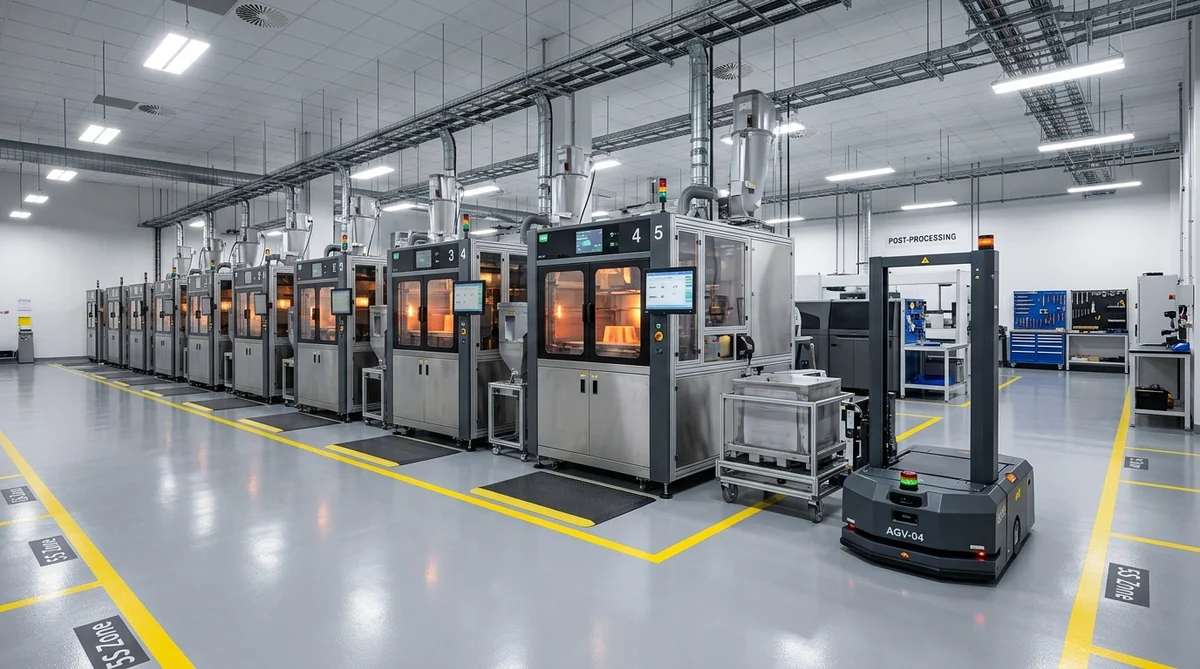
For years, product teams saw 3D printing only as a fast tool for making prototypes. Today, modern additive systems run real mass production batches every day.
Using 3D printing for mass production changes how hardware brands build parts. It removes high mold costs and lets you launch goods weeks sooner.
Furthermore, digital storage cuts warehouse costs. Brands can now print parts on demand right near end users.
At AS Prototypes, our additive print farm runs day and night. In this guide, we break down costs, key tech, and rules for scaling your 3D printing to volume production.
Why Pick 3D Printing for Mass Production?
Traditional volume manufacturing demands high upfront spending on tools and dies. In contrast, additive production offers unique business perks.
First, zero tooling cost lowers your upfront risk. Hard steel tools often cost ten to fifty thousand dollars before you sell one unit.
Second, speed to market is unmatched. Production batches typically achieve ex-factory dispatch within 4 to 8+ business days depending on order volume and post-processing.
Third, geometric freedom unlocks organic part shapes. Industrial printers make internal fluid channels and light lattice grids with ease. Standard CNC mills cannot cut these shapes.
Finally, supply chains stay lean and agile. If your team updates a design, you simply upload a new file. There are no scrapped tools or costly mold fixes.
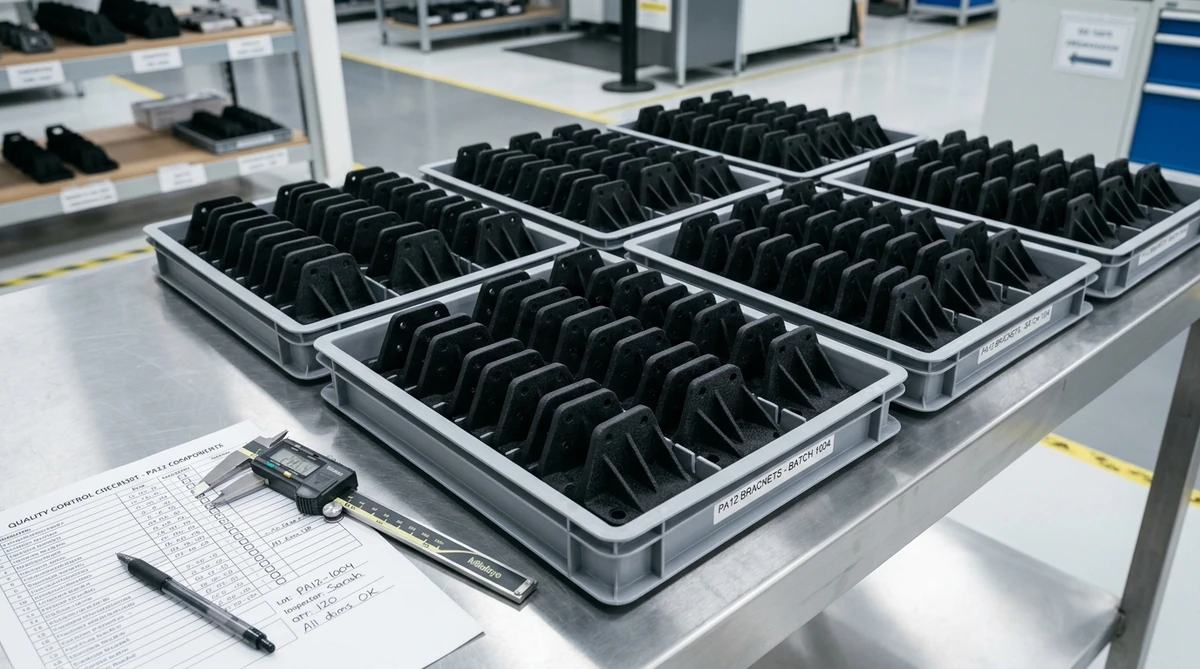
Top Additive Systems for Volume Production
Not every 3D printing method fits volume manufacturing. Industrial teams rely mainly on three high-speed technologies.
1. Selective Laser Sintering (SLS)
SLS uses a CO2 laser to fuse polymer powder layer by layer. Unfused powder supports the parts during the entire print.
Consequently, SLS needs zero extra support structures. Technicians can nest hundreds of parts in 3D space inside a single build bin.
Common materials include tough nylon PA11 and PA12. These materials yield stiff parts that resist wear and last for years.
2. Multi Jet Fusion (MJF)
Multi Jet Fusion applies heat lamps and liquid fusing agents across powder beds. It fuses full layers in fast, single passes.
While MJF delivers significantly better interlayer fusion than filament-based printing, powder-bed fusion parts still exhibit slight directional variation: ultimate tensile strength in the XY plane reaches 48–52 MPa, while the vertical Z-axis experiences a 10–15% reduction alongside reduced elongation at break. In mass production, AS Prototypes nesting engineers align primary functional stress paths along the XY build plane to maximize mechanical integrity.
Furthermore, MJF cools fast between runs. This makes it a great choice for batches of 500 to 50,000 units.
3. Direct Metal Laser Sintering (DMLS)
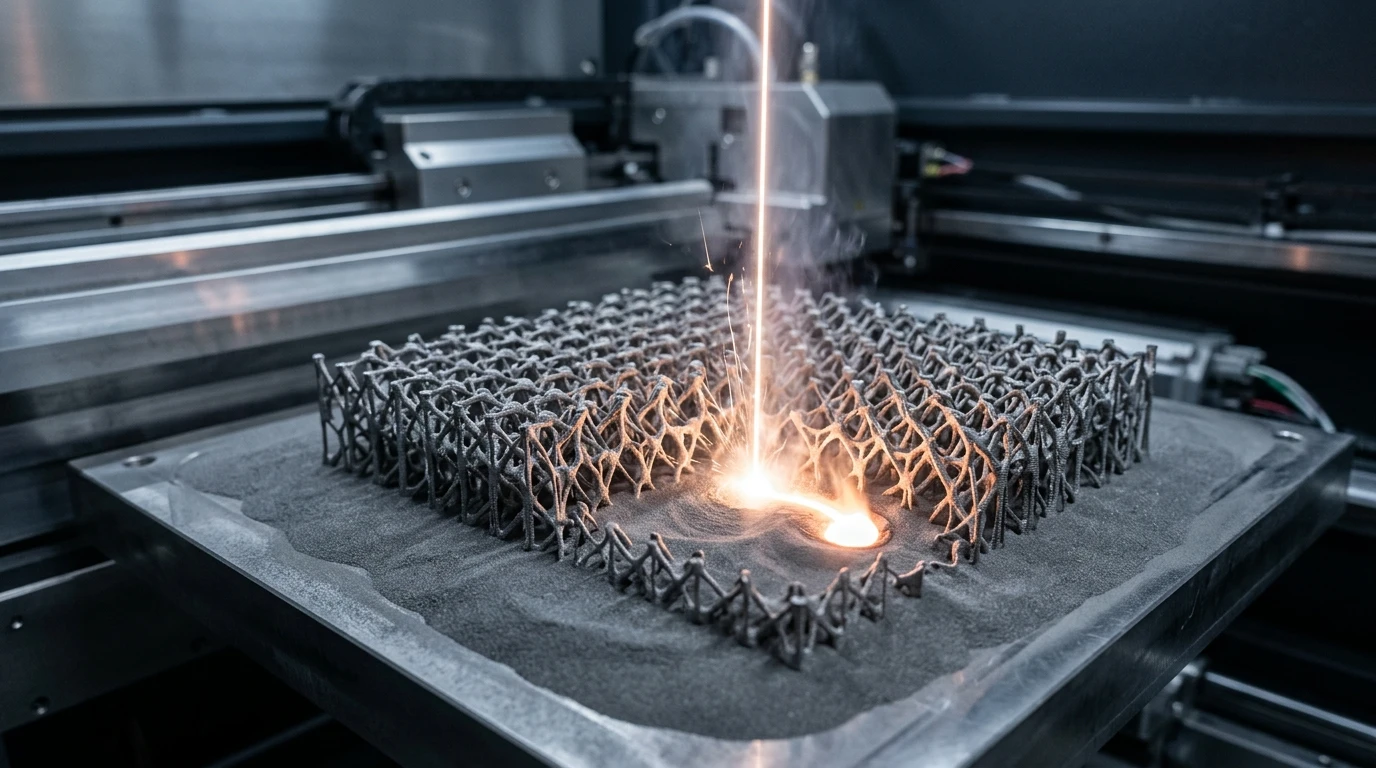
DMLS uses high-power fiber lasers to weld fine metal powders into solid parts. It works with titanium, aluminum, stainless steel, and Inconel.
In aerospace and medical fields, DMLS makes end-use parts with over 99.5 percent metal density. To mitigate steep thermal gradients and severe residual stresses inherent to laser melting, every AS Prototypes DMLS production batch undergoes mandatory high-temperature vacuum stress-relief annealing while still anchored to the build platform prior to wire EDM separation, followed by secondary 5-axis CNC machining on critical bearing datums. Explore our specialized metal printing services to view fully traceable, high-performance flight-grade alloys.
Economics: 3D Printing vs CNC vs Injection Molding
Understanding cost curves helps engineers choose the most profitable process.
| Method | Upfront Tool Cost | Tool Lead Time | Unit Cost Trend | Design Change Cost |
|---|---|---|---|---|
| Industrial 3D Printing | \$0 (No tooling needed) | 0 Days (Digital Tooling) | Steady across low to mid runs | Zero tool scrap penalty. |
| CNC Machining | Low to Mid (Custom jaws) | 3 – 7 Days | Drops steadily at mid runs | CAM updates only. |
| Injection Molding | High (\$5,000 – \$50,000+) | 3 – 6 Weeks | Lowest at massive volume | High (Needs mold re-tooling). |
Additive Volume Production Matrix
Compare print speeds, materials, and tolerances across key production systems below.
| Process | Top Materials | Tolerance | Typical Batch Size | Best Serial Use Case |
|---|---|---|---|---|
| MJF | PA12, PA11, TPU Rubber | +/-0.2 mm | 100 – 50,000 parts | Consumer gear, drone arms, and vent ducts. |
| SLS | PA12, Glass Nylon | +/-0.3 mm | 50 – 10,000 parts | Stiff brackets, robot clamps, and cases. |
| DMLS | Titanium, AlSi10Mg, 316L | +/-0.1 mm | 10 – 2,000 parts | Rocket nozzles and surgical bone plates. |
Smart Design Tips for Additive Mass Production
Follow these simple rules to reduce piece costs during volume additive runs.
- Nest Parts in 3D: In powder beds, packing parts close together cuts total machine run time.
- Use Internal Lattices: Hollow out thick zones to save expensive powder and speed up laser passes.
- Combine Assemblies: Join several mating parts into one single CAD body to eliminate assembly bolts.
- Add Vapor Smoothing: Chemical vapor smoothing seals porous surfaces and gives parts a semi-gloss look.
Additive manufacturing wins on small to medium batches between 500 and 20,000 units. It also wins when complex shapes cannot be cut into steel molds.
Yes. Modern MJF and SLS nylon PA12 parts reach 95 percent of molded strength. They also provide uniform strength in all three directions.
Automated shot blasting and vapor smoothing seal rough surfaces. These treatments give parts a smooth look that rivals molded plastic.
Scale Your Production with AS Prototypes Additive Farms
From bridge batches to thousands of end-use polymer and metal components, AS Prototypes delivers fast, precision-inspected production-grade components. Upload your STEP CAD files today for an instant quote.
Request an Additive Manufacturing Quote