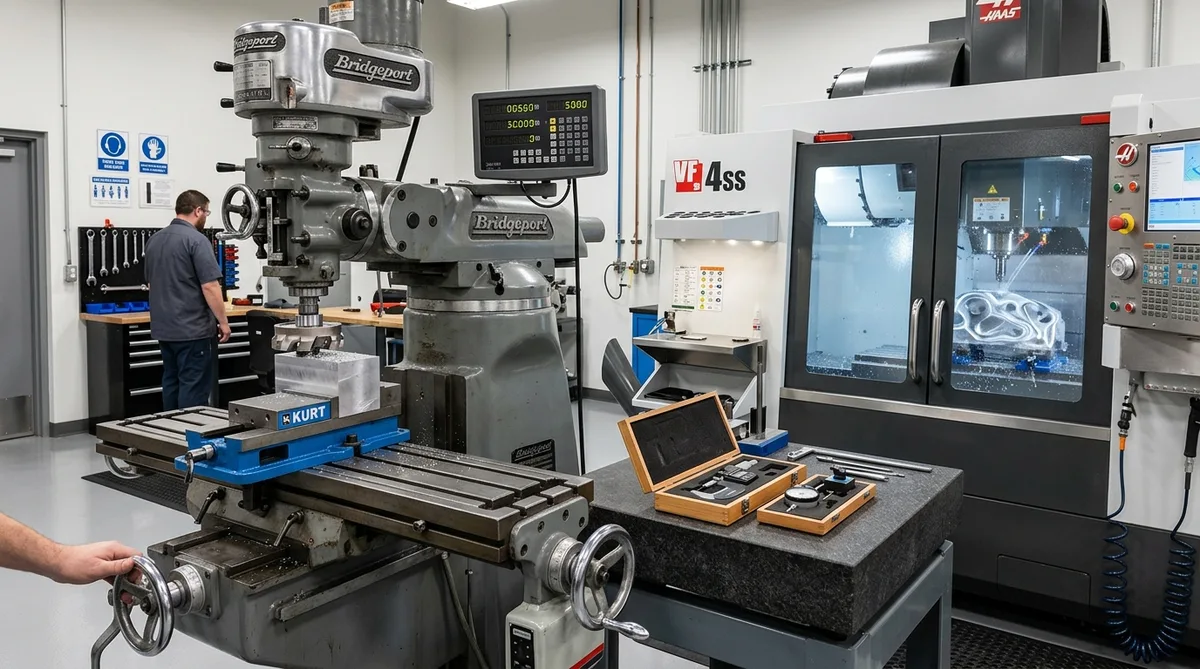
In precision manufacturing and rapid prototyping, deciding between CNC machining and manual machining is one of the earliest decisions affecting project lead time, per-part cost, and geometric viability. While multi-axis Computer Numerical Control (CNC) machining centers dominate modern production runs due to automated repeatability and complex 3D contouring, manual knee mills and engine lathes remain indispensable in agile toolrooms for rapid fixturing, quick-turn modifications, and single-piece rework. Understanding the operational, technical, and economic trade-offs allows engineering teams to maximize manufacturing efficiency at every development stage.
What Is Manual Machining?
Manual machining relies entirely on a skilled machinist directly operating mechanical handwheels, lead screws, and levers to guide cutting tools into metal or plastic stock. Equipment like Bridgeport vertical knee mills, engine lathes, and surface grinders utilize mechanical dials or Digital Readouts (DRO) to track positional coordinates along X, Y, and Z axes.
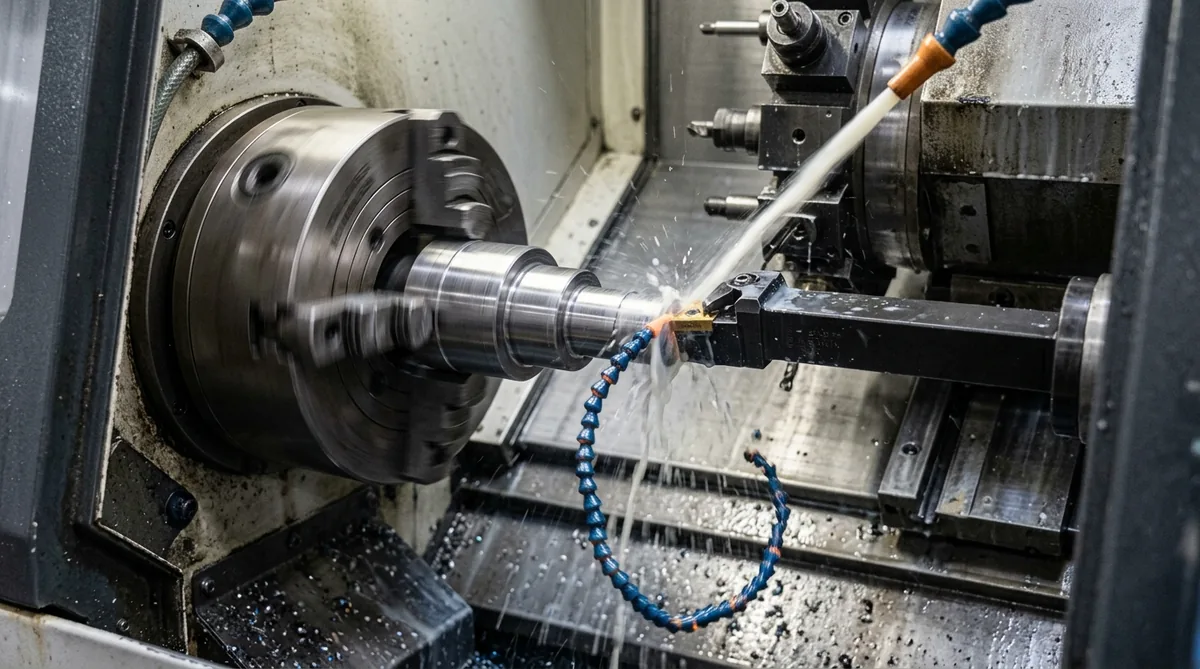
Because there is no CAD-to-CAM programming phase, a seasoned toolmaker can clamp a raw billet in a Kurt vise, touch off a datum, and immediately begin facing, drilling, or slotting within minutes. However, feed rates and path precision depend directly on human tactile sensitivity and physical stamina, making complex curves and high-volume consistency difficult to achieve.
What Is CNC Machining?
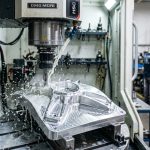
CNC (Computer Numerical Control) machining automates subtractive manufacturing via pre-programmed G-code instructions generated from digital 3D CAD models. Multi-axis CNC milling centers (3-axis, 4-axis, and continuous 5-axis) and CNC turning centers execute synchronized multi-axis interpolation, high-pressure through-spindle cooling, and automatic tool changes (ATC) with zero human intervention during the cut cycle.
In our in-house machine shop, precision CNC machining delivers positional tolerances down to ±0.005 mm (±0.0002 in), high material removal rates (MRR), and identical dimensional repeatability across batches ranging from dozens to thousands of parts.
Key Comparison: Capabilities & Technical Limits
Evaluating which method suits a specific mechanical assembly requires examining geometric complexity, tolerance capability, and operator dependency:
| Engineering Parameter | Manual Machining (Mills & Lathes) | CNC Machining (3/4/5-Axis Centers) |
|---|---|---|
| Achievable Tolerances | ±0.05 mm to ±0.10 mm (Skill-dependent) | ±0.005 mm to ±0.025 mm (Machine-governed) |
| Geometric Capability | Prismatic shapes, 2D planes, straight steps, circular holes | Complex 3D organic surfaces, undercuts, continuous 5-axis impellers |
| Setup & Programming Lead Time | Immediate (15–30 minutes, zero CAM programming) | Requires 3D CAD modeling, CAM toolpath programming, and G-code simulation |
| Repeatability Across Batch | Low (Variations accumulate with operator fatigue) | Near perfect (Consistent sub-micron encoder feedback) |
| Production Scalability | Strictly low volume (1 to 5 units maximum) | Highly scalable (10 to 10,000+ units with multi-part fixturing) |
| Surface Roughness (Ra) | Ra 1.6 µm – 3.2 µm (Manual feed control) | Ra 0.4 µm – 1.6 µm (Constant chip load & high-speed milling) |
The Economics of Volume: Break-Even Analysis
The cost dynamic between manual and CNC machining hinges on the division between upfront programming/setup investment and recurring per-part runtime:
- Single-Piece Prototype or Simple Rework (1–3 Parts): If a component has simple prismatic features—such as squaring up an aluminum plate, drilling four mounting holes, or turning a shaft shoulder—manual machining is often faster and less costly because it eliminates the CAM programming overhead and digital work-holding setup.
- Complex Geometry or Small Batches (5–50 Parts): Once part quantities exceed 5 pieces or include 3D contours, tapered threads, or angled bores, CNC machining becomes overwhelmingly more cost-effective. The upfront CAM programming cost is amortized across the batch, while automated cycle times reduce per-part machining costs by 60% to 80%.
- Production Volumes (100+ Parts): Manual machining is completely unviable for mid-to-high volumes. CNC machining cells equipped with pallet changers, modular multi-station tombstones, and automated tool monitoring deliver rapid cycle times with rock-solid consistency.
| Production Batch Size | Optimal Machining Approach | Upfront Setup & NRE | Unit Cost Dynamics |
|---|---|---|---|
| 1 Part (Simple Geometry) | Manual Toolroom Machining | Negligible | Moderate (High labor rate, but zero CAM fee) |
| 1 Part (Complex 3D Contours) | 3-Axis or 5-Axis CNC Machining | CAM Programming Required | High (Reflects programming & setup time) |
| 5 to 50 Parts | CNC Machining | Amortized across batch | Fast cost drop per piece |
| 50 to 1,000+ Parts | Multi-Axis CNC Machining with Live Tooling | Fully absorbed | Lowest per-unit cost with unmanned night shifts |
When Should Engineers Choose Manual Machining?
While CNC machining is the core engine of modern production, our toolroom actively utilizes manual machinery in specific high-value scenarios:
- Emergency Modification of Existing Castings or Mold Bases: Drilling an auxiliary cooling port, facing an ejector plate, or tapping extra mounting threads on an already-machined tool steel block without re-generating digital CAM setups.
- Custom Fixture & Soft Jaw Fabrication: Rapidly squaring up 6061 aluminum stock or milling custom step jaws directly on the bench to support upcoming CNC production runs.
- Shaft Chamfering & Polishing: Quickly deburring or emery-cloth polishing bearing seats on manual lathes for prototype sub-assemblies.
When Is CNC Machining Mandatory?
In the vast majority of engineering applications, precision CNC turning and multi-axis milling are essential:
- Aerospace & Defense Components: Thin-wall structural brackets, turbine blisks, and avionics enclosures requiring 5-axis simultaneous contouring and ±0.005 mm true position tolerances.
- Medical Devices & Surgical Tools: Micro-turned bone screws, titanium implant housings, and cannulated shafts with stringent Ra 0.4 µm surface finish callouts.
- Injection Mold Cavities: Hardened tool steels (S136, NAK80, H13) requiring high-speed hard milling, EDM electrode milling, and mirror-grade finishing.
- Batch Production Consistency: Eliminating human error and fatigue when every part in a 500-piece assembly must fit seamlessly into an automated production line.
For very simple, single-piece metal blocks requiring straightforward squaring, facing, or tapping, manual machining can be cheaper and faster by bypassing 3D CAM programming fees. However, if the prototype features complex curves, pockets, or tolerances tighter than ±0.02 mm, CNC machining is essential and more cost-effective.
A master toolmaker can achieve tight tolerances (down to ±0.01 mm) on manual equipment for simple dimensions using sensitive micrometers and indicators. However, manual machines cannot sustain this accuracy across complex 3D profiles or repeat it consistently across multiple workpieces due to backlash and human fatigue.
Manual machining delivers immediate turnaround for basic 1-piece modifications (often within hours). CNC machining typically requires 3 to 5 working days to allow for 3D model validation, CAM programming, tool selection, fixture setup, and CMM metrology inspection.
Optimize Your Prototyping & Production Machining Strategy
Whether you are developing initial single-piece proof-of-concept models or scaling high-precision series production, AS Prototypes provides expert DFM feedback to determine the most cost-efficient machining pathways for your mechanical components.