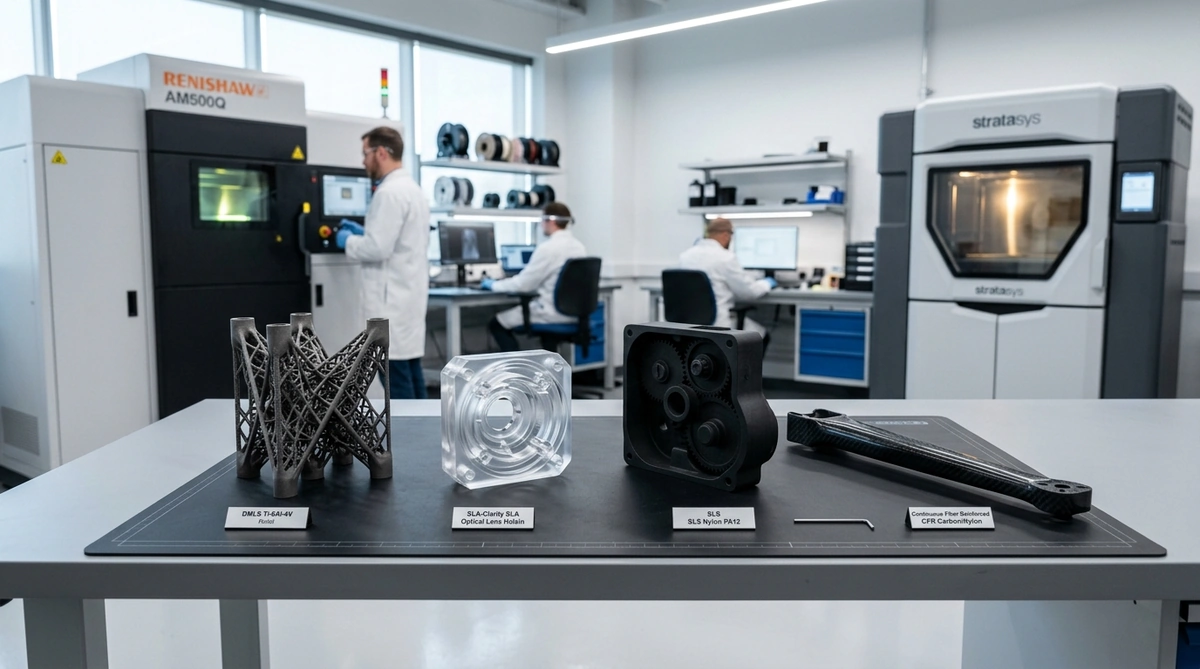
Selecting the right additive manufacturing technology determines the mechanical strength, surface finish, and unit cost of your prototype. Today, engineers can leverage seven primary 3D printing types to turn complex digital designs into high-performance components. Each technology relies on distinct physics, material states, and energy sources. Consequently, matching your functional requirements to the correct process is critical for project success.
According to the international ISO/ASTM 52900 standard, additive manufacturing divides into seven distinct categories. Below, we examine each technology family in detail. Furthermore, we outline key material options, process capabilities, and production trade-offs.
1. Powder Bed Fusion (PBF)
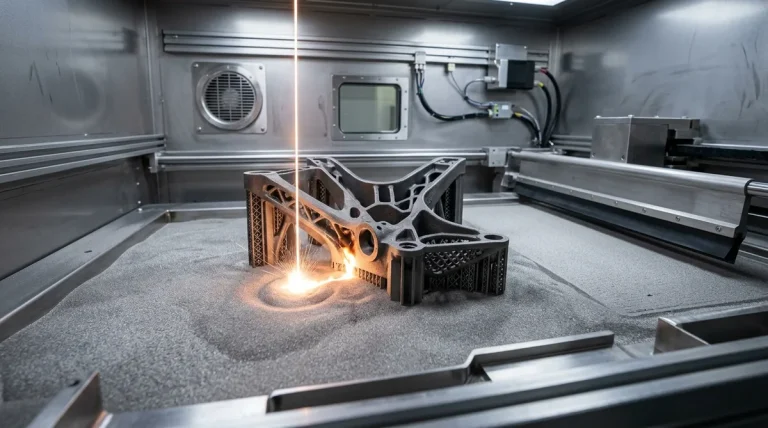
Powder Bed Fusion represents the gold standard for high-strength functional prototypes and end-use industrial hardware. In this process, a precision recoater spreads a thin layer of fine powder across a build platform. Subsequently, a high-power thermal source selectively fuses the cross-sectional geometry.
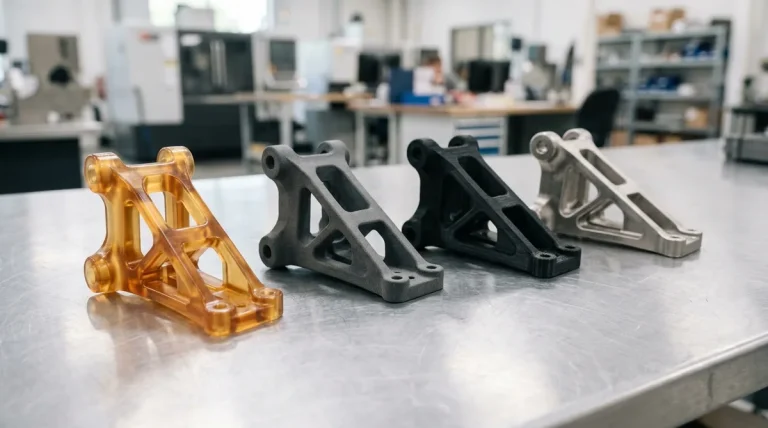
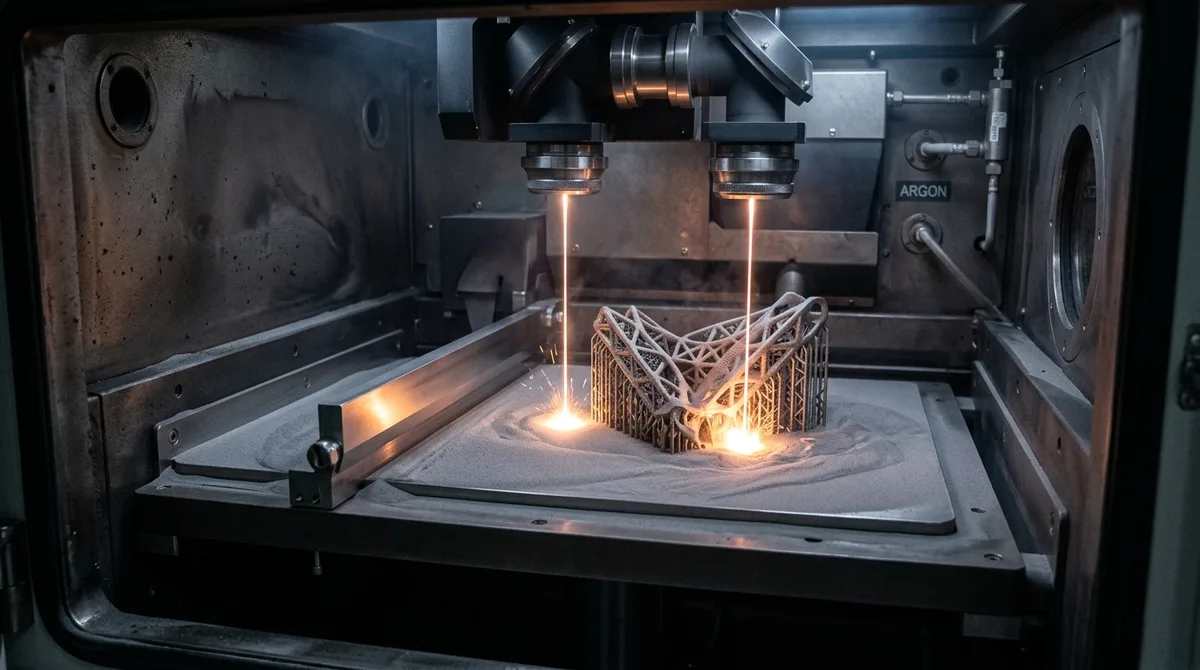
For metallic alloys, Direct Metal Laser Sintering (DMLS) and Selective Laser Melting (SLM) utilize focused fiber lasers inside an inert argon chamber. These systems achieve full metallurgical bonding with relative densities exceeding 99.7%. Common aerospace alloys include Titanium Ti-6Al-4V, Inconel 718, 316L stainless steel, and AlSi10Mg aluminum. When your project demands flight-critical mechanical integrity, our specialized metal 3D printing capabilities provide rapid turnarounds with tight dimensional control.
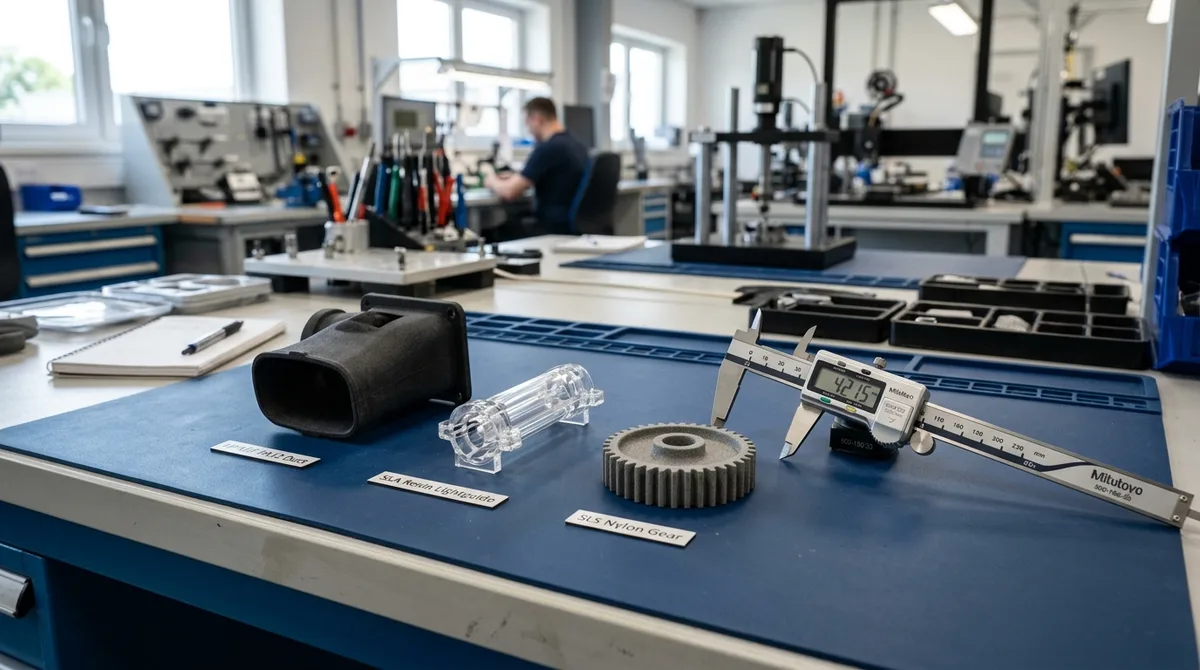
In polymer applications, Selective Laser Sintering (SLS) fuses thermoplastic powders such as Nylon PA12 and PA11 without requiring dedicated support structures. Because the surrounding unsintered powder supports overhanging features, SLS empowers engineers to print highly complex internal channels, nested assemblies, and organic ducting.
2. Vat Photopolymerization
Vat photopolymerization solidifies liquid photocurable resin layer-by-layer using ultraviolet light. Because light can be focused to microscopic spot sizes, this family delivers the highest feature resolution and smoothest surface finishes among all polymer additive technologies.
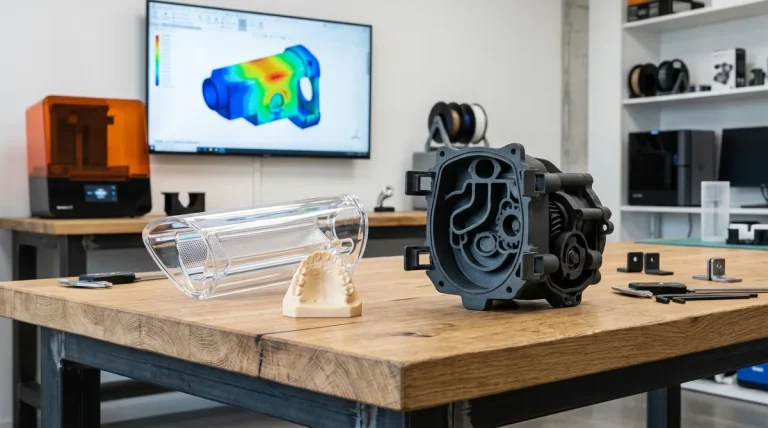
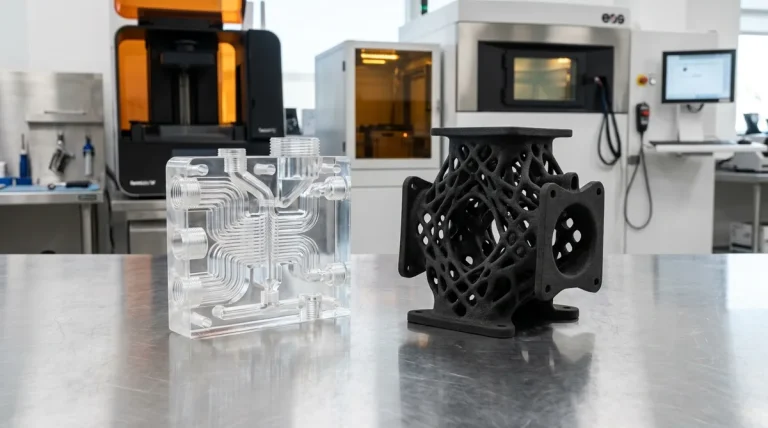
Stereolithography (SLA) scans a UV laser beam across the liquid resin surface. Meanwhile, Digital Light Processing (DLP) and LCD-based Masked SLA (mSLA) flash complete layer cross-sections simultaneously using micro-mirror chips or high-resolution LCD arrays. For medical manifolds, micro-fluidic channels, and optical housings, SLA delivers crisp edge definition and near-isotropic mechanical properties. Explore our comprehensive industrial 3D printing services to inspect functional clear resins and tough engineering photopolymers.
3. Material Extrusion (MEX)
Material Extrusion, commonly known as Fused Deposition Modeling (FDM) or Fused Filament Fabrication (FFF), feeds a continuous thermoplastic filament through a heated nozzle. The nozzle deposits semi-molten material onto a build platform along pre-calculated toolpaths.
While desktop printers use standard PLA or ABS, industrial extrusion machines process high-performance engineering thermoplastics such as PEEK, PEKK, and ULTEM 9085. Additionally, continuous fiber reinforcement (CFR) can embed continuous carbon fiber strands directly inside nylon matrices, yielding stiffness-to-weight ratios that rival 6061-T6 aluminum.
4. Material Jetting (MJ)
Material Jetting operates similarly to an inkjet document printer. Print heads deposit hundreds of microscopic photopolymer droplets simultaneously across the build plate. Immediately following deposition, an integrated ultraviolet lamp passes over the droplets to solidify them instantly.
Because multiple print heads can jet different proprietary formulations simultaneously, Material Jetting enables multi-material and full-color 3D printing. Engineers frequently specify this process for ergonomic overmolding prototypes, combining rigid ABS-like cores with soft elastomeric coatings ranging from Shore 30A to 95A.
5. Binder Jetting (BJT)
Binder Jetting decouples the deposition process from thermal fusion. First, a roller spreads a fine layer of metallic, ceramic, or sand powder. Next, an inkjet printhead deposits a liquid binding adhesive onto selected areas to bind the particles together.
After the complete green part is formed, it undergoes a separate thermal debinding and high-temperature furnace sintering cycle. Because the printing phase generates zero residual thermal stress, Binder Jetting prevents part warpage during deposition. As a result, it serves as a highly economical choice for batch runs of stainless steel components and sand casting cores.
6. Directed Energy Deposition (DED)
Directed Energy Deposition focuses thermal energy—such as an industrial laser or electron beam—directly at the deposition zone while simultaneously feeding metal wire or blown powder. The heat source melts the feedstock as it contacts the substrate.
DED achieves massive deposition rates compared to powder bed systems. Therefore, manufacturers deploy DED primarily for large aerospace structural repairs, adding features onto existing forgings, and creating multi-axis hybrid machine tools that combine additive cladding with high-speed CNC milling.
7. Sheet Lamination (SL)
Sheet Lamination bonds thin sheets of material together using adhesive, heat, or ultrasonic welding, followed by laser or CNC contour cutting. Ultrasonic Additive Manufacturing (UAM) utilizes ultrasonic energy to bond metal foils at room temperature, enabling engineers to embed delicate electronic sensors and fiber optics directly inside solid metal matrices.
Comprehensive Engineering Comparison: The 7 AM Technologies
To help engineering teams select the optimal manufacturing method, the table below contrasts the technical capabilities of all seven ISO/ASTM 52900 process categories:
| Process Category | Common Technologies | Primary Materials | Min Layer Thickness | Standard Tolerance | Best Industrial Application |
|---|---|---|---|---|---|
| Powder Bed Fusion (PBF) | DMLS, SLM, SLS, EBM | Titanium, Inconel, 316L, Nylon PA12 | 20 – 50 μm | ±0.1 mm to ±0.2 mm | Aerospace brackets, functional snap-fits |
| Vat Photopolymerization | SLA, DLP, LCD, CLIP | Standard, Tough, Castable & Clear Resins | 25 – 100 μm | ±0.05 mm to ±0.1 mm | Optical prototypes, dental, master patterns |
| Material Extrusion | FDM, FFF, CFR | ABS, PC, PEEK, Carbon-Nylon | 100 – 300 μm | ±0.2 mm | Jigs, fixtures, rugged concept models |
| Material Jetting | PolyJet, NPJ | Rigid & Flexible Photopolymers | 16 – 32 μm | ±0.1 mm | Multi-color, multi-durometer models |
| Binder Jetting | Metal BJ, Sand BJ | Stainless Steel, Sand, Infiltration bronze | 50 – 100 μm | ±0.2 mm to ±0.5 mm | Sand molds, batch production of steel parts |
| Directed Energy Deposition | LMD, WAAM, Cold Spray | Titanium, Stainless Steel, Nickel alloys | 500 – 2000 μm | ±0.5 mm to ±1.5 mm | Turbine blade repair, huge aerospace shells |
| Sheet Lamination | LOM, UAM | Paper, Aluminum foil, Copper sheets | 100 – 150 μm | ±0.2 mm to ±0.3 mm | Embedded smart sensors, non-critical molds |
Metal AM vs. Polymer AM: Process Selection Matrix
When selecting among different 3D printing types, engineers must evaluate whether a polymer prototype suffices for fit checks or if end-use metallic properties are required. The comparison below illustrates performance metrics across our primary production lines:
| Manufacturing Process | Representative Material | Tensile Strength (MPa) | As-Built Surface Finish (Ra) | Lead Time |
|---|---|---|---|---|
| DMLS / SLM | Titanium Ti-6Al-4V | 1050 – 1150 | 6.3 – 10 μm | 3 – 5 Days |
| SLS Nylon | Polyamide 12 (PA12) | 45 – 50 | 8.0 – 12.5 μm | 2 – 3 Days |
| SLA Photopolymer | Tough ABS-Like Resin | 40 – 65 | 0.8 – 2.5 μm | 1 – 3 Days |
| Industrial FDM | Polycarbonate (PC) | 55 – 70 | 12.5 – 25 μm | 2 – 4 Days |
Stereolithography (SLA) and Material Jetting provide the tightest tolerances among polymer systems, achieving plus or minus 0.05 mm to 0.1 mm. In metal additive manufacturing, Direct Metal Laser Sintering (DMLS) holds tolerances of plus or minus 0.1 mm to 0.2 mm. Furthermore, post-print CNC milling can refine critical datum faces down to plus or minus 0.005 mm.
Yes. Fully dense components produced via DMLS or SLM undergo post-build stress relief and hot isostatic pressing (HIP). As a result, their yield strength and tensile properties match or exceed traditional wrought alloys. Consequently, aerospace and medical device manufacturers routinely qualify DMLS parts for mission-critical applications.
3D printing delivers unmatched cost efficiency for low volumes, complex topological structures, and rapid design iterations. However, when batch quantities exceed several hundred units, or when pristine surface roughness (Ra below 0.8 micrometers) is required across simple geometric profiles, CNC machining or rapid tooling injection molding becomes more economical.
Accelerate Your Prototyping with AS Prototypes
Whether your project requires DMLS titanium aerospace brackets, clear SLA optical housings, or functional SLS nylon enclosures, AS Prototypes delivers precision additive manufacturing backed by on-demand CMM metrology inspection and comprehensive DFM review. Upload your 3D CAD files (STEP, IGES, or STL) to receive an engineer-reviewed DFM analysis and an instant quote within 24 hours.