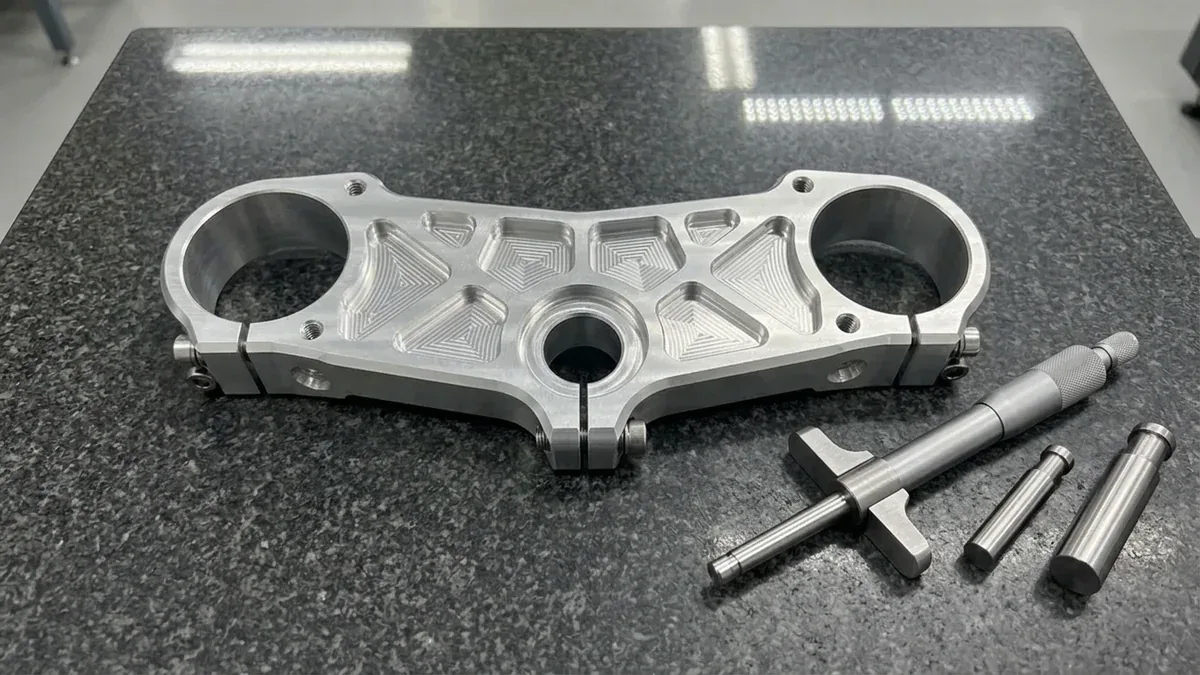
Motorcycles represent the purest blend of mechanical precision, aesthetic expression, and raw engineering performance. Unlike passenger cars where intricate internal mechanics are shielded behind heavy sheet metal, a motorcycle leaves its skeleton, heart, and running gear completely exposed to the world. For performance racers, custom bike builders, and restoration specialists alike, off-the-shelf cast components often impose painful compromises on strength, weight, and visual distinction.
This is where custom CNC motorcycle parts have revolutionized the two-wheeled industry. Leveraging multi-axis CNC milling, high-speed CNC turning, and precision simultaneous 5-axis machining, custom machining empowers builders to eliminate excess unsprung mass, optimize critical engine tolerances, and achieve bespoke geometry that stock mass production simply cannot offer.
Executive Summary & Engineering Takeaways (BLUF)
- Core Focus & DFM Scope: Actionable shop-floor engineering guidelines for custom cnc motorcycle parts, covering material selection, geometric tolerancing, and defect prevention.
- Achievable Tolerance Envelope: General features hold ISO 2768-mK; critical bearing bores, dowel pins, and mating datums hold ±0.010 to ±0.020 mm (±0.0004″ to ±0.0008″), with Wire EDM/grinding to ±0.005 mm (±0.0002″).
- Machining & Surface Integrity: High-speed 3-axis and 4-axis VMCs (with simultaneous 5-axis for complex contours) delivering as-machined Ra 0.8 µm (32 µin) to Ra 0.4 µm (16 µin) per ASME B46.1.
- Metrology & Process Control: On-machine spindle probing paired with 20°C (68°F) climate-controlled Zeiss CMM coordinate verification and calibrated Go/No-Go plug/ring gauges.
- Ex-Factory Turnaround: 4 to 8 business days for as-machined rapid prototypes; 7 to 12 business days for anodized, plated, or multi-operation production runs (excluding 3–5 days air transit).
Article Engineering Navigation
1. Why Precision CNC Machining is Indispensable for Modern Motorcycles
Stock original equipment manufacturer (OEM) motorcycle components are predominantly manufactured using high-pressure die casting or injection molding. While cost-effective for mass production in tens of thousands of units, cast components suffer from inherent metallurgical limitations: internal microporosity, structural brittleness, and thicker wall requirements to compensate for strength deficiencies.
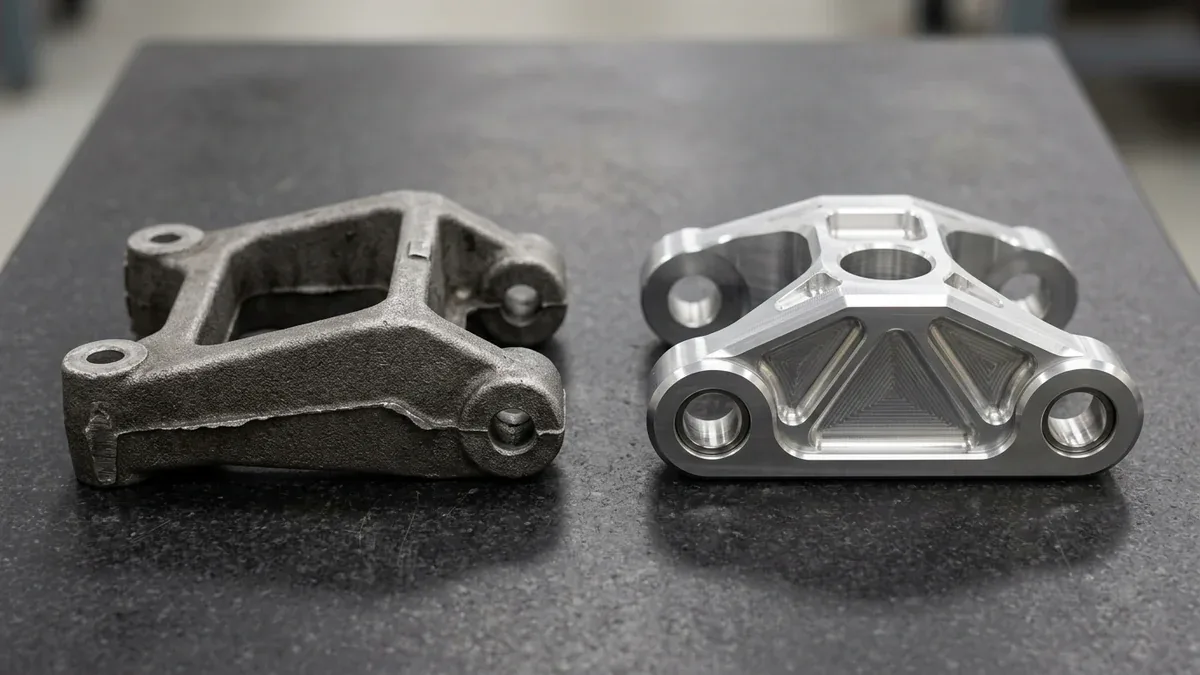
In contrast, CNC machined billet parts offer distinct engineering advantages:
- Superior Strength-to-Weight Ratio: Milled from dense, wrought billets of aircraft-grade 6061-T6 or 7075-T6 aluminum, billet parts eliminate void porosity, yielding fatigue resistance up to 40% higher than cast counterparts.
- Extreme Dimensional Tolerances: Modern 4-axis and 5-axis CNC machines maintain repeatable tolerances within ±0.01 mm (±0.0004 in), ensuring airtight engine seals, vibration-free wheel rotation, and frictionless suspension movement.
- Unmatched Geometry Freedom: Complex internal fluid channels, weight-saving honeycomb pockets, and sculpted ergonomic contours can be carved directly from 3D CAD models without tooling or mold constraints.
- Rapid Prototyping & Low-Volume Flexibility: Whether you require a single one-off custom bracket for a custom cafe racer build or a 500-unit production batch for a boutique EV motorcycle brand, CNC machining delivers rapid turnaround without expensive tooling lead times.
2. Core Motorcycle Components Prime for Custom CNC Fabrication
1. Structural Triple Clamps & Steering Stems
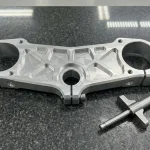
The front-end triple clamp (or triple tree) governs steering responsiveness, front fork alignment, and high-speed stability. Factory cast clamps are notoriously bulky and prone to flex under hard track braking. Custom 3/4-axis and 5-axis CNC machined triple trees carved from Billet 7075-T651 aluminum significantly increase torsional rigidity while trimming unsprung weight, providing riders with sharper cornering feedback and precise front-end tracking.
2. Ergonomics: Custom Rearsets, Footpegs & Levers
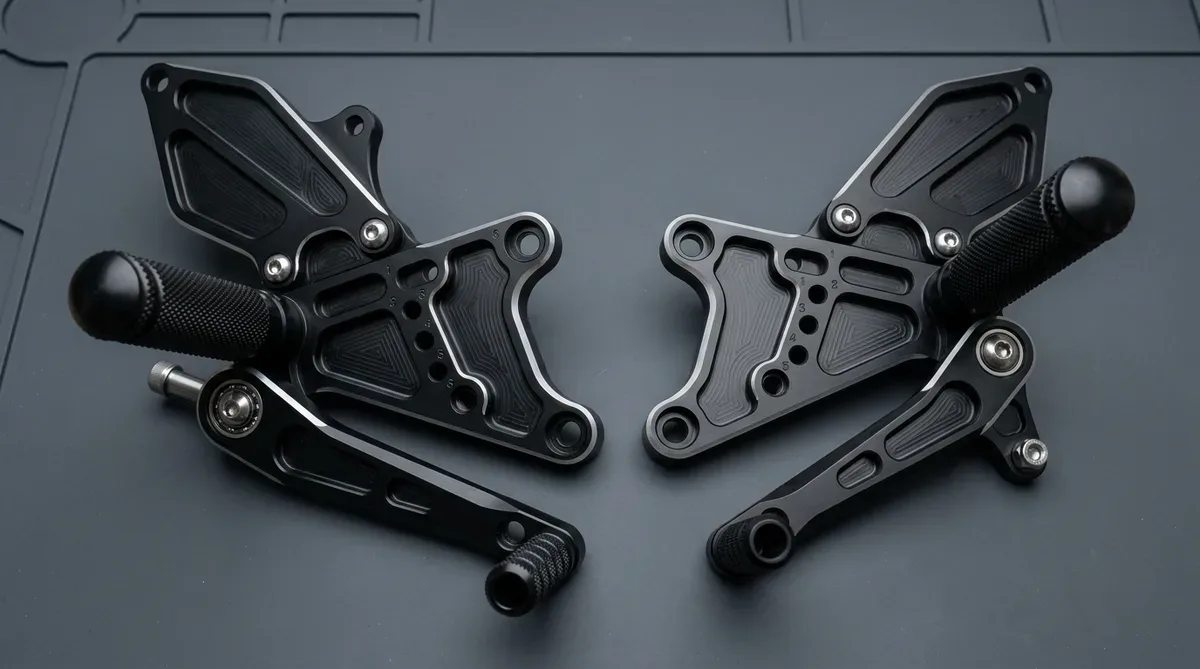
Every rider’s ergonomics and inseam geometry are unique. Factory footpegs are fixed in position and cast from brittle alloys that break on minor tip-overs. Custom CNC adjustable rearsets, clip-on handlebar clamps, and folding brake/clutch levers machined from 6061-T6 aluminum allow full adjustment of peg height, setback angle, and lever reach, significantly reducing rider fatigue on endurance journeys or competitive track days.
3. Engine Performance Tuning & Billet Clutch Covers
Engine performance optimization—whether for superbike circuit racing, motocross, or vintage cafe tuning—hinges upon maximizing volumetric efficiency, heat dissipation, and valvetrain synchronization:
- Billet Clutch & Stator Covers: Machined from solid 6061-T6 aluminum blocks, billet engine cases provide reinforced impact resistance against crash damage while offering integrated cooling fins and precision O-ring gasket channels.
- High-Compression Pistons: Forged and CNC turned from high-silicon aluminum alloys (e.g., 2618 or 4032), custom CNC pistons feature precision valve reliefs and skirt profiles that endure elevated thermal loads and RPM limits without scouring cylinder walls.
- Custom Camshafts: Precision CNC turned and finish-ground with total radial runout within 0.005 mm, custom-profiled camshafts alter valve lift and duration, optimizing the intake fuel-air charge for specialized torque curves.
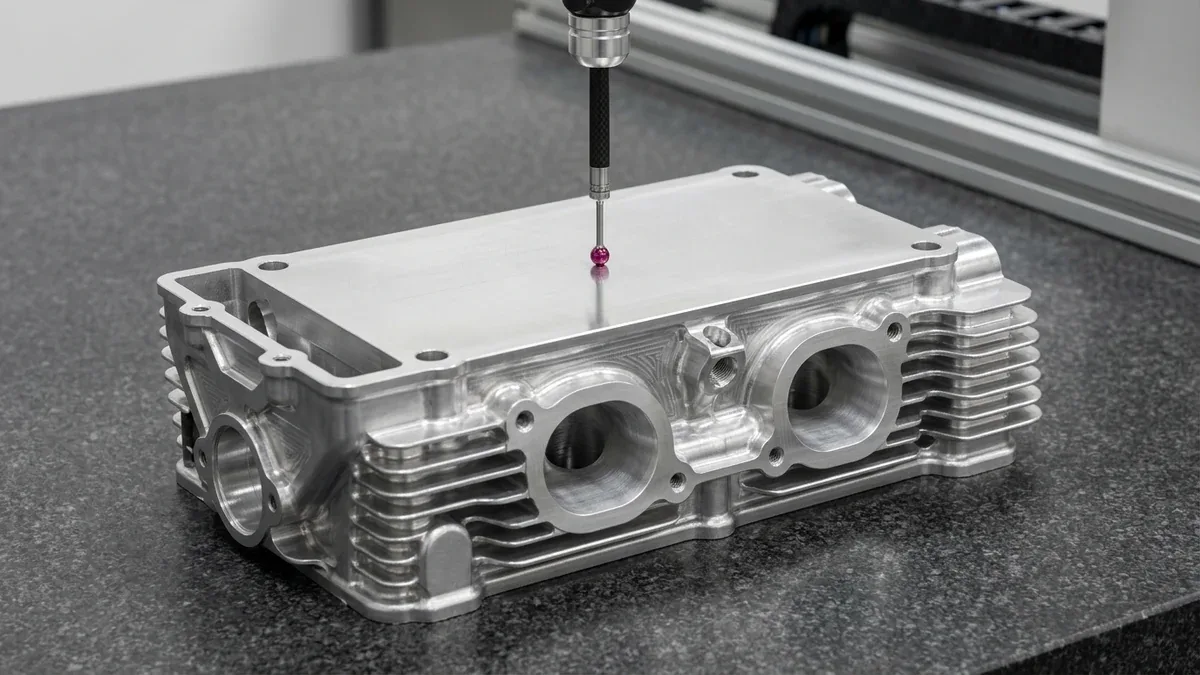
- Cylinder Heads & Intake Manifolds: 5-axis CNC porting cleans and reprofiles internal intake and exhaust runners to eliminate turbulent boundary layers, noticeably boosting airflow and horsepower output.
4. Custom Billet Swingarms & Suspension Linkages
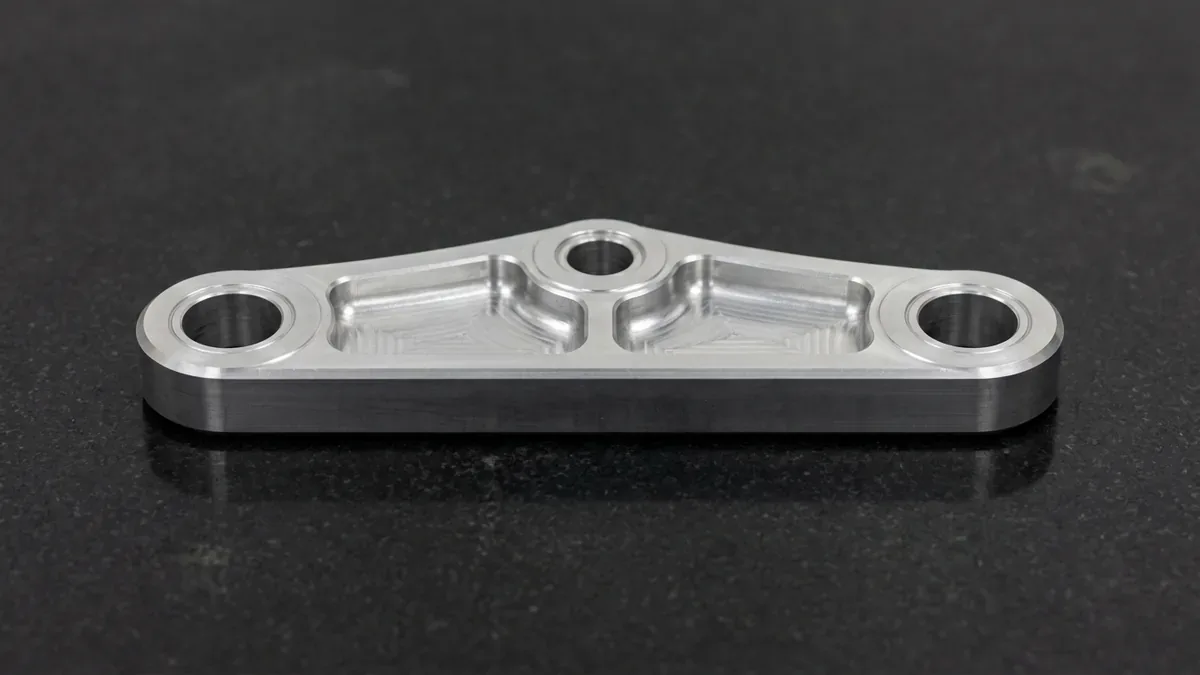
In high-performance superbikes and custom builds, the rear swingarm must endure tremendous chain drive tension, side-to-side torsional twist under cornering, and rapid vertical articulation. CNC machining allows the fabrication of monolithic or multi-piece welded billet swingarms featuring integrated chain adjuster tracks, hollow internal pocketing, and needle bearing bores machined to drawing-specified tolerances for bind-free suspension stroke.
5. Lightweight Custom Wheel Hubs, Sprockets & Titanium Axles
Rotating unsprung mass has an exponential impact on acceleration, braking distances, and gyro-stabilization during rapid lean transitions. Custom CNC machined wheel hubs and one-piece billet wheel rims allow dramatic weight savings compared to OEM cast wheels, delivering immediate throttle response improvements and sharper handling through corners.
At AS Prototypes, custom wheel hubs, sprocket carriers, and hollow Grade 5 titanium (Ti-6Al-4V) wheel axles are multi-axis turned and milled from solid aerospace-grade forgings, precision-balanced to eliminate dynamic runout at sustained highway and circuit speeds.
6. Bespoke Optical Lighting & Protective Covers
Modern custom builds demand futuristic lighting solutions. High-precision CNC milling produces polished optical-grade polycarbonate (PC) lenses and custom aluminum LED heatsink housings with integrated cooling fins, combining modern nighttime illumination with sleek minimalist design.
3. Motorcycle Component CNC Machining & Material Selection Guide
Selecting the optimal engineering material is vital to balancing weight reduction, yield strength, thermal stability, and manufacturing cost:
| Component | Recommended Material | CNC Machining Process | Key Engineering Benefits |
|---|---|---|---|
| Triple Clamps & Fork Trees | Aluminum 7075-T6 | 3/4-Axis CNC Milling (5-Axis for Sculpted Contours) | Ultimate tensile strength (~570 MPa), maximum torsional stiffness |
| Engine Cases & Clutch Covers | Aluminum 6061-T6 | 3/4-Axis CNC Milling | Excellent corrosion resistance, lightweight, superb anodizing finish |
| Wheel Hubs & Axles | Ti-6Al-4V (Grade 5 Titanium) / 7075-T6 | CNC Turning & Milling | 45% lighter than steel, immune to rust, high shock absorption |
| Rearset Brackets & Controls | Aluminum 6061-T6 / 7075-T6 | 3/4-Axis CNC Milling | High fatigue endurance, diamond knurling grip, multi-hole ergonomic positioning |
| Billet Swingarms & Linkages | Aluminum 6061-T6 / 7075-T6 | 3/4-Axis & 5-Axis CNC Milling | Torsional rigidity under hard acceleration, precision bearing journals |
| Frame Sliders & Spools | Delrin / POM (Polyoxymethylene) | CNC Turning | Low friction coefficient, superior impact dissipation, road wear resistance |
| Headlight Lens & Housings | Optical Polycarbonate (PC) & AL6061 | 3/4-Axis Milling & Vapor Polishing (with 60°C–80°C post-annealing) | High impact resistance, glass-like optical clarity, efficient heat sinking |
4. Surface Finishing Options for Custom CNC Motorcycle Parts
Because motorcycle components face harsh environmental conditions—including road grit, UV radiation, chain lubricants, and engine heat—the post-machining surface treatment is critical:
- Type II & Type III (Hardcoat) Anodizing: Imparts a durable oxide layer up to 50 microns thick, providing superior scratch resistance, weatherproofing, and a vibrant aesthetic palette (matte black, gold, titanium gray, racing red).
- Bead Blasting: Creates an ultra-uniform, satin-matte texture that conceals tool marks and resists road dust accumulation.
- Mirror Polishing: Delivers a dazzling chrome-like sheen ideal for classic custom cruisers, cafe racers, and exposed show-bike engine covers.
- ASTM A967 Passivation & Electroless Nickel Plating (ENP): Passivation removes free surface iron on stainless steel fasteners and spacers with zero dimensional build-up, while ENP (5–25 µm uniform build-up) protects alloy steel and brass components against road salt and moisture.
Whether you are designing a one-off performance upgrade, developing a custom scrambler build, or seeking a dependable low-volume manufacturing partner for aftermarket motorcycle accessories:
- Tight Tolerances: Precision machining down to ±0.01 mm for critical engine and suspension fits.
- Broad Material Inventory: In-stock aerospace-grade aluminum (6061, 7075, 2024), titanium, stainless steel, and engineering polymers.
- Fast Turnaround: Ex-factory turnaround in 4 to 8 business days for as-machined prototypes (7 to 12 business days with anodizing or plating).
- Free DFM Engineering Review: Detailed design-for-manufacturability feedback to optimize parts for weight, strength, and machining efficiency.
🔗 Related CNC DFM & Metrology Engineering Guides:
To further optimize cycle time and dimensional stability in custom CNC motorcycle parts, combine proper internal corner relief with datum-based coordinate inspection. Consult our shop-floor engineering guides on Maintaining Dimensional Stability in Thin-Wall Machining, Eliminating Sharp Internal Corners & Tool Deflection, and Precision CMM Metrology & GD&T Verification.
5. Technical Engineering FAQ
7075-T6 delivers exceptional tensile yield strength (503 MPa) compared to cast aluminum (180–240 MPa), providing uncompromising torsional rigidity under extreme front-fork braking loads while reducing unsprung mass.
Critical bearing seats and axle journals are precision machined to drawing tolerances of ±0.010 mm on high-speed 3/4-axis VMCs, CNC turning centers, and cylindrical grinders to eliminate wheel wobble and high-speed bearing chatter.
At AS Prototypes, DFM reviews and confidential quotes are provided within 24 hours. As-machined prototype batches achieve an ex-factory turnaround of 4 to 8 business days (excluding 3–5 days air freight), with MIL-A-8625 Type II/III anodizing completed in 7 to 12 business days.
Partner with Our Precision CNC Machining & Engineering Team
Eliminate tool deflection, residual stress distortion, and tolerance stack-up risks before production begins. Upload your 3D CAD files (STEP/IGES) and 2D GD&T drawings for a comprehensive shop-floor DFM review and custom quotation.
Upload 3D CAD for Engineering DFM & RFQ