SLS 3D Printing Services: Custom PA12 & PA11 Nylon Parts
Selective Laser Sintering (SLS) Working Principle
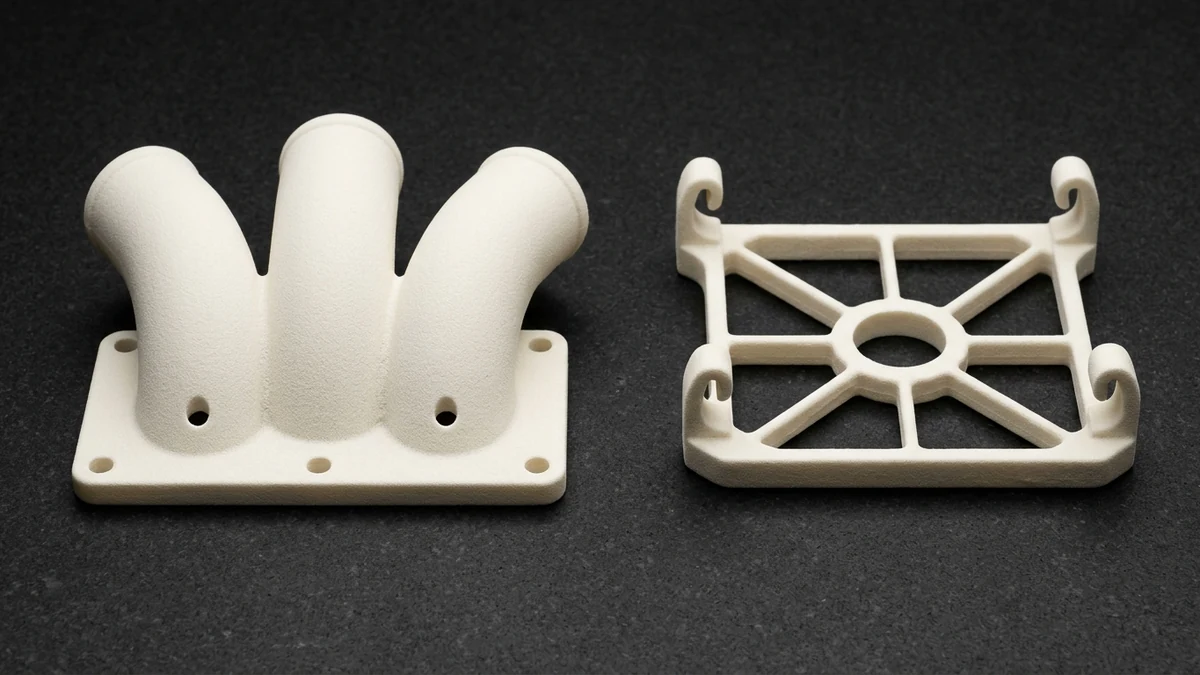
Selective Laser Sintering builds functional parts inside a nitrogen-inerted chamber heated just below the polymer melting point, recoating 80–120 µm (0.003–0.005 in) powder layers for CO₂ laser fusion. Surrounding cake supports hollow multi-branch flanged manifolds with base drainage ports and diagonal-ribbed carrier brackets with corner snap-fit hooks (shown alongside).
- Zero Support Structures: The surrounding powder cake acts as continuous natural support, allowing complete design freedom for internal channels, deep undercuts, and nested interlocking assemblies.
- Near-Homogeneous Mechanical Performance (80%–90% Z-Axis Tensile Retention): Inter-layer polymer chain diffusion delivers dense, impact-resistant thermoplastic parts (42 MPa Z vs. 48 MPa XY in PA12).
- High-Density 3D Batch Nesting: Multiple parts stack throughout our 400 × 400 × 450 mm build volume in a single thermal cycle, eliminating dedicated mold tooling.
SLS Engineering Thermoplastics & Material Specifications
All selective laser sintering builds utilize controlled powder refresh ratios (typically 30%–50% virgin polyamide blended with thermally stabilized recycle) inside nitrogen-inerted chambers to guarantee repeatable tensile modulus, elongation, and surface consistency across production batches:
| Material Designation | Tensile Strength (XY / Z) | Tensile Modulus | Elongation at Break | Thermal Rating / HDT @ 0.45 MPa (1.82 MPa) | Standard As-Printed Tolerance | Primary Engineering Applications |
|---|---|---|---|---|---|---|
| Nylon PA 12 (Standard Polyamide 12) | 48 / 42 MPa (7.0 / 6.1 ksi) | 1,650 MPa (239 ksi) | 18% (XY) / 10% (Z) | 157°C / 315°F (64°C / 147°F) | ±0.20 mm (or ±0.20% >100 mm) | Functional housings, snap-fit enclosures, complex air ducts, structural brackets, print-in-place hinges |
| Nylon PA 11 (Bio-Based High Ductility) | 52 / 45 MPa (7.5 / 6.5 ksi) | 1,550 MPa (225 ksi) | 35% – 45% (XY) / 25% (Z) | 180°C / 356°F (70°C / 158°F) | ±0.20 mm (or ±0.20% >100 mm) | Integral living hinges, high-impact clips, automotive interior crash-resistant brackets, orthotic braces |
| PA 12-GF (30% Glass-Bead Filled) | 51 / 44 MPa (7.4 / 6.4 ksi) | 3,200 MPa (464 ksi) | 8% – 10% (XY) / 5% – 7% (Z) | 166°C / 331°F (96°C / 205°F) | ±0.25 mm (or ±0.25% >100 mm) | High-stiffness structural mounts, thermally loaded engine-bay brackets, pump impellers, wind-tunnel models |
| Flame-Retardant PA 12 (UL 94 V-0 / FAR 25.853) | 46 / 39 MPa (6.7 / 5.7 ksi) | 1,950 MPa (283 ksi) | 8% – 12% (XY) / 5% – 8% (Z) | 162°C / 324°F (68°C / 154°F) | ±0.25 mm (or ±0.25% >100 mm) | Halogen-free self-extinguishing avionics housings, UAV cabin environmental ducts, rail electrical switchgear covers |
| Thermoplastic Polyurethane (TPU, Shore 88A – 92A) | 22 / 18 MPa (3.2 / 2.6 ksi) | 75 – 95 MPa (11 – 14 ksi) | >250% (Rubber-Like) | Vicat ~110°C / 230°F | ±0.30 mm (or ±0.30% >100 mm) | Convoluted dust-boot bellows, vibration isolators, flexible pneumatic seals, non-marring robotic gripper pads |
| CastForm Polystyrene (Sacrificial Foundry) | 2.8 MPa (0.41 ksi, Wax-Infiltrated) | 1,600 MPa (232 ksi, Infiltrated) | ≤ 2% (<0.02% Burnout Ash) | Tg ~90°C / 194°F (650–1,000°C Burnout) | ±0.30 mm (or ±0.30% >100 mm) | Direct investment-casting sacrificial patterns for complex steel, titanium, and aluminum foundry impellers |
SLS vs. HP MJF vs. SLA vs. Injection Molding: Process Selection Matrix
Choosing between powder-bed fusion (SLS and HP Multi Jet Fusion), vat photopolymerization (SLA vs. SLS comparison), and rapid injection molding depends on part geometry, surface finish, and batch volume:
| Evaluation Criterion | SLS (Selective Laser Sintering) | HP MJF (Multi Jet Fusion) | SLA (Stereolithography Resin) | Rapid Injection Molding |
|---|---|---|---|---|
| Support Structures | Zero Required (Self-Supporting Powder Cake) | Zero Required (Self-Supporting Powder Cake) | Mandatory Sacrificial Lattice Supports | Draft Angles (0.5°–2.0°) & Parting Lines Required |
| Native Part Color & Finish | Natural Sugar-White Matte (Ra 6.0–10.0 µm); Easily Dyed Any Color | Mottled Charcoal-Gray (Ra 3.5–5.0 µm); Best Dyed Jet Black | Smooth Satin / Optical Clear (Ra 0.8–1.6 µm) | Custom Molded-In Color / SPI A-1 to D-3 |
| Max Single-Piece Build Size | 400 × 400 × 450 mm (15.7 × 15.7 × 17.7 in) | 380 × 284 × 380 mm (15.0 × 11.2 × 15.0 in) | 800 × 800 × 550 mm (31.5 × 31.5 × 21.7 in) | 50T–850T Press Envelope (15 g – 2,800 g Shot) |
| Mechanical Durability & UV Aging | True Semi-Crystalline Polyamide; Long-Term End-Use Stability | Near-Isotropic Polyamide; High Z-Axis Tensile Retention | Thermoset Photopolymer; More Brittle Under Long-Term UV/Creep | 100% Isotropic Virgin Engineering Thermoplastics |
| Economic Sweet Spot & Lead Time | 1 – 250 pcs (4 – 8 Business Days Ex-Factory) | 10 – 1,000+ pcs (4 – 8 Business Days Ex-Factory) | 1 – 50 pcs (4 – 8 Business Days Ex-Factory) | 200 – 100,000+ pcs (12 – 35 Business Days Ex-Factory incl. T1) |
Mechanical Performance & Advanced Post-Processing
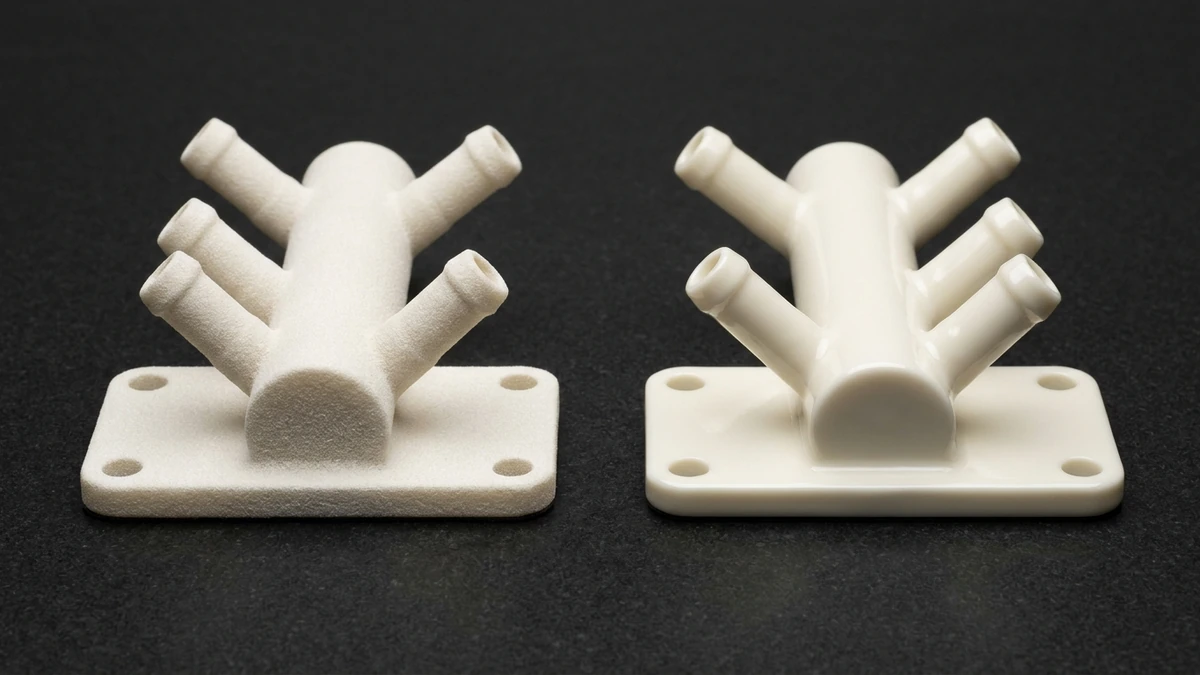
Standard media-blasted SLS polyamide exhibits a matte, granular sugar-like texture at Ra 6.0–10.0 µm (236–394 µin). As demonstrated on the six-port barbed PA12 fluidic manifolds alongside, our in-house post-processing seals open surface porosity into smooth, washable, fluid-tight production hardware:
- Automated Chemical Vapor Smoothing: Closed-loop solvent-vapor reflow (600 × 400 × 400 mm chamber) seals surface micro-porosity across walls and hose barbs, reducing roughness to Ra 1.0–2.0 µm (39–79 µin).
- Vibro-Tumbling & Media Blasting: Ceramic media rotary tumbling removes residual unsintered powder and smooths outer peaks to Ra 3.5–5.0 µm (138–197 µin) for clean tactile handling.
- Deep-Bath Immersion Dyeing: Pressurized hot-bath dyeing penetrates 0.3–0.5 mm (0.012–0.020 in) below the nylon surface, resisting scratching and flaking unlike superficial spray coats.
- Process & Dimensional Quality Control: Controlled 30%–50% virgin powder refresh ratios paired with non-contact 2.5D Optical Vision Measuring System (VMS) inspection, ISO 4287 roughness verification, and ASTM D2240 Shore hardness testing.
Target Industry Solutions & High-Performance Applications
Design for Additive Manufacturing (DfAM): 8-Point SLS CAD Rules
Designing specifically for selective laser sintering thermal dynamics prevents differential shrinkage warpage, guarantees complete powder evacuation from internal passages, and enables support-free moving assemblies:
| Geometric Feature | Minimum Recommended Threshold | Preferred Production Target | Shop-Floor Engineering Rationale & DFM Mitigation |
|---|---|---|---|
| 1. Supported Structural Walls | ≥ 0.80 mm (0.031 in) | 1.50 – 2.50 mm (0.059 – 0.098 in) | Walls thinner than 0.8 mm risk incomplete laser scan fill or deflection during depowdering (use ≥ 1.5 mm for rigid PA12-GF). |
| 2. Freestanding Tall Walls & Ribs | ≥ 1.20 mm (0.047 in) | 1.80 – 3.00 mm (0.071 – 0.118 in) | Keep rib height-to-thickness aspect ratio ≤ 8:1 and add 0.5 mm root fillets to prevent buckling during recoater roller passes. |
| 3. Maximum Solid Cross-Section | ≤ 5.0 mm (0.197 in) Solid Bosses | Core Out to 2.0 – 3.0 mm Shell | Thick solid nylon blocks accumulate excessive laser heat (“thermal mass sink”), causing surface concavity and dimensional shrinkage distortion. |
| 4. Powder Escape Drain Ports | ≥ 2 Holes × Ø3.5 mm (0.138 in) | ≥ 2 Holes × Ø5.0 mm (0.197 in) | Place drain holes at opposite ends of enclosed cavities or curved manifolds so compressed air and suction lances can evacuate unsintered cake. |
| 5. Print-in-Place Moving Joints | ≥ 0.50 mm (0.020 in) Radial Gap | 0.60 – 0.80 mm (0.024 – 0.031 in) | Radiant heat around the melt pool partially sinters adjacent powder (“thermal bleed”) if articulating hinges or ball joints have gaps under 0.45 mm. |
| 6. Mating Assembly & Slip-Fit Clearance | ≥ 0.25 mm (0.010 in) per Side | 0.30 – 0.40 mm (0.012 – 0.016 in) per Side | Accounts for granular roughness (Ra 6.0–10.0 µm) and ±0.20 mm dimensional tolerance; add +0.10 mm per side if vapor smoothing is specified. |
| 7. Integral Living Hinges (PA 11 Preferred) | 0.40 – 0.60 mm (0.016 – 0.024 in) Web | L ≥ 3.0 mm Length, R ≥ 1.0 mm Fillet | Specify bio-based PA 11 (35%–45% elongation) rather than brittle PA 12-GF for living hinges requiring repeated 180° flex cycles. |
| 8. Large Planar Panels (>150 mm Span) | Add Cross-Hatch Stiffening Ribs | 2.5 mm Wall + 2.0 mm Grid Ribs | Large flat unribbed plates are prone to differential thermal curling during powder cake cool-down; diagonal ribs or honeycomb cutouts lock flatness. |
4-Level SLS Surface Finishing Grades & In-House Optical Metrology
Specify your required surface finishing tier directly on 2D drawings or Request for Quotation (RFQ) notes. All turnaround windows below represent ex-factory production and final inspection completion, strictly separate from 3–5 business days DHL, FedEx, or UPS international air transit.
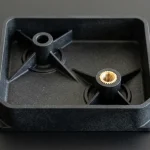
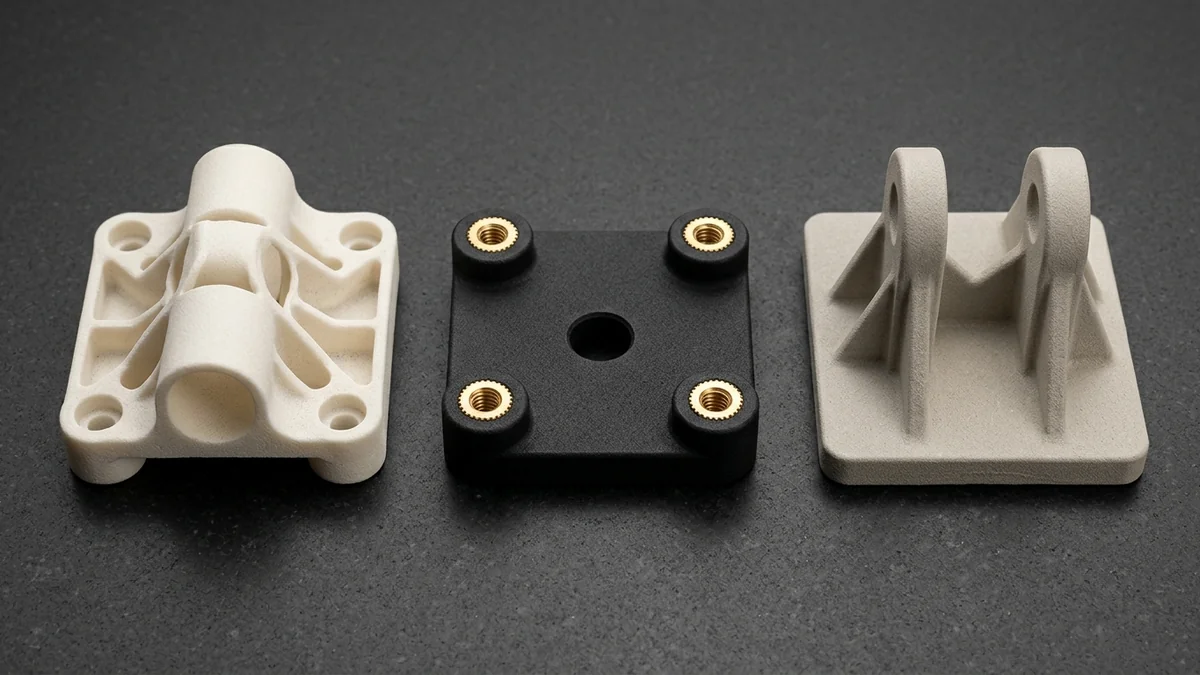
Because flexible polyamides can deflect under high-force tactile styluses, our quality lab inspects natural PA12 ribbed cable carriers, immersion-dyed matte-black PA12 plates with flush heat-set knurled brass inserts, and gusseted PA12-GF clevis brackets (shown alongside) using non-contact 2.5D Optical VMS, calibrated Go/No-Go pin gauges, and mating fit-up fixtures.
| RFQ Finishing Code | Post-Processing Workflow | Typical Surface Roughness (Ra) | Fluid / Gas Permeability | Ex-Factory Turnaround & Best Application |
|---|---|---|---|---|
| Level 1: Standard Media-Blasted | Automated unpacking + glass-bead & compressed-air depowdering (natural sugar-white matte) | Ra 6.0 – 10.0 µm (236 – 394 µin) | Slightly Micro-Porous | 4–8 Business Days Ex-Factory · Internal brackets, ducts & structural jigs |
| Level 2: Vibro-Tumbled Smooth Matte | Ceramic media rotary vibratory tumbling to knock down sintered surface peaks and soften edges | Ra 3.5 – 5.0 µm (138 – 197 µin) | Reduced Surface Porosity | 7–10 Business Days Ex-Factory · Handheld enclosures, wear-resistant cable carriers |
| Level 3: Deep-Bath Immersion Dyed | Pressurized hot-bath acid dyeing (0.3–0.5 mm subsurface penetration in Matte Black or custom colors) + satin sealer | Ra 3.5 – 6.0 µm (138 – 236 µin) | Splash-Resistant | 7–12 Business Days Ex-Factory · Customer-facing electronics housings & UAV hardware |
| Level 4: Chemical Vapor Smoothed | Automated solvent-vapor surface reflow (natural white or dyed black) sealing open surface pores | Ra 1.0 – 2.0 µm (39 – 79 µin) | Airtight & Watertight (Washable) | 7–12 Business Days Ex-Factory · Fluid manifolds, coolant reservoirs, skin-contact wearables |
Frequently Asked Questions (FAQ)
How does SLS compare to SLA and FDM 3D printing?
Why does SLS 3D printing not require support structures?
Are SLS nylon parts strong enough for end-use production applications?
Can SLS nylon parts be sealed to make them airtight or watertight?
Ready to Print Functional Prototypes & Production Runs with SLS?
Upload your 3D CAD models (STEP, IGES, STL) and 2D tolerance drawings for a comprehensive DfAM build-orientation review, powder-drainage check, and custom SLS production quotation within 24 hours.