Executive Summary & Engineering Takeaways (BLUF)
Polyurethane vacuum casting (also termed urethane molding or silicone tooling) is the definitive bridge manufacturing process for producing 10 to 100 high-fidelity, production-grade polymer components. By combining high-resolution master patterns (SLA or CNC machined) with room-temperature vulcanizing (RTV-2) platinum silicone molds, vacuum casting replicates the intricate details, surface textures, and physical properties of mass-production injection molded thermoplastics without the prohibitive tooling investment and 4 to 8 week steel lead times.
- Resin Simulation Spectrum: Formulated thermoset polyurethanes closely emulate ABS (high impact), Polypropylene/HDPE (living hinges), Polycarbonate/PMMA (optical clarity >88%), high-temperature resins (HDT up to 150°C, UL94 V-0 flame retardant), and elastomeric urethanes (Shore 30A to 90A).
- Dimensional Accuracy & Tolerances: Typically holds ±0.15 mm for linear dimensions up to 100 mm, and ±0.20% for larger dimensions. Critical bearing journals can be secondary CNC finished to ±0.020 mm.
- Unmatched Geometric Freedom: Silicone’s high elongation at break (>300%) accommodates negative undercuts, zero draft angles, complex snap-fit lugs, pre-encapsulated threaded brass inserts, and dual-durometer overmolding.
- Tooling Lifespan & Turnaround: Sacrificial silicone molds yield 15 to 25 shots before chemical isocyanate degradation; functional prototypes deliver in 4 to 8 business days, with low-volume production batches (50 to 100+ parts) completed in 7 to 15 business days.
Engineering Guide Contents
- 1. The Physics and Thermodynamics of Vacuum Degassing & Gravity Flow
- 2. Polyurethane Resin Chemistry & Production Thermoplastic Simulation
- 3. RTV-2 Silicone Tooling Architecture: Master Patterns to Multi-Part Molds
- 4. Advanced DFM Guidelines: Undercuts, Inserts & Dual-Durometer Overmolding
- 5. Silicone Tool Life Degradation Mechanics & Production Volume Crossover
- 6. Dimensional Inspection, CMM Metrology & Surface Finishing
- 7. Engineering FAQ: Polyurethane Vacuum Casting
1. The Physics and Thermodynamics of Vacuum Degassing & Gravity Flow
Polyurethane vacuum casting operates on the fundamental physical principles of vacuum degassing, chemical fluid dynamics, and controlled differential pressure. In conventional atmospheric casting, mixing reactive thermoset components inevitably traps ambient air, forming microscopic bubbles that cause catastrophic structural voids, dielectric breakdown, and unsightly cosmetic pits. Vacuum casting largely eliminates this porosity by conducting both the degassing and pouring phases inside a sealed chamber evacuated to an ultra-deep vacuum of 0.5 to 2.0 mbar (50 to 200 Pa).
According to Boyle’s Ideal Gas Law (P1 V1 = P2 V2), as ambient pressure decreases from atmospheric levels (1,013 mbar) down to 2 mbar, entrained micro-air bubbles expand by a volumetric factor of over 500 times. This massive expansion forces the bubbles to overcome liquid viscous drag, rapidly rise to the resin surface, and rupture. Dynamic vacuum degassing is applied to both Part A (polyol blend with chain extenders and catalysts) and Part B (diisocyanate prepolymer) prior to metering and blending.
The chemical reaction driving polyurethane formation is a step-growth polyaddition between an aromatic or aliphatic diisocyanate (such as diphenylmethane diisocyanate, MDI) and a hydroxyl-terminated polyol: R-N=C=O + R’-OH → R-NH-COO-R’ The stoichiometric isocyanate index (INCO) is tightly regulated between 1.00 and 1.05 to ensure complete conversion of reactive groups without residual moisture sensitivity. Once blended via an automated mechanical impeller inside the chamber, the liquid resin exhibits an initial low viscosity between 200 and 1,500 mPa·s, enabling it to penetrate fine intricate ribs, texturing grains, and zero-draft undercuts.
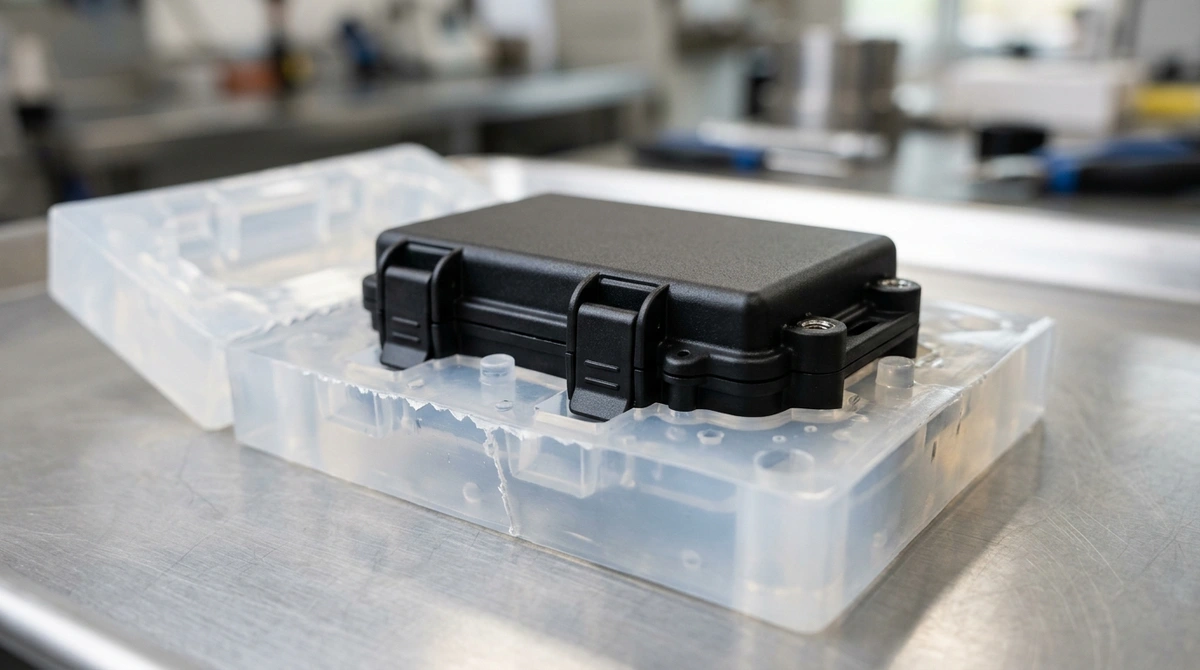
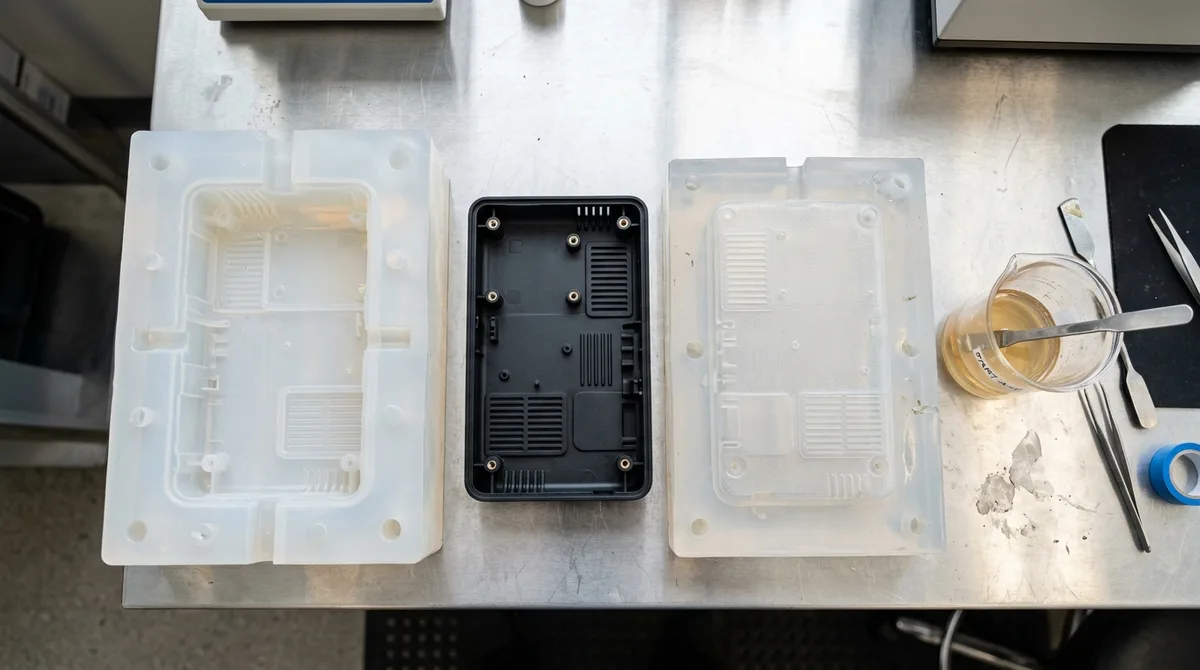
The two-part translucent RTV-2 platinum silicone mold resting flat on a workbench reveals the precision cavity and core architecture engineered for vacuum casting. Next to the mold halves, a freshly demolded polyurethane instrument enclosure illustrates complete flow replication across internal ribs, ventilation grilles, and mounting bosses, alongside laboratory-grade resin mixing and vacuum degassing preparations.
Because the silicone mold is positioned beneath the mixing cup inside the same vacuum chamber, pouring occurs under pure gravity differential. Once the cavity is completely filled, controlled atmospheric air is bled back into the upper chamber. This controlled pressure differential applies a uniform compressive hydrostatic force onto the sprue and risers, driving the liquid polyurethane into the deepest sub-millimeter cavity features before the resin reaches its gel point (typically 3 to 8 minutes at 25°C to 40°C).
Following filling, the silicone tool is transferred into a precision thermal convection oven maintained at 60°C to 70°C for 45 to 90 minutes. This controlled heating accelerates the exothermic cross-linking reaction, completing initial demold cure. For components requiring maximum mechanical rigidity, thermal resistance, or dielectric strength, a secondary post-cure cycle of 2 to 4 hours at 80°C to 100°C is executed to fully mature the secondary cross-linked polymer network and achieve peak glass transition temperature (Tg).
2. Polyurethane Resin Chemistry & Production Thermoplastic Simulation
The primary technical reason hardware engineering teams specify polyurethane vacuum casting is the extensive selection of specialized formulated thermoset resins. Unlike standard 3D printing filaments or photopolymers that often suffer from brittleness, anisotropy, or UV degradation, advanced polyurethane casting resins (such as Axson/Sika, Hei-Cast, and Smooth-On) are chemically formulated to match the exact stress-strain curves, impact resistance, and heat deflection temperatures of mass-production injection molding thermoplastics.
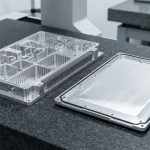
Cast thermoset specimens resting flat on an ESD tray demonstrate engineering material simulation across multiple polymer classes. The high-density formulation balances tensile yield strength and flexural modulus to emulate production-grade polymers ranging from optical PC and PMMA down to flexible Shore A elastomeric rubbers.
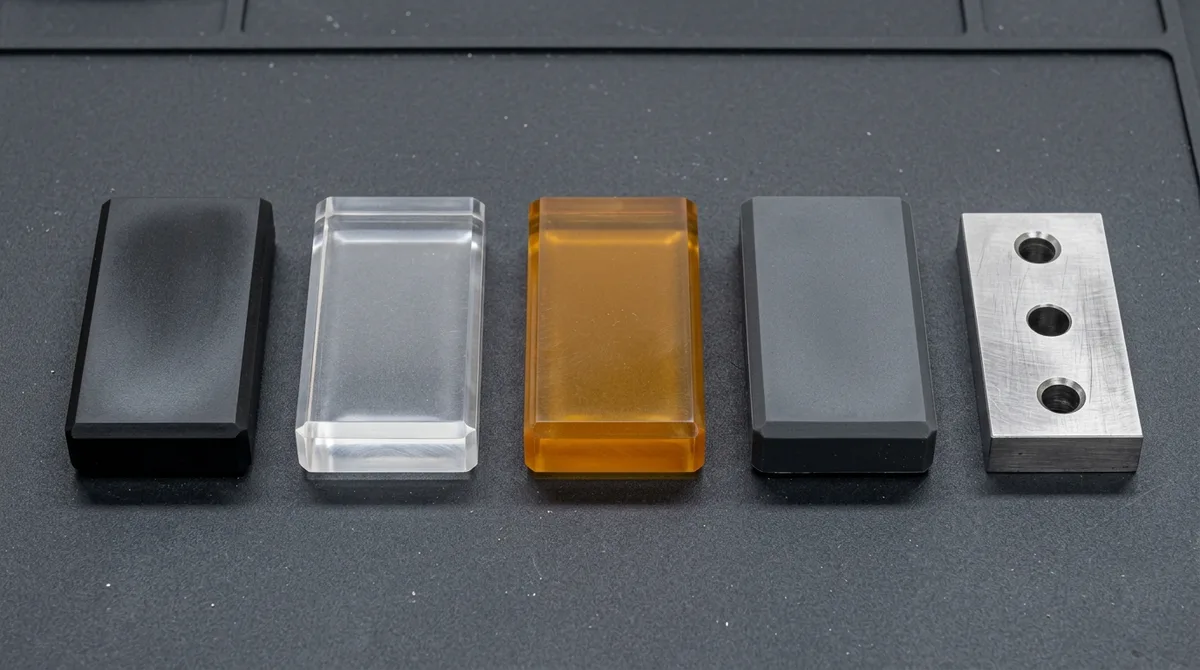
Polyurethane resins can be classified into five distinct performance groups based on their molecular backbone and simulated production polymers:
- ABS-Like Resins (e.g., Axson PX 223 / Hei-Cast 8150): Formulated with stiff aromatic isocyanates and polyether polyols to deliver tensile strengths of 65 to 72 MPa, a flexural modulus exceeding 2,000 MPa, and notched Izod impact strength of 25 to 35 kJ/m². They are the gold standard for handheld electronic enclosures, computing chassis, snap-fit bezels, and medical diagnostic consoles.
- Polypropylene (PP) & HDPE-Like Resins (e.g., Hei-Cast 8400 / Axson PX 2017): Engineered with flexible aliphatic chains that provide elongations at break of 35% to 50% combined with exceptional flexural fatigue resistance. These resins simulate the ductile yield behavior of polypropylene, making them ideal for functional living hinges, snap buckles, fluid reservoirs, and automotive trim clips.
- Water-Clear Optical Resins (e.g., Axson PX 521 / Hei-Cast 8260): Synthesized using high-purity aliphatic diisocyanates (such as H12MDI) to provide complete UV stability without yellowing. These resins achieve over 88% visible light transmission, an Abbe number of 56, and a refractive index of nd ≈ 1.51, matching optical-grade Polycarbonate (PC) and PMMA (acrylic) for light pipes, headlamp lenses, and medical flow cells.
- High-Temperature & Flame-Retardant Resins (e.g., Axson PX 245 / Sika Biresin): Formulated with highly cross-linked polyfunctional prepolymers that exhibit Heat Deflection Temperatures (HDT at 0.45 MPa) between 130°C and 150°C. Available in compliant UL94 V-0 flame-retardant grades, these polyurethanes serve aerospace ventilation ducts, high-voltage battery enclosures, and under-hood automotive brackets.
- Elastomeric Urethanes (Shore 30A to 90A, e.g., Hei-Cast 2150 / Axson UR 3400): By systematically adjusting the ratio of hard segments (diisocyanate and short-chain diols) to soft segments (long-chain polyether or polyester polyols), elastomeric polyurethanes cover the complete Shore A spectrum. They deliver high tear strength (>25 kN/m) and low compression set, perfectly replicating vulcanized rubber, TPE, TPU, and silicone seals.
| Resin System | Simulated Polymer | Tensile Strength & Modulus | HDT (0.45 MPa) | Elongation / Hardness | Key Physical Attributes & Uses |
|---|---|---|---|---|---|
| Axson PX 223 / Hei-Cast 8150 | ABS / High-Impact PS | 68 MPa / 2,200 MPa | 85°C – 95°C | 12% – 15% / Shore 82D | High impact strength, rigid snap-fits, consumer electronics, medical housings |
| Axson PX 2017 / Hei-Cast 8400 | Polypropylene (PP) / HDPE | 42 MPa / 1,250 MPa | 80°C – 90°C | 35% – 50% / Shore 78D | Excellent flexural fatigue resistance, durable living hinges, fluid tanks |
| Axson PX 521 / Hei-Cast 8260 | Optical Polycarbonate / PMMA | 72 MPa / 2,450 MPa | 95°C – 105°C | 8% – 11% / Shore 85D | >88% light transmission, non-yellowing UV stability, optical lenses, light guides |
| Axson PX 245 / Sika Biresin | High-Temp PBT / PA66 | 82 MPa / 2,650 MPa | 130°C – 150°C | 6% – 8% / Shore 86D | Under-hood automotive ducting, heat-dissipating enclosures, UL94 V-0 options |
| Hei-Cast 2150 / Axson UR 3400 | TPE / TPU / Silicone Rubber | 16 – 26 MPa / N/A | 60°C – 70°C | 250% – 450% / Shore 30A–90A | Elastomeric seals, IP-rated gaskets, soft-touch ergonomic grips, acoustic dampers |
3. RTV-2 Silicone Tooling Architecture: Master Patterns to Multi-Part Molds
The dimensional precision and surface fidelity of a vacuum cast part depend directly on the quality of its master pattern and the structural integrity of the RTV-2 (Room-Temperature Vulcanizing, 2-Component) silicone tool. Because cured silicone rubber replicates microscopic surface topography down to sub-micron scales, every contour, machine cutter mark, or grain texture present on the master model transfers faithfully onto every cast polyurethane part.
Master pattern fabrication employs two primary manufacturing routes depending on part geometry and required tolerances:
- High-Resolution Stereolithography (SLA 3D Printing): Built at 0.05 mm layer thickness using high-modulus, low-shrink photopolymer resin. Following printing and UV post-cure, our technicians hand-sand and polish the model to SPI-A1/A2 high gloss or apply custom bead-blast texturing. SLA is ideal for complex organic surfaces, internal manifolds, and highly contoured housings.
- Precision 3/4-Axis CNC Machining: Milled from stable engineering stock such as POM (Delrin), PMMA (acrylic), or 6061-T6 aluminum. CNC machining holds ±0.010 mm to ±0.020 mm tolerances on critical datums, planar sealing faces, and bearing pockets, minimizing pattern warpage during silicone encapsulation.
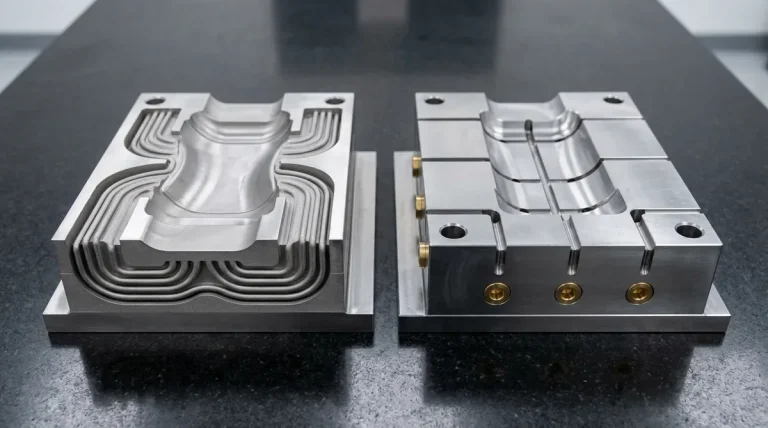
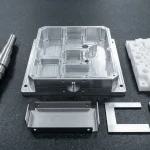
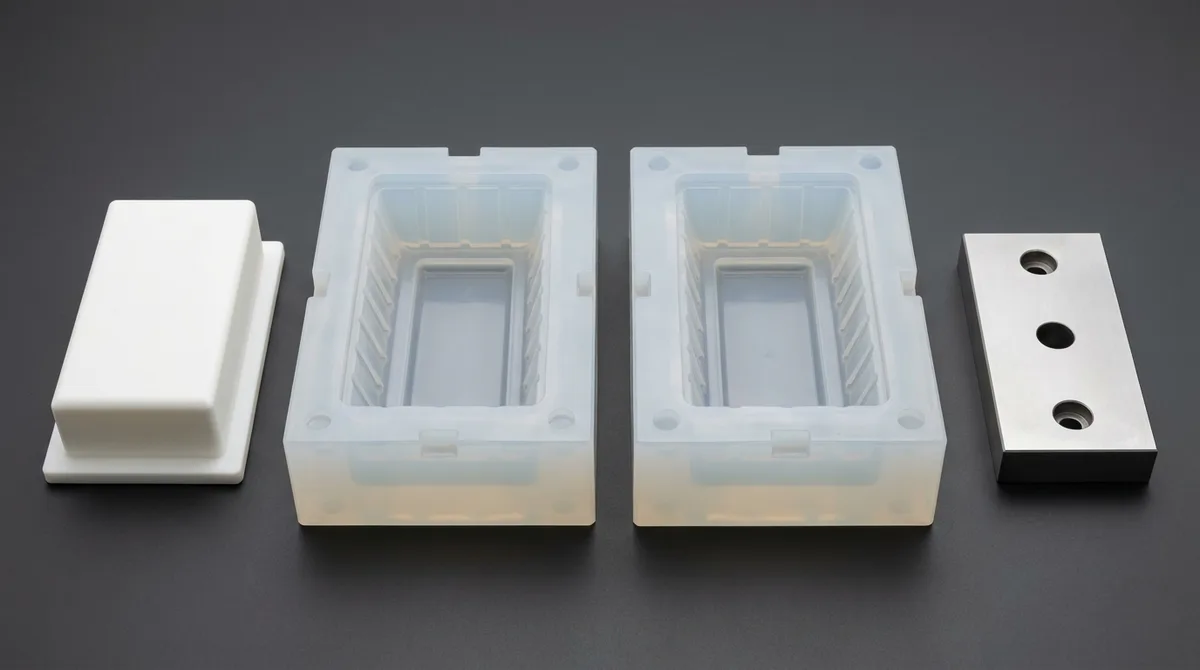
A two-part RTV silicone mold and master pattern resting flat on a workbench reveal engineered parting lines, alignment keys, and gate runner branches. The manual wave-cut parting architecture provides precise geometric registration across dozens of thermal casting cycles while minimizing seam misalignment.
For high-precision industrial tooling, our facility utilizes exclusively addition-cure (platinum-catalyzed) silicone rubbers rather than condensation-cure (tin-catalyzed) silicones. Platinum-cured vinyl-addition silicones undergo polyaddition without generating volatile reaction byproducts like alcohols or moisture. This yields negligible linear curing shrinkage (<0.1% compared to 0.5%–1.0% in tin silicones), outstanding tear propagation resistance (28 to 35 N/mm), and an elongation at break exceeding 300% to 450%.
To fabricate the silicone mold, the prepared master pattern is mounted onto a primary parting board inside a rigid casting flask. Sprue cones, runner channels, and high-point riser needles (0.5 to 1.0 mm stainless steel pins) are affixed to critical blind pockets to ensure unimpeded air evacuation during vacuum filling. Liquid platinum silicone is degassed, poured over the master, and cured in a convection oven at 40°C to 50°C for 8 to 12 hours.
Once cured, our master toolmakers execute a manual scalpel wave-cut along the designated parting perimeter. Cutting the silicone block with undulating, multi-faceted registration waves creates robust mechanical interlocking keys between mold halves. This interlocking geometry prevents lateral parting-line shift during clamping and casting, holding parting line flash to a microscopic minimum (≤0.08 mm).
Critical to dimensional precision is the total shrinkage compensation factor (Stotal) applied during the initial CAD design of the master pattern: Stotal = Smaster_thermal + Ssilicone + SPU_resin While platinum silicone shrinkage is minimal (≈ 0.08%), liquid polyurethane undergoes thermal and polymerization linear shrinkage between 0.15% and 0.35% depending on wall thickness and resin chemistry. Our engineering team scales the CAD master pattern by 1.003 to 1.005 (0.3% to 0.5%) prior to SLA printing or CNC machining, ensuring the final room-temperature polyurethane parts land precisely within nominal print dimensions.
| Tooling Parameter | RTV-2 Platinum Silicone Tooling | Rapid 7075 Aluminum Tooling | Production P20 / H13 Steel Tooling |
|---|---|---|---|
| Tooling Lead Time | 2 – 4 Business Days (Pattern + Silicone Cure) | 18 – 35 Business Days | 25 – 45 Business Days |
| Tooling Upfront Investment | Extremely Low NRE (Sacrificial Tool) | Moderate Investment | High Capital Expenditure |
| Expected Tool Life | 15 – 25 Shots per Cavity | 5,000 – 25,000 Cycles | 100,000 – 1,000,000+ Cycles |
| Undercut & Draft Mandate | 0° Draft Allowed; Deep Undercuts Flexible | 1° – 2° Draft; Mechanical Slides Required | 1.5° – 3° Draft; Complex Hydraulics & Lifters |
| Part Cycle Time | 45 – 90 Minutes (Oven Cure Batch) | 20 – 45 Seconds | 10 – 30 Seconds |
| Economic Production Range | 10 – 100 Parts (Bridge Batches) | 500 – 5,000 Parts | 10,000 – 500,000+ Parts |
4. Advanced DFM Guidelines: Undercuts, Inserts & Dual-Durometer Overmolding
While injection molding requires strict adherence to uniform wall thickness rules, minimum 1° to 2° draft angles, and costly mechanical side actions to clear undercut geometries, silicone tooling provides unprecedented geometric freedom. Cured platinum silicone exhibits a low modulus of elasticity and remarkable flexibility, stretching up to 300% without permanent plastic deformation. This elasticity allows design engineers to validate aggressive enclosure geometries without compromising industrial styling.
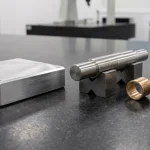
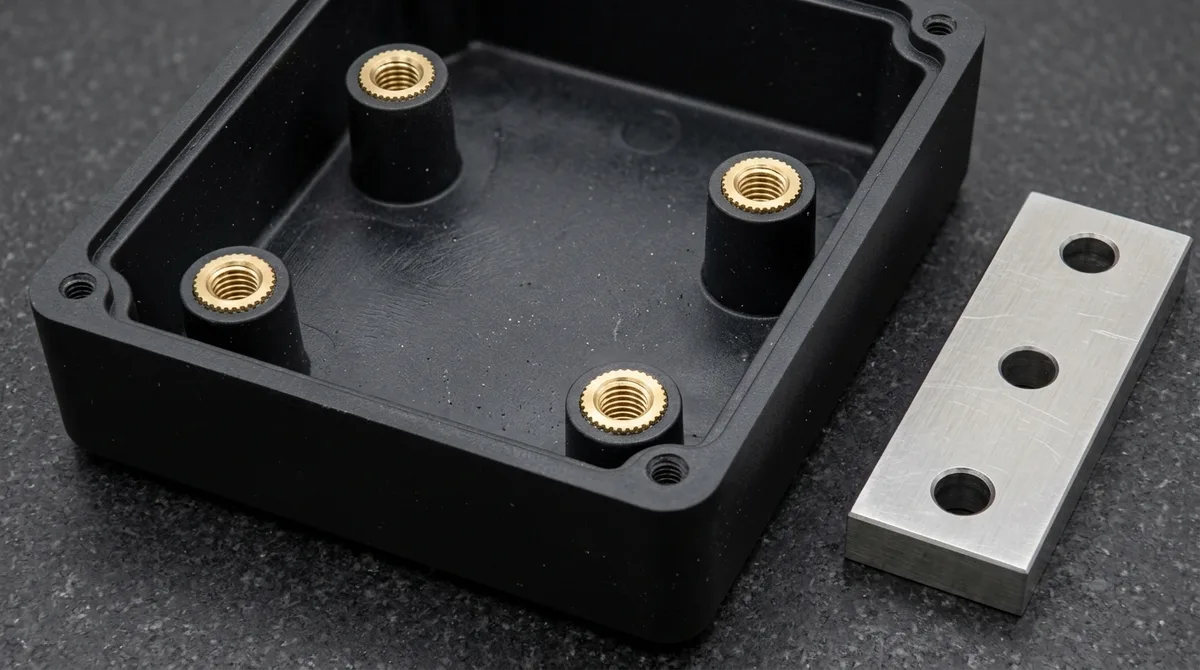
A precision polyurethane electronics enclosure resting flat on a granite inspection table demonstrates pre-encapsulated circular knurled brass threaded inserts. The mechanical interlock formed by the cured thermoset urethane provides superior pull-out strength and torque retention compared to post-molding heat-staking.
To maximize part quality, dimensional stability, and silicone tool lifespan, engineers should incorporate the following DFM rules into their 3D CAD models:
Wall Thickness Optimization & Transition Radii
The recommended nominal wall thickness for polyurethane vacuum casting is 1.5 mm to 3.5 mm. While thin walls down to 0.8 mm can be cast over short flow lengths (<50 mm), large thin-walled panels risk incomplete filling or warping due to high flow resistance. Conversely, thick cross-sections exceeding 6.0 mm generate internal thermal cores during the exothermic polyaddition reaction, which induces volumetric shrinkage sink marks and internal micro-voids. Where thick structural bosses are required, core them out from the underside or maintain rib thickness at 50% to 60% of the adjacent nominal wall thickness.
Zero-Draft Angles and Negative Undercuts
Unlike metal molds that seize on zero-draft features, silicone tooling easily releases features with 0° draft over depths up to 20 mm. Deep negative undercuts, reverse clips, wire routing hooks, and hollow perimeter snap features can be extracted simply by manual flexing of the elastomeric tool. However, for deep vertical ribs or external aesthetic faces exceeding 25 mm in height, providing a modest 0.5° to 1.0° draft angle significantly reduces demolding shear friction, extending mold life from 15 shots to over 25 shots.
In-Mold Threaded Brass Insert Encapsulation
Vacuum casting provides an outstanding solution for integrating high-strength fasteners. Threaded brass inserts with helical or diamond knurling, alignment dowels, and stamped electrical terminals can be pre-positioned directly inside the silicone mold onto precision steel locator pins prior to vacuum resin pouring. As the liquid polyurethane cures, it flows completely into the micro-knurls and undercut retaining grooves, forming a permanent mechanical encapsulation. This eliminates post-cure ultrasonic heat-staking, supports precise thread perpendicularity (±0.05 mm), and provides pull-out and torsional retention torque exceeding ultrasonic inserts in standard thermoplastics.
Dual-Durometer Overmolding & Multi-Shot Prototyping
Prototyping multi-material consumer products (such as power tool handles with soft-touch rubber grips, sealed electronic enclosures with IP67 integrated gaskets, and surgical instruments) is readily achieved using two-stage silicone tooling. A rigid ABS-like polyurethane core is cast and demolded first. This substrate is then inserted into a secondary silicone tool cavity that defines the elastomeric overmold volume. A soft urethane resin (Shore 40A to 60A) is cast over the core. Chemical compatibility between polyurethane chemistry groups establishes a robust chemical bond; for dissimilar materials, mechanical retention interlocks (such as through-holes, perimeter dovetails, or undercut grooves) help prevent delamination under mechanical peel stresses.
| Design Feature | Recommended Value | Feasible Limit | Engineering Rationale & Best Practices |
|---|---|---|---|
| Nominal Wall Thickness | 1.5 – 3.5 mm | 0.8 mm (Min) / 6.0 mm (Max) | Uniform walls prevent differential shrinkage; core out thick bosses to avoid sink |
| Draft Angle | 0.5° – 1.0° | 0.0° (Zero Draft Feasible) | Silicone elasticity permits 0° draft; 0.5° on deep ribs minimizes mold abrasive wear |
| Structural Ribs | 0.5 × Wall Thickness | 0.4 – 0.7 × Wall Thickness | Height ≤ 3 × base thickness; generous base fillet radii (R ≥ 0.5 mm) prevent tearing |
| Internal Undercuts | Up to 15 mm Depth | Up to 30 mm with Core Pull | Elastomeric release allows severe undercuts without mechanical lifters or slides |
| Threaded Inserts | M2 to M8 Brass Knurled | M1.6 to M12 Feasible | Pre-encapsulate on locator pins; provides higher torque strength than heat staking |
| Minimum Lettering / Details | 0.5 mm Width × 0.3 mm Depth | 0.2 mm Width × 0.1 mm Depth | Embossed text releases cleaner than debossed text; replicates SPI-A1 and Mold-Tech textures |
5. Silicone Tool Life Degradation Mechanics & Production Volume Crossover
While silicone tooling eliminates the massive initial capital investment and long delivery schedules of hardened steel injection molds, the mold itself is inherently sacrificial. Understanding the chemical and physical degradation mechanisms of RTV silicone enables engineering teams to optimize batch production strategies, maintain tight dimensional repeatability, and forecast the exact crossover point to rapid hard tooling.
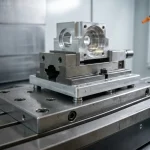
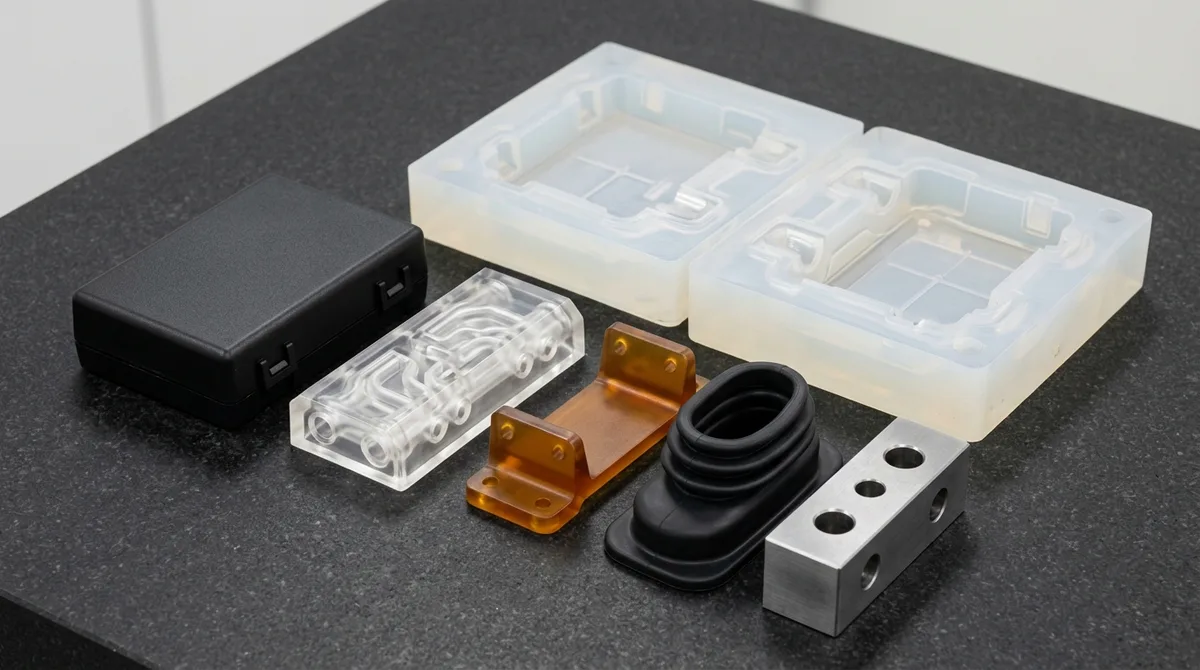
Precision polyurethane prototype enclosures and sacrificial silicone tooling resting flat on a granite inspection table highlight the economic sweet spot of 10 to 100 units. Batch production scales seamlessly by replicating multiple silicone molds from a single master model, delivering production-grade parts in days without steel tooling delays.
Silicone Mold Wear & Degradation Physics
Silicone mold degradation is driven by two simultaneous phenomena:
- Chemical Isocyanate Attack: Highly reactive isocyanate functional groups (-N=C=O) present in liquid polyurethane prepolymers act as aggressive organic penetrants. With each casting cycle at 65°C, isocyanates diffuse into the surface layers of the silicone rubber, leaching low-molecular-weight siloxane plasticizers and chemically attacking cross-linking bonds. Over 15 to 20 shots, this chemical degradation manifests as surface chalking, micro-pitting, and loss of gloss fidelity.
- Mechanical Demolding Fatigue: Each demolding extraction exerts mechanical tensile strain on internal corners, thin rib fins, and undercut cores. As the silicone loses elastic modulus due to thermal aging and chemical attack, tear propagation resistance drops, resulting in edge flaking or corner micro-tearing.
The operational lifespan of a premium platinum silicone mold depends heavily on resin aggressiveness:
- Standard ABS / PP-Like Resins: 18 to 25 shots per mold cavity.
- High-Temperature & Flame-Retardant Resins (130°C+ HDT): 10 to 15 shots due to higher thermal cure cycles and aggressive chemistry.
- Water-Clear Optical Polyurethanes: 12 to 18 shots before micro-pitting degrades optical transmission and requires fresh tooling.
- Soft Elastomeric Urethanes (Shore 30A to 70A): 25 to 35+ shots due to low demold strain and gentle exothermic curves.
For batch runs between 50 and 200 units, our facility casts 2 to 8 identical silicone molds simultaneously from the original master pattern. This parallel tooling strategy allows our shop floor to cast 20 to 40 parts per day, fulfilling bridge production runs in 7 to 15 business days without dimensional drift.
The Volume & Technology Crossover Point
Selecting the optimal manufacturing method depends strictly on production volume, aesthetic requirements, and required mechanical properties:
- 1 to 10 Parts (Direct Additive Manufacturing vs Vacuum Casting): For purely geometric form-and-fit checks, direct 3D printing (SLA, SLS, or FDM) offers the fastest turnaround. However, when parts require production-grade surface textures (SPI-A1 optical polish or Mold-Tech grains), true multi-durometer overmolding, or exact thermoplastic mechanical properties for physical drop testing, vacuum casting remains the superior choice even at quantities as low as 3 to 5 units.
- 10 to 100 Parts (The Vacuum Casting Sweet Spot): Within this batch volume, polyurethane vacuum casting is economically and technically unbeatable. Upfront tooling investment is a small fraction of hard tooling, zero CNC machine setup is required per part, and parts exhibit pristine surface finishes with zero layer stepping.
- 100 to 500 Parts (The Bridge Tooling Threshold): As quantities approach 200 to 500 units, the cumulative labor of casting batches in multiple duplicate silicone molds converges with Rapid 7075 Aluminum Tooling. Aluminum molds require higher initial tooling investment but reduce per-unit cycle time from 60 minutes down to 30 seconds and run genuine production thermoplastic pellets (ABS, PC, nylon).
- 500+ Parts (High-Volume Production Tooling): At volumes above 500 to 1,000 units, rapid aluminum or hardened steel injection molding dominates the total cost equation through extreme economies of scale.
| Evaluation Criteria | Direct 3D Printing (SLA / SLS) | Polyurethane Vacuum Casting | Rapid Aluminum Injection Tooling |
|---|---|---|---|
| Optimal Quantity Range | 1 – 10 Units | 10 – 100 Units (Up to 250) | 250 – 10,000 Units |
| Tooling Upfront NRE | Zero Tooling Investment | Extremely Low NRE | Moderate Tooling Investment |
| Unit Production Cost Curve | Flat (No Scale Advantage) | Moderate Unit Cost; Steep Drop at 10+ | High Upfront, Ultra-Low Unit Cost |
| Surface Quality & Texture | Layer stepping visible; requires post-prep | Injection-Grade Finish (SPI-A1 / MT) | Production Grade (SPI-A1 / EDM Spark) |
| Material Performance | Photopolymer / sintered powder; anisotropic | Isotropic Thermoset PU (High Toughness) | 100% Genuine Production Thermoplastics |
| Standard Turnaround | 4 – 6 Business Days | 4 – 15 Business Days | 18 – 35 Business Days |
6. Dimensional Inspection, CMM Metrology & Surface Finishing
Ensuring dimensional consistency across polyurethane vacuum casting runs requires rigorous quality control protocols tailored to the compliant nature of polymers and the chemical dynamics of thermoset curing. Our in-house metrology lab combines non-contact optical inspection with high-precision contact probing to verify that parts strictly adhere to customer 3D CAD models and 2D engineering drawings.
Dimensional Tolerances & Inspection Protocols
General unmachined vacuum cast polyurethane tolerances typically fall within the following resin- and geometry-dependent bands:
- Dimensions ≤ 100 mm: Standard tolerance of ±0.15 mm.
- Dimensions > 100 mm: Standard tolerance of ±0.20% of nominal dimension (e.g., ±0.40 mm across a 200 mm enclosure span).
- Parting Line Mismatch & Seam Flash: Maintained under ≤ 0.08 mm through precision scalpel wave-keyed silicone tooling.
- Critical Mating Journals & Dowel Bores: For tight bearing seats or alignment dowel holes requiring ±0.010 mm to ±0.020 mm, our CNC department performs secondary precision boring and reaming operations on cured polyurethane parts using dedicated soft-jaw holding fixtures.
Every production batch undergoes multi-stage metrology verification:
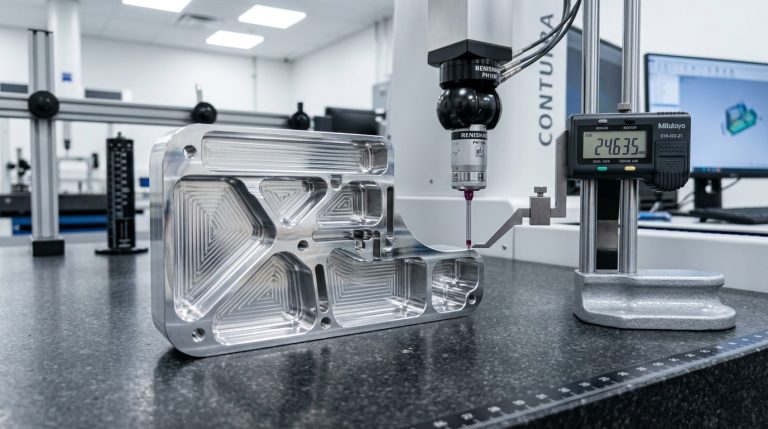
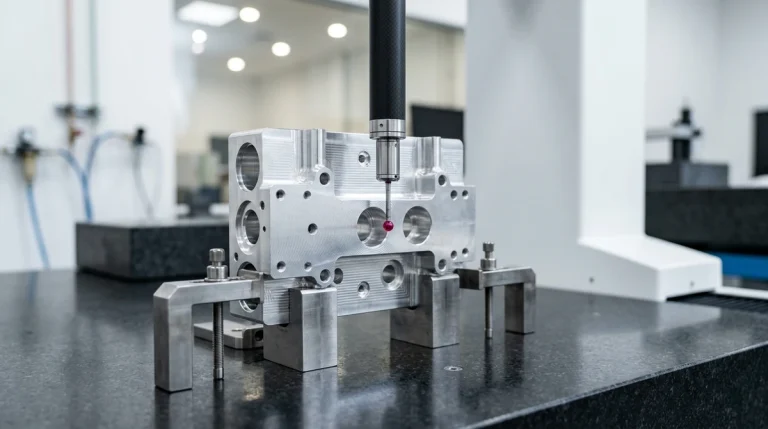
- Zeiss Bridge CMM Verification: Precision touch-trigger ruby probes inspect primary datum planes (Datum A, B, C), hole center-to-center distances, and threaded insert true position (conforming to ASME Y14.5-2018 GD&T standards). Low contact probing forces prevent elastic deflection of thin plastic walls.
- 3D Blue-Light Optical Surface Scanning: Non-contact structured blue-light scanners capture millions of point-cloud coordinates across complex organic contours, generating full-field 3D color deviation heatmaps against the native STEP file. This immediately detects thermal warp or post-demold deflection.
Comprehensive Surface Finishing & In-Mold Pigmenting
Vacuum casting provides unmatched post-processing versatility. Parts can be produced in any custom aesthetic configuration:
- In-Mold Custom Pigmenting: Concentrated liquid pigments are vacuum-dispersed directly into Part B polyols prior to chamber pouring. Parts are dyed completely through-body to exact Pantone or RAL color specifications, ensuring scratches or surface scuffs do not reveal a contrasting core.
- Surface Texture Replication: Mold textures replicate the master model with high fidelity. We produce optical high-gloss mirrors (SPI-A1 / SPI-A2, Ra ≤ 0.05 μm), fine satin finishes (SPI-B1/B2), or textured matte grains conforming to Mold-Tech specifications (such as MT-11010, MT-11020, and MT-11050).
- Automotive-Grade Polyurethane Spray Painting: Dual-component polyurethane topcoats (matte, satin, high gloss, soft-touch tactile velvet) applied in pressurized clean spray booths provide superior scratch resistance and UV shielding.
- EMI / RFI Shielding Spray Coating: For sensitive telecommunications and medical electronics enclosures, interior cavity surfaces receive selective robotic airless spray application of conductive copper or nickel shielding paints (achieving surface resistivity < 0.05 Ω/sq and attenuation exceeding 60 dB across 30 MHz to 1.5 GHz).
7. Engineering FAQ: Polyurethane Vacuum Casting
What dimensional tolerances can be held in polyurethane vacuum cast parts?
Standard vacuum casting tolerances typically hold ±0.15 mm for linear features up to 100 mm, and ±0.20% for dimensions exceeding 100 mm. Part accuracy is governed by master pattern precision, silicone curing shrinkage (<0.1%), and resin thermal contraction during oven curing. For tight assembly interfaces such as bearing seats or dowel pin locations, secondary CNC machining is performed on our multi-axis machining centers to achieve critical tolerances of ±0.010 mm to ±0.020 mm.
How many parts can be produced from a single silicone mold before replacement?
A high-grade platinum-cured RTV-2 silicone mold yields 15 to 25 shots for standard ABS-like and polypropylene-like resins. Abrasive or high-temperature resins (HDT > 130°C) with aggressive isocyanate chemistries yield 10 to 15 shots before micro-pitting occurs, while soft elastomeric urethanes (Shore 30A to 70A) can achieve 30+ shots. For larger production batches of 50 to 200+ parts, our facility casts multiple duplicate silicone molds from the original master pattern to run parallel casting cycles.
Can polyurethane vacuum casting replicate flame-retardant (UL94 V-0) or optical clarity requirements?
Yes. Advanced formulated polyurethane casting resins replicate specialized engineering thermoplastics. High-purity aliphatic urethanes (such as Axson PX 521 and Hei-Cast 8260) deliver optical clarity exceeding 88% light transmission with complete UV stability for lenses and light guides. For aerospace, rail, and electronic enclosures, flame-retardant polyurethane grades (such as Axson PX 245) meet UL94 V-0 flammability standards and heat deflection temperatures between 130°C and 150°C.
How does polyurethane vacuum casting compare economically to 3D printing and rapid tooling?
Polyurethane vacuum casting occupies the definitive sweet spot between 10 and 100 parts. Direct 3D printing is faster for 1 to 5 pieces but exhibits anisotropic mechanical weakness, visible layer lines, and high per-part costs. Rapid aluminum injection tooling requires higher upfront tooling investment and roughly 4 to 7 weeks of tooling lead time. Vacuum casting eliminates hard tooling investment, provides production-grade injection molded surface finishes (SPI-A1, Mold-Tech), and delivers 10 to 30 piece prototype batches in 4 to 8 business days (50 to 100+ piece batches in 7 to 15 business days).
Can threaded metal inserts and multi-material overmolding be cast directly in silicone molds?
Yes. Threaded brass inserts with diamond or spiral knurling can be pre-positioned directly inside the silicone tool onto precision locator pins prior to pouring. The liquid thermoset polyurethane encapsulates the knurls, delivering pull-out and torsional retention superior to ultrasonic heat-staking. Furthermore, two-shot dual-durometer overmolding is routinely executed by first casting a rigid ABS-like substrate, inserting it into a secondary silicone cavity, and casting a soft Shore 40A to 60A elastomer overmold for waterproof seals or tactile grips.
Fast-Track Low-Volume Plastic Parts with Vacuum Casting
Transition your functional prototypes from digital CAD to production-grade polyurethane parts in days. Our engineering team conducts comprehensive DFM reviews, evaluates parting line architecture, and recommends resin systems tailored to your mechanical, thermal, and optical specifications.