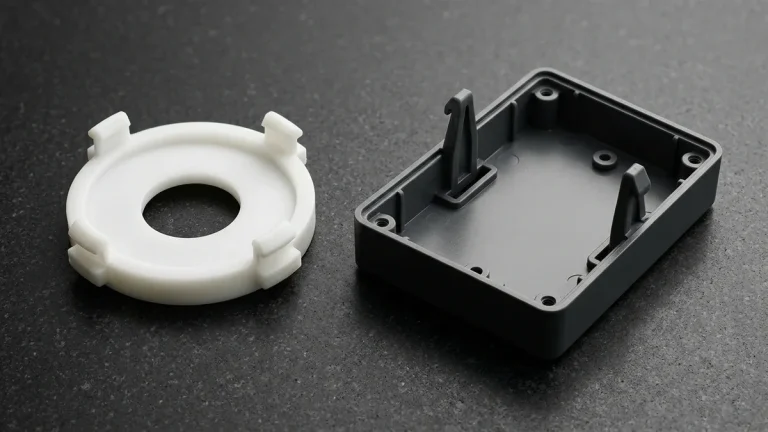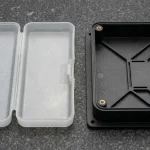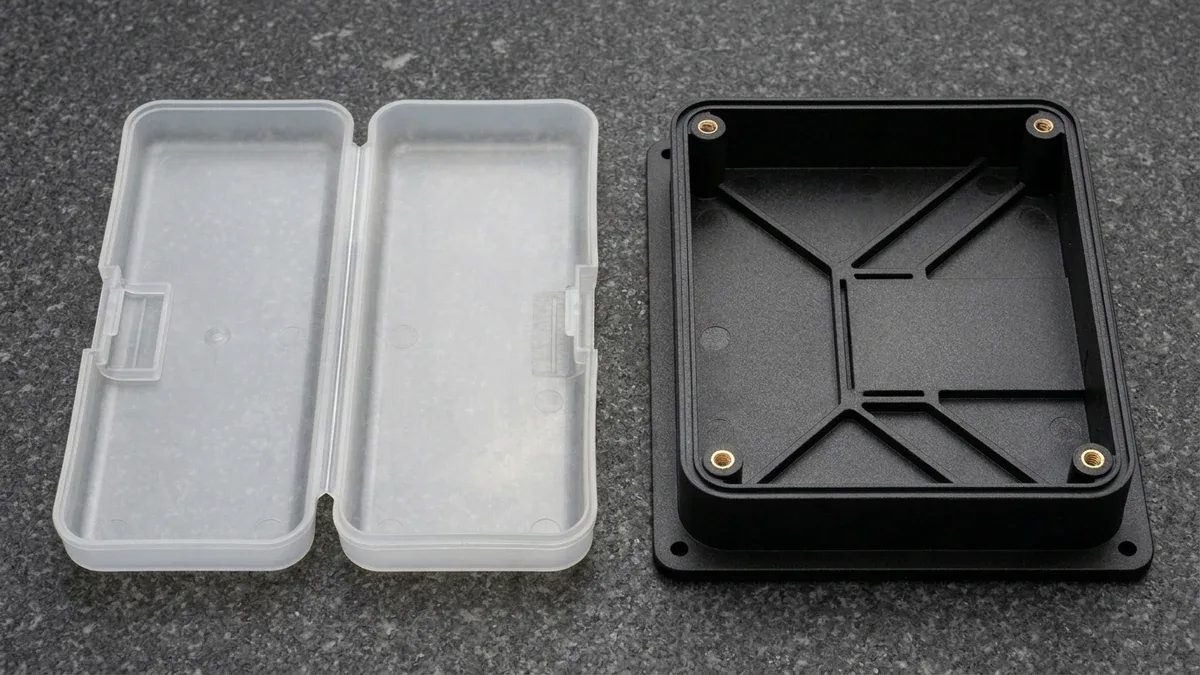
Polypropylene injection molding converts semi-crystalline isotactic polypropylene (PP) into chemically inert fluid manifolds, medical consumables, and integral living-hinge closures. Because polymer chains fold into dense monoclinic lamellae during mold cooling, unfilled PP exhibits an anisotropic linear shrinkage rate of 1.5% to 2.2% (0.015 to 0.022 in/in) alongside exceptional flexural fatigue endurance.
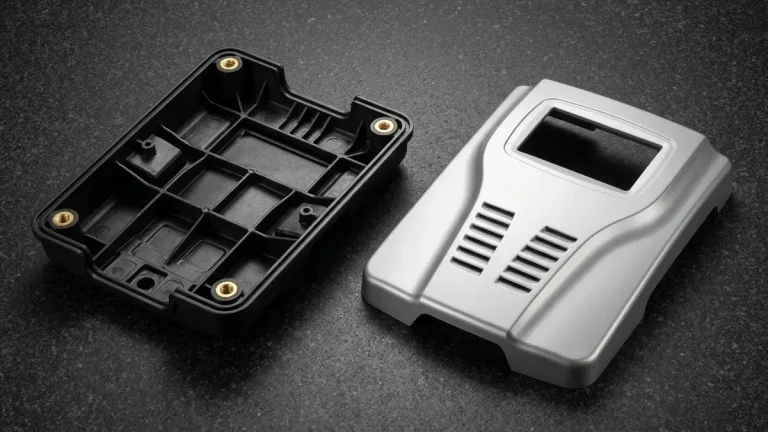
Achieving tight tolerances and million-cycle hinge life requires matching resin Melt Flow Rate (MFR) with precision mold DFM. Unfilled homopolymer PP forms a continuous 0.25–0.35 mm (0.010″–0.014″) living-hinge web on medical clamshells, whereas structural housings use warp-resistant 20%–30% talc-filled (PP-TD20) or glass-filled (PP-GF30) grades with cored ribs and brass inserts.
In our in-house mold shop and precision plastic injection molding facility, we machine pre-hardened P20/718H and vacuum-hardened S136 tool steel cavities with directional shrinkage scaling. Combining perpendicular fan gating, shallow 0.015–0.025 mm (0.0006″–0.0010″) parting-line venting, and immediate hot-flexing eliminates sink marks, flash, and hinge delamination.
Executive Summary & Engineering Takeaways (BLUF)
- Living Hinge Standard: Specify unfilled Homopolymer PP (MFR 12–25 g/10 min standard, up to 35 g/10 min thin-wall per ISO 1133), recessed web tweb = 0.25–0.35 mm (0.38 mm max), flat land L = 1.2–1.6 mm (1.50 mm nominal), perpendicular fan gating, and immediate 60°C–80°C hot-flexing for > 1,000,000 cycles.
- Shrinkage & Reinforcements: Unfilled homopolymer shrinks 1.5%–2.2% and impact copolymer 1.4%–2.0%; specify 20%–30% Talc-Filled PP-TD20 / TD30 (0.8%–1.3% isotropic) or 30% Glass-Filled PP-GF30 (0.4%–0.8% flow / 0.9%–1.3% cross-flow) for warp-free structural housings.
- Tooling & Shallow Venting: Machine P20/718H cavities and hardened S136/H13 (48–52 HRC) coining lands to ±0.005–±0.010 mm (±0.0002″–±0.0004″) via EDM, with 0.015–0.025 mm (0.0006″–0.0010″) shallow parting-line vents to prevent flash in low-viscosity PP melt.
- Prototyping Discipline: Never use thermoset polyurethane vacuum casting to fatigue-test a living hinge; CNC-machine virgin homopolymer PP for functional hinge prototypes and reserve vacuum casting for rigid enclosure fit validation.
- Ex-Factory Turnaround: DFM review in 24 hours, CNC PP prototypes in 4–8 business days, and rapid injection tooling with T1 samples in 18–35 business days (Ex-Factory, plus 3–5 business days air transit).
Article Engineering Navigation
- 1. How Does Polymer Crystallinity Govern PP Grade Selection?
- 2. What Are the DFM Rules for a Million-Cycle PP Living Hinge?
- 3. How Do You Compensate for Anisotropic PP Mold Shrinkage & Warpage?
- 4. Why Do Molded Polypropylene Living Hinges Delaminate or Crack Prematurely?
- 5. Which Mold Steels, Coining Lands & Vent Depths Prevent PP Flash?
- 6. How Do We Prototype, Qualify & Deliver Production PP Parts?
- 7. Technical Engineering FAQ
1. How Does Polymer Crystallinity Govern PP Grade Selection?
Isotactic polypropylene is a semi-crystalline thermoplastic that develops 50%–65% monoclinic α-phase crystallinity during mold cooling, achieving a 32–37 MPa (4.6–5.4 ksi) tensile yield strength and 0.900–0.910 g/cm³ specific gravity. For medical and fluid-handling assemblies, we mold USP Class VI and FDA 21 CFR 177.1520 compliant raw resin grades with lot traceability.
Selecting the proper Melt Flow Rate (ISO 1133 at 230°C / 2.16 kg) governs thin-wall filling and chain entanglement. We specify MFR 12–25 g/10 min (up to 35 g/10 min thin-wall) homopolymer PP for integral hinges: fractional-melt resins (MFR < 4) freeze mid-web, whereas hyper-fluid grades (MFR > 45) reduce tear strength.
When NOT to Choose Filled or Copolymer PP: Never specify PP-GF30, PP-TD20, or impact block copolymer (PP-B) for living hinges. Mineral talc platelets, chopped glass fibers, and ethylene-propylene rubber domains sever oriented fibrils during folding, fracturing a 0.30 mm web under 50 cycles; reserve filled grades for rigid ribbed housings with brass inserts.
| PP Resin Grade | MFR (ISO 1133) | Linear Shrinkage (%) | Flexural Modulus (MPa) | Notched Izod (23°C) | Recommended Application / When to Choose |
|---|---|---|---|---|---|
| Unfilled Homopolymer (PP-H) | 12–25 (up to 35) g/10 min | 1.5%–2.2% (DIN 16742 TG6–TG7) | 1,400–1,700 MPa | 2.5–4.5 kJ/m² | Mandatory for >1,000,000-cycle 0.25–0.35 mm living hinges and medical clamshells. |
| Random Copolymer (PP-R) | 10–25 g/10 min | 1.4%–1.9% (DIN 16742 TG6–TG7) | 950–1,200 MPa | 4.5–7.5 kJ/m² | High-clarity diagnostic cuvettes, syringe barrels, and moderate-duty closures. |
| Impact Block Copolymer (PP-B) | 8–20 g/10 min | 1.4%–2.0% (DIN 16742 TG6–TG7) | 1,050–1,350 MPa | 8.0–15.0 kJ/m² | Sub-zero (−20°C) battery cases, automotive bumpers, and rugged non-hinged crates. |
| 20%–30% Talc-Filled (PP-TD20 / TD30) | 6–15 g/10 min | 0.8%–1.3% (DIN 16742 TG5–TG6) | 2,600–3,200 MPa | 3.0–5.0 kJ/m² | Warp-resistant electronics housings with brass inserts and 125°C HVAC shrouds. |
| 30% Glass-Filled (PP-GF30) | 4–10 g/10 min | 0.4%–0.8% (flow) / 0.9%–1.3% (cross-flow, TG5) | 5,500–6,800 MPa | 6.5–10.5 kJ/m² | Pressurized fluid pump volutes, structural brackets, and pinned-knuckle enclosures. |
2. What Are the DFM Rules for a Million-Cycle PP Living Hinge?
An injection-molded polypropylene living hinge survives over 1,000,000 continuous 180° flex cycles only when its recessed web thickness is held between tweb = 0.25 and 0.35 mm (0.010″ to 0.014″), with 0.38 mm (0.015″) maximum for heavy snap closures. Webs thicker than 0.45 mm (0.018″) exceed outer-fiber tensile yield strain during folding and crack at the root.
To eliminate stress concentration where nominal wall T transitions into the thin web, our in-house toolmakers machine a flat recess land L = 1.2–1.6 mm (0.047″–0.063″; 1.5 mm nominal), a bottom concave radius R = 0.75 mm (0.030″), and shoulder fillets R = 0.50–0.75 mm (see schematic below).
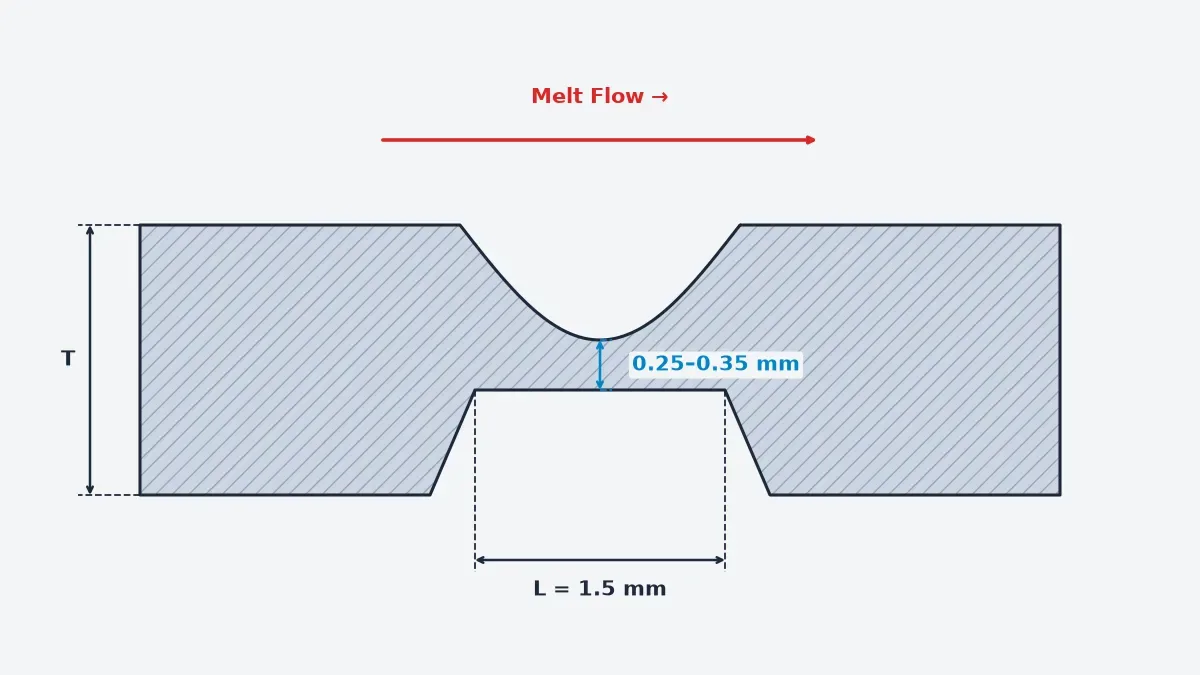
Gates must sit strictly on the heavier enclosure half within 35 to 50 mm of the hinge centerline so unfilled Homopolymer PP flows 100% perpendicular across the central recessed coining land. Never use dual-side gating—which traps a brittle weld line inside the web—or axial flow parallel to the hinge axis.
📐 Living Hinge Outer-Fiber Bending Strain, Fan Gate Shear Rate & Clamping Tonnage
εmax = t / (2 × Rneutral) = t / (2 × Rbend + t) | γ̇ = (6 × Q) / (W × t²) [s⁻¹] | Fclamp = Aproj × Pcav × k
Bending Strain & Shear Rate: Folding a t = 0.30 mm web (L = 1.5 mm) over Rbend = 0.75 mm (Rneutral = 0.90 mm) gives εmax = 0.30 / 1.80 = 16.7%, whereas 0.60 mm reaches 0.60 / 2.10 = 28.6% (cracking). At Q = 32,000 mm³/s through a 10.0 × 0.80 mm fan gate, γ̇ = 30,000 s⁻¹ (< 40,000 s⁻¹).
Clamping Tonnage: Across an unfolded 160 × 90 mm (Aproj = 14,400 mm²) clamshell at mean cavity pressure Pcav = 35 MPa, net force is 504.0 kN (51.4 tf); with safety factor k = 1.20, Fclamp = 14,400 × 35 × 1.20 = 604.8 kN (61.7 tf / 68.0 US tons), sizing a 90T–120T press.
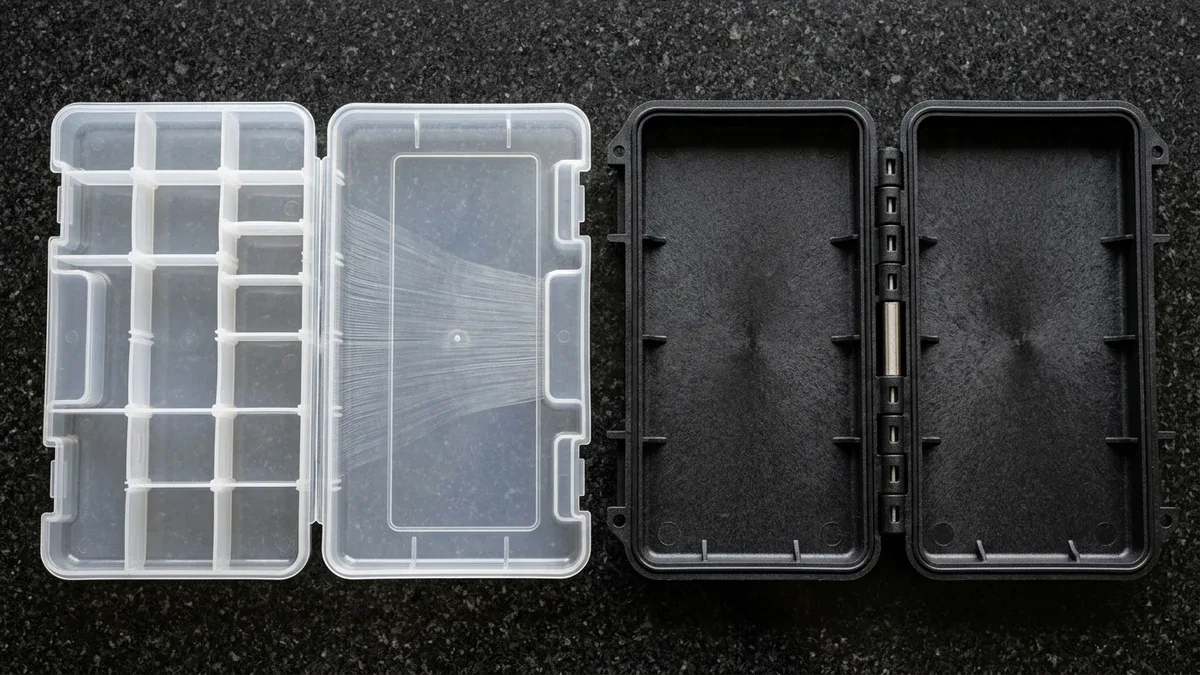
Immediately upon ejection at 60°C–80°C (140°F–176°F), operators hot-flex the hinge 2 to 3 times through 90°–180°. Cold-drawing stretches spherulites into aligned fibrils across the full-width homopolymer PP web (left below)—unlike brittle PP-GF30 housings (right), where glass fibers sever thin webs and require molded knuckles with a centerless-ground 316L stainless steel pin.
3. How Do You Compensate for Anisotropic PP Mold Shrinkage & Warpage?
As polypropylene cools from an amorphous melt (1.32 cm³/g at 220°C) into a semi-crystalline solid (1.105 cm³/g at 23°C), uncompensated p-v-T contraction reaches ~16.3%. After holding-pressure packing (35–55 MPa), net volumetric shrinkage remains 4.5% to 6.5%, producing anisotropic linear mold shrinkage of 1.5% to 2.2% (0.015 to 0.022 mm/mm).
To prevent warpage and sink marks across molded enclosures, we enforce uniform 1.50–3.00 mm (0.060″–0.118″) walls, keep stiffening rib roots at 0.50T–0.60T with 0.25T–0.40T base fillets, and size heat-set brass insert bosses at 2.0× to 2.5× insert OD with base coring moats per ISO 20457 (DIN 16742 TG5–TG7) and ISO 2768-mK.
📐 Shop-Floor Anisotropic Cavity Scaling & Differential Shrinkage Warpage Formula
Dcavity = Dpart / (1 − S) | Lcavity,flow = Lpart / (1 − Sflow) | Wcavity,cross = Wpart / (1 − Scross) | ΔS = L × (Scross − Sflow)
Anisotropic PP-GF30 Tray Sizing (ISO 294-4): For a 150.00 × 100.00 mm PP-GF30 tray (Sflow = 0.004 [0.4%], Scross = 0.011 [1.1%]), cavity dimensions scale to Lcavity,flow = 150.00 / 0.996 = 150.602 mm and Wcavity,cross = 100.00 / 0.989 = 101.112 mm, yielding a differential shrinkage across 100.00 mm of ΔS = 100.00 × (0.011 − 0.004) = 0.70 mm.
PP-H vs. Isotropic PP-TD20 Comparison: Unfilled PP-H (Sflow = 0.018, Scross = 0.019) scales to 152.749 × 101.937 mm (ΔS = 0.10 mm per 100 mm), whereas isotropic PP-TD20 (Sflow = 0.010, Scross = 0.011) scales to 151.515 × 101.112 mm, cutting differential warpage across 100 mm from 0.70 mm to 0.10 mm (−85.7%).
Beyond steel cavity scaling, controlling crystalline shrinkage requires matching barrel melt temperatures, differential mold water-circuit temperatures, and multi-stage holding pressures to each resin formulation. Our in-house scientific molding team locks in the process windows below during T1 trials to stabilize critical boss-to-boss center distances.
| PP Grade | Melt Temp (°C / °F) | Mold Temp (°C / °F) | Fill Velocity (mm/s) | Hold Pressure (MPa) | Shop-Floor Process Rule |
|---|---|---|---|---|---|
| Homopolymer (PP-H Hinge) | 210–240°C (410–464°F) | 30–45°C (86–113°F) | 120–200 mm/s | 30–45 MPa (4.4–6.5 ksi) | Cross 0.30 mm web without hesitation; hot-flex at 60–80°C within 3 s. |
| Impact Copolymer (PP-B) | 200–230°C (392–446°F) | 25–45°C (77–113°F) | 70–130 mm/s | 35–50 MPa (5.1–7.3 ksi) | Step-down holding pressure in 3 stages to prevent core sticking. |
| Talc-Filled (PP-TD20 / TD30) | 215–245°C (419–473°F) | 45–65°C (113–149°F) | 60–110 mm/s | 40–55 MPa (5.8–8.0 ksi) | Run 50–65°C cavity water to suppress surface talc-blush marks. |
| Glass-Filled (PP-GF30) | 230–260°C (446–500°F) | 50–80°C (122–176°F) | 80–140 mm/s | 45–65 MPa (6.5–9.4 ksi) | Limit screw back pressure to 3–6 MPa to preserve 0.4–0.8 mm fiber length. |
4. Why Do Molded Polypropylene Living Hinges Delaminate or Crack Prematurely?
Molded polypropylene living hinges delaminate or fracture within 10 to 500 cycles when melt flows parallel to the hinge axis, hesitates mid-web at low injection velocity, exceeds 0.45 mm thickness, or misses 60°C–80°C post-ejection hot-flexing. Our in-house molding team resolves five recurring shop-floor defects through targeted protocols:
- White-Stress Fibril Delamination (< 500 Cycles): Symptom: Chalky white laminar peeling along the fold line during early flexing. Root Cause: Melt front hesitation across the 0.30 mm coining gap or first-time folding after cooling to 23°C when spherulites have locked into brittle lamellae. Corrective Action: Machine a 2.5 mm flow leader behind the gate, raise linear fill velocity to 120–200 mm/s, and hot-flex 2–3 times at 60°C–80°C within 3 seconds of ejection.
- Parting-Line & Hinge-Edge Flash: Symptom: Thin feathery burrs along the hinge perimeter that initiate edge tearing. Root Cause: Shear-thinning polypropylene penetrating vents ground deeper than 0.030 mm (0.0012″) or excessive clamp deflection. Corrective Action: Surface-grind perimeter vents to 0.015–0.025 mm (0.0006″–0.0010″) depth over a 1.5 mm land and bed the central coining insert to 0.005 mm shut-off parallelism.
- Opposite-Rib Sink Marks & Internal Voids: Symptom: Cosmetic depressions on A-side enclosure walls opposite internal ribs or brass-insert bosses. Root Cause: Localized thermal mass where rib roots exceed 0.75T, causing slow core crystallization and inward volumetric pull. Corrective Action: Thin rib roots to 0.50T–0.60T, core out screw-boss bases with a 0.8 mm moat, and maintain 35–50 MPa packing until gate freeze-off.
- Inward Sidewall Toe-In (“Box-Effect” Corner Warpage): Symptom: Rectangular clamshell sidewalls bowing inward by 0.4–1.2 mm, preventing snap-latch engagement. Root Cause: Heat accumulation on internal core corners raising inside crystallinity and shrinkage (2.1% inner vs. 1.6% outer). Corrective Action: Run differential mold cooling circuits—chilling the B-side core to 30°C–35°C with copper-alloy baffles while holding the A-side cavity at 45°C–55°C.
- End-of-Hinge Short Shots & Air Traps (> 120 mm Span): Symptom: Incomplete web edges or diesel-effect burn marks on wide clamshells. Root Cause: Compressed air trapped in the second cavity pocket as the melt wave crosses the thin coining land. Corrective Action: Replace single point gates with a wide perpendicular fan gate and cut 0.015–0.020 mm perimeter vents every 25–30 mm plus vented ejector pins on the receiver side.
5. Which Mold Steels, Coining Lands & Vent Depths Prevent PP Flash?
We machine bridge molds (up to 100,000 shots) from pre-hardened P20 or 718H steel (28–34 HRC), cosmetic PP-R cavities from pre-hardened NAK80 (37–42 HRC), and high-volume or abrasive PP-GF30 production tools from vacuum-hardened S136 or H13 tool steel (48–52 HRC per ASTM E18) to resist glass-fiber gate erosion.
As shown in our clamshell mold cavity block below, a left-side sprue dish and wide fan gate drive molten polypropylene 100% perpendicular across the central recessed living-hinge coining land, which is finished via Electrical Discharge Machining (EDM) to ±0.005–±0.010 mm (±0.0002″–±0.0004″) and Ra 0.2 µm (8 µin) per ISO 4287.
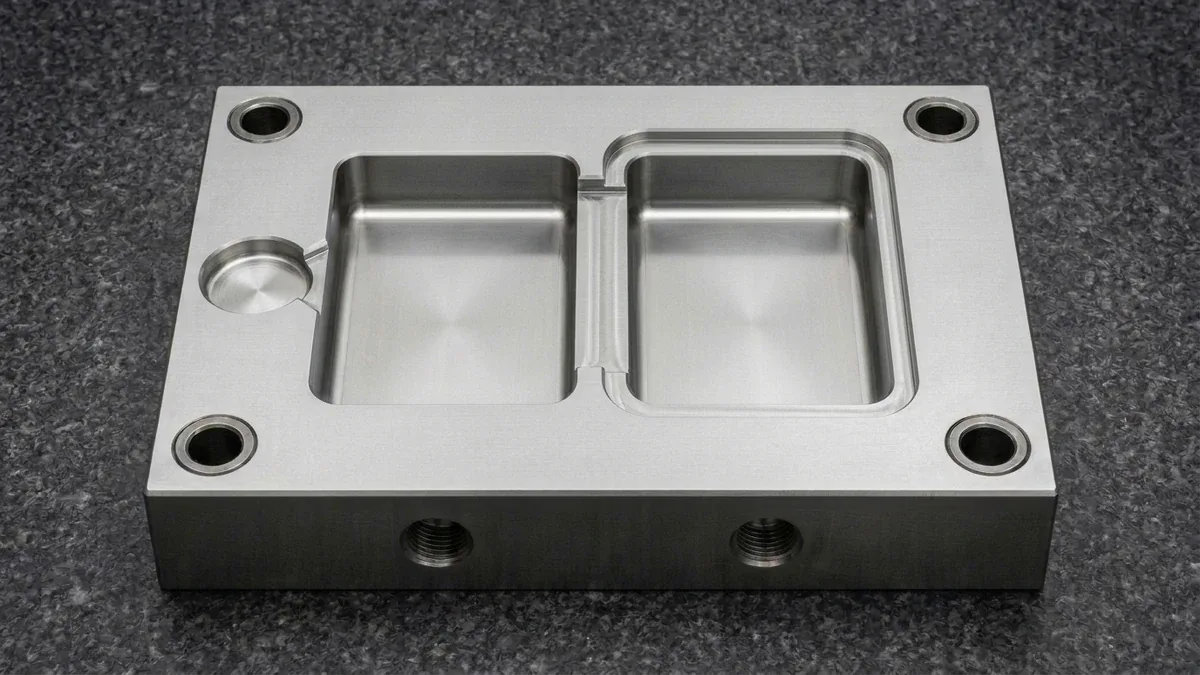
We construct the central coining land as a replaceable, steel-safe S136/H13 sub-insert initialized at a 0.25–0.30 mm shut-off gap for fine surface-grinding adjustment during T1 trials. Because polypropylene crystallizes exothermically, keeping nominal walls at 1.50–2.50 mm is critical to prevent quadratic cooling-time penalties:
📐 1D Fourier Thermal Diffusion Cooling Time Formula for Semi-Crystalline PP
tcool = [h² / (π² × αeff)] × ln[(4 / π) × (Tmelt − Tmold) / (Teject − Tmold)]
Worked Example: At αeff = 0.065 mm²/s, Tmelt = 220°C, Tmold = 40°C, and Teject = 90°C, logarithmic factor ln(4.5837) = 1.5225. A uniform h = 2.00 mm wall cools in tcool = [4.00 / (9.8696 × 0.065)] × 1.5225 = 9.5 s, whereas h = 3.50 mm requires 29.1 s (+206%) and causes sink marks.
| Tooling / Part Feature | Homopolymer Living Hinge | Talc / Glass Housing | Tooling Tolerance / Metrology | In-House Shop-Floor Rule |
|---|---|---|---|---|
| Web / Nominal Wall | 0.25–0.35 mm (0.38 mm max) | 1.50–3.00 mm (0.060″–0.118″) | ±0.005 to ±0.010 mm EDM | Fit modular S136/H13 coining inserts draw-polished to Ra 0.2 µm. |
| Recess Land & Radii | L = 1.2–1.6 mm, R = 0.75 mm | Corner R ≥ 0.50T inside | Non-Contact 2.5D Optical VMS | Add R = 0.50–0.75 mm shoulder fillets to prevent tearing. |
| Parting-Line Vent Depth | 0.015–0.020 mm (0.0006″–0.0008″) | 0.020–0.025 mm (0.0008″–0.0010″) | ±0.005 mm (±0.0002″) Surface Ground | Space 1.5 mm land vents every 25–30 mm into 1.2 mm relief channels. |
| Draft Angle | 1.0°–1.5° (SPI B-1 / A-2 Polish) | 1.5°–2.5° (VDI 3400 Texture) | 2.5D Optical VMS & Go/No-Go Fixtures | Add +0.5° extra draft on internal cores and +1.0° per 0.025 mm texture. |
| Ribs & Insert Bosses | Ribs 0.50T–0.60T (Height ≤ 3T) | Boss OD = 2.0×–2.5× Insert OD | Class ZZ GO/NO-GO Pin Gauges | Core out boss bases with a moat to prevent A-side sink marks. |
| Mold Steel Selection | P20 / 718H / NAK80 + S136 Insert | 718H / Hardened S136 / H13 | ASTM E18 (28–52 HRC) | Specify hardened S136/H13 (48–52 HRC) for coining lands & PP-GF30. |
6. How Do We Prototype, Qualify & Deliver Production PP Parts?
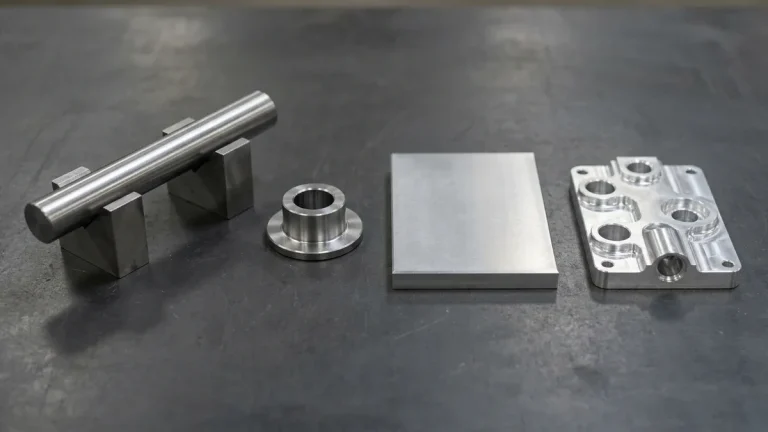
Never use thermoset polyurethane vacuum casting to fatigue-test a living hinge, as cross-linked urethanes cannot cold-draw into fibrils and tear within 30 to 100 bends. Instead, we machine functional hinge prototypes from virgin Homopolymer PP on High-Speed 3-Axis and 4-Axis CNC Milling centers (Vc = 180–280 m/min), reserving vacuum casting for rigid enclosures.
Because non-polar polypropylene exhibits a low native surface energy of 29–31 dynes/cm, adhesives and coatings delaminate without pretreatment. For painted housings or bonded manifolds, we apply corona/plasma activation, flame treatment (raising surface tension above 44 dynes/cm), and chlorinated polyolefin (CPO) adhesion promoters, or use 1064 nm Nd:YAG and 355 nm UV laser marking.
Every polypropylene rapid tooling and production molding program follows our four-stage in-house qualification workflow to lock in fibril orientation, flatness, and Cpk ≥ 1.33–1.67 dimensional capability before batch release:
- Execute Moldflow Shear & Shrinkage Simulation: Analyze gate-to-hinge flow vectors, verify apparent shear rates remain below 40,000 s⁻¹, and apply directional anisotropic shrinkage scaling (1.5%–2.2% for PP-H, 0.8%–1.3% for PP-TD20, or 0.4%–1.3% for PP-GF30) to the 3D cavity CAD.
- Machine Steel-Safe Coining Inserts & Shallow Vents: Cut cavity pockets on 3/4-axis CNC mills, sink central S136/H13 living-hinge coining lands via precision EDM to ±0.005–±0.010 mm with draw-polished Ra 0.2 µm radii, and surface-grind 0.015–0.025 mm perimeter vents.
- Establish Decoupled Scientific Molding Windows & Hot-Flexing: Conduct T1 viscosity and gate-seal studies on all-electric presses, balance differential core/cavity water circuits (30°C–65°C), and hot-flex homopolymer hinges 2–3 times at 60°C–80°C immediately upon ejection.
- Verify Dimensions in Our 20°C ± 1°C Metrology Lab: Inspect flexible 0.25–0.35 mm hinge webs and molded PP housings using non-contact 2.5D Optical Video Measuring Systems (VMS) and dedicated go/no-go checking fixtures (zero tactile CMM ruby probing on flexible PP parts), verify steel mold cavities on our Zeiss Bridge CMM (available upon request), and pressure-test manifolds at 3.5–6.0 bar.
Our standard Ex-Factory Production & Inspection Turnaround lead times—including our 3-day metrology and quality buffer and explicitly separated from 3 to 5 business days international express air transit (DHL/FedEx/UPS)—are:
- DFM & Moldflow Simulation Review: Within 24 hours (24–48 hours for complex multi-cavity or slider tooling).
- CNC Machined Homopolymer PP Prototypes: 4 to 8 business days (Ex-Factory).
- Rapid Injection Tooling (P20 / 718H / S136 / H13) & T1 Samples: 18 to 35 business days (Ex-Factory).
- Low-to-Mid Volume Production Molding (100–10,000+ Units): 7 to 12 business days for standard low-volume batches and 7 to 30 business days for full production runs post-T1 approval (Ex-Factory).
🔗 Related Injection Molding & Tooling Engineering Guides
- Explore our Custom Plastic Injection Molding & Rapid Tooling services for P20, 718H, and S136 production molds.
- Read our Living Hinges Design: DFM Rules, Resins & Molding vs 3D Printing guide for high-cycle closures.
- Review our Mold Flow Analysis: Injection Molding Simulation & Defect Prevention Guide to eliminate weld lines, sink marks, and warpage.
7. Technical Engineering FAQ
Specify unfilled Homopolymer Polypropylene (MFR 12–25 g/10 min per ISO 1133) with a 0.25–0.35 mm recessed web (0.38 mm max for heavy closures) and a 1.2–1.6 mm flat land. Immediately hot-flex the hinge 2–3 times at 60°C–80°C upon ejection to achieve over 1,000,000 flex cycles.
Unfilled semi-crystalline polypropylene shrinks linearly by 1.5% to 2.2% (0.015 to 0.022 in/in) during mold cooling. Our toolmakers apply directional anisotropic scaling factors to the P20/S136 cavity steel and specify 20%–30% talc-filled PP (0.8%–1.3% shrinkage) or 30% glass-filled PP (0.4%–1.3% shrinkage) for warp-critical structural housings.
Positioning fan or edge gates strictly on one side forces molten polypropylene to flow 100% perpendicular across the 0.30 mm coining land at high shear without stopping. This transverse flow aligns polymer chains across the bend axis and prevents brittle weld lines inside the hinge.
Never use thermoset polyurethane vacuum casting to fatigue-test a living hinge, because cross-linked urethanes cannot cold-draw into oriented fibrils and tear within 30–100 bends. Instead, we machine functional hinge prototypes from Homopolymer PP on 3/4-axis CNC mills and reserve vacuum casting for rigid enclosures.
Validate Your Polypropylene Living Hinge & Tooling Design
Upload your 3D CAD models (STEP/IGES) and 2D drawings for Moldflow gate simulation, anisotropic shrinkage review, and custom P20/S136 tooling quotation from our in-house engineering team.
Upload 3D CAD for DFM & Tooling Quote →