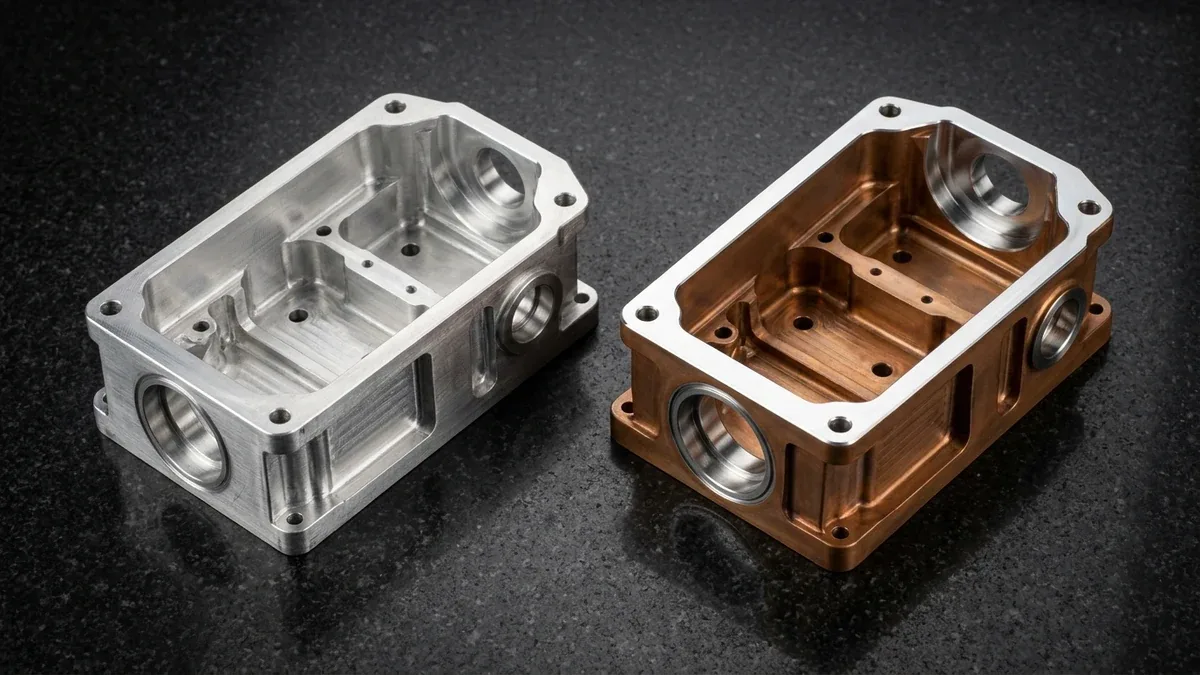
When designing high-pressure hydraulic manifolds, subsea pump shafts, and structural aerospace bulkheads, mechanical engineers require yield strengths exceeding 1,100 MPa (160 ksi) paired with corrosion resistance and dimensional stability. Conventional medium-carbon steels such as 4140 achieve hardness through high-temperature austenitizing and rapid liquid quenching, which induces severe thermal shock, uneven martensitic expansion, and unpredictable part warpage.
Understanding what is precipitation hardening (also called age hardening or particle hardening) enables hardware teams to bypass liquid-quench distortion entirely. Rather than relying on carbon-driven martensitic shock during final hardening, precipitation-hardenable alloys nucleate fine intermetallic precipitates—ε-Cu clusters in 17-4 PH, γ″ (Ni3Nb) in Inconel 718, γ′ (CuBe) in C17200, and η′ (MgZn2) in 7075-T651—that pin dislocations.
At our in-house precision CNC machining facility at our in-house facility, we execute two-stage rough-and-finish workflows tailored to precipitation-hardened alloys. By rough-milling 17-4 PH in solution-annealed Condition A with a 0.15 to 0.25 mm stock allowance per side before vacuum aging and finish skimming, we hold ±0.010 mm to ±0.020 mm tolerances at 40 to 44 HRC.
Executive Summary & Engineering Takeaways (BLUF)
- 3-Stage Thermal Cycle: Precipitation hardening executes (1) Solution Treatment above the solvus line, (2) Rapid Quenching into a metastable Supersaturated Solid Solution (SSSS), and (3) Isothermal Age Hardening to nucleate dislocation-pinning intermetallic precipitates.
- Predictable 17-4 PH Contraction: Aging 17-4 PH (SAE 630 / UNS S17400 / 1.4542 per AMS 5643 and ASTM A564) from Condition A (1,040°C ± 14°C, ≤ 36 HRC) contracts linear dimensions isotropically by 0.04% to 0.06% (−0.0004 to −0.0006 mm/mm) in H900 (482°C / 900°F × 1 hr, 40–44 HRC), 0.05% to 0.07% in H1025 (552°C × 4 hrs, 35–38 HRC), and 0.09% to 0.12% in H1150 (621°C × 4 hrs, 28–33 HRC).
- Two-Stage CNC Allowance: For parts requiring ±0.010 mm bore tolerances or ⌖ ⌀0.015 mm true position, our shop rough-machines Condition A leaving 0.15 to 0.25 mm per side, performs vacuum aging, and finish-skims or grinds (±0.005 mm) followed by ASTM A967 passivation.
- Pre-Stretched T651 Aluminum & Baking Cap: Specify 6061-T651 and 7075-T651 plate (mechanically stretched 1.5% to 3.0% after water quenching per AMS 2770) and keep 7075-T651 stress relief strictly ≤ 100°C–110°C (212°F–230°F) to prevent over-aging softening above its 120°C T6 aging ceiling.
- Superalloys, CuBe & Shop-Floor Verification: Double-aged Inconel 718 (AMS 5663, 38–46 HRC via γ″ Ni3Nb) and C17200 Beryllium Copper (ASTM B841, 38–44 HRC via γ′ CuBe) are verified in our 20°C ± 1°C metrology room via OES chemical analysis, ASTM E18 Rockwell HRC, ASTM E384 microhardness, and Zeiss bridge CMM inspection.
Article Engineering Navigation
- 1. Metallurgical Physics of the 3-Stage Precipitation Hardening Cycle
- 2. Aging Spectrum: Peak Aging (H900 / T6) vs. Over-Aging (H1150 / T73)
- 3. How Do We Machine & Age-Harden 17-4 PH (UNS S17400 / SUS630)?
- 4. How Do You Control Residual Stress Warpage in 6061-T651 & 7075-T651 Aluminum?
- 5. Hard Milling & 5-Axis Machining of H1025 Impellers, Inconel 718 & C17200
- 6. GD&T Callouts, Metrology Verification & Ex-Factory Lead Times
- 7. Technical Engineering FAQ
1. Metallurgical Physics of the 3-Stage Precipitation Hardening Cycle
The thermodynamic prerequisite for precipitation hardening is an alloy phase diagram exhibiting decreasing solid solubility of the alloying solute as temperature drops across the solvus boundary. At elevated solutionizing temperatures, the parent solvent lattice dissolves high concentrations of solute atoms; at lower temperatures, equilibrium solubility falls sharply, driving controlled second-phase precipitation.
Unlike quench-and-temper carbon steels (such as 4140 or 4340) that rely on diffusionless carbon trapping inside distorted body-centered tetragonal martensite during a violent liquid quench, precipitation-hardening alloys separate the rapid cooling step from the final strengthening step. This decoupling allows machinists to rough-cut parts in a ductile intermediate state before low-temperature aging.
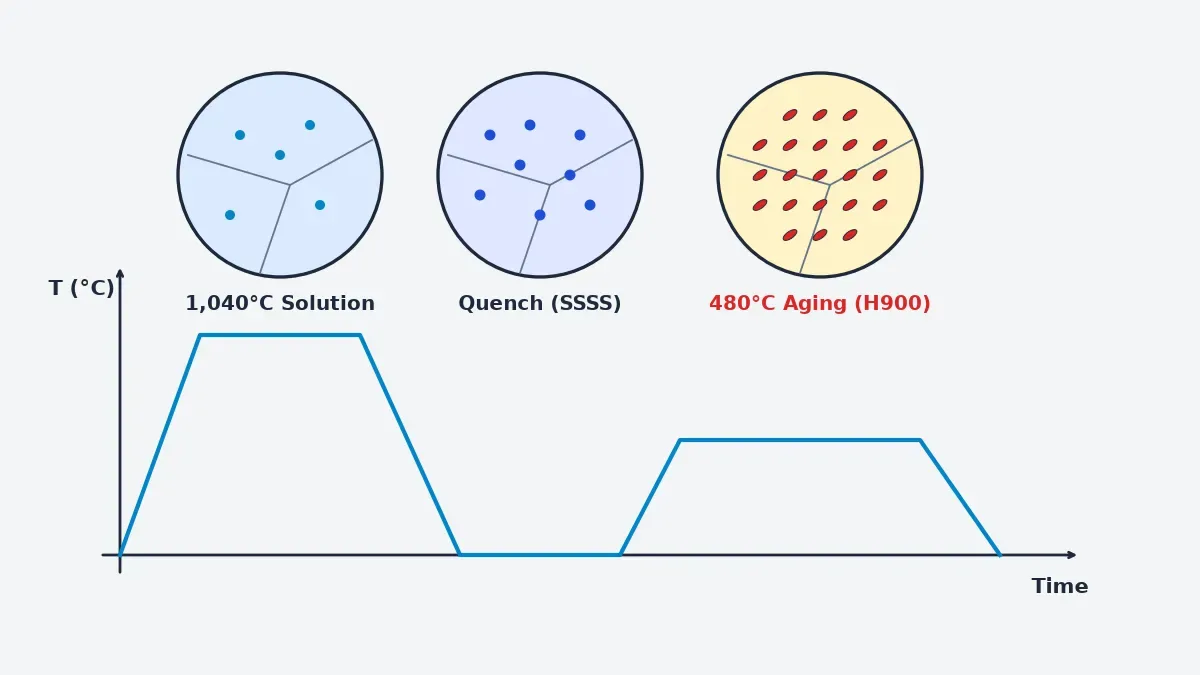
- Stage 1 — Solution Heat Treatment: The alloy is soaked in the single-phase solid solution region—1,040°C ± 14°C (1,900°F ± 25°F) for 17-4 PH stainless steel (AMS 5643 / ASTM A564), 530°C for 6061 aluminum, 475°C for 7075 aluminum (AMS 2770), 980°C for Inconel 718 (AMS 5662), or 790°C for C17200 beryllium copper—dissolving coarse intermetallics into a uniform matrix.
- Stage 2 — Rapid Quenching into Supersaturated Solid Solution (SSSS): Rapid cooling via water immersion, oil, or forced inert gas suppresses atomic diffusion, trapping excess solute atoms inside a metastable Supersaturated Solid Solution (SSSS). In 17-4 PH, cooling below 32°C (90°F) transforms the matrix into soft, low-carbon lath martensite known as Condition A (≤ 36 HRC max, typ. 28–34 HRC, ~790 MPa yield, ~1,030 MPa UTS).
- Stage 3 — Isothermal Age Hardening (Precipitation): Reheating the alloy to a controlled intermediate temperature below the solvus line (482°C–621°C for PH stainless steels; 120°C–177°C for aluminum; 315°C for C17200; 720°C → 620°C for Inconel 718) promotes short-range atomic diffusion, nucleating fine Guinier-Preston (GP) zones and coherent intermetallic precipitates.
During isothermal aging, coherent and semi-coherent precipitates create localized elastic lattice coherency strains that impede dislocation glide. Dislocations must either shear through fine coherent clusters or bow around larger semi-coherent particles via Orowan looping, elevating yield strength by 40% to 180% while maintaining isotropic dimensional stability, as plotted in the thermal cycle schematic below.
2. Aging Spectrum: Peak Aging (H900 / T6) vs. Over-Aging (H1150 / T73)
Precipitation-hardenable alloys allow mechanical engineers to balance yield strength, fracture toughness, and stress-corrosion cracking (SCC) resistance by selecting the exact aging temperature and soak duration. In under-aged matrices, solute clusters are tiny and widely dispersed, allowing dislocations to shear cleanly through particles with moderate cutting resistance.
At peak aging—such as 17-4 PH Condition H900 (482°C / 900°F for 1 hr, 40–44 HRC, yield ≥ 1,170 MPa / 170 ksi, UTS ≥ 1,310 MPa / 190 ksi), 7075-T651 (120°C for 24 hrs, 150 HBW), or C17200 TF00/AT (315°C for 3 hrs, 38–44 HRC)—intermetallic particle spacing reaches the critical Orowan radius.
When components operate in sour oilfield gas (NACE MR0175 / ISO 15156) or marine chloride environments, peak-aged alloys risk sulfide stress cracking or chloride SCC. Deliberate over-aging—such as H1025 (552°C / 1,025°F for 4 hrs, 35–38 HRC), H1150 (621°C / 1,150°F for 4 hrs, 28–33 HRC), or 7075-T7351—coarsens precipitates via Ostwald ripening, elevating impact toughness.
| Alloy & Temper Standard | Strengthening Precipitate | Solution & Aging Thermal Cycle | Yield / Tensile | Hardness | Typical CNC Applications |
|---|---|---|---|---|---|
| 17-4 PH Condition A (AMS 5643) | Unaged low-C martensite | 1,040°C ± 14°C sol. → Cool < 32°C | 790 / 1,030 MPa | ≤ 36 HRC (28–34) | Rough/semi-finish CNC bar & plate stock |
| 17-4 PH H900 (ASTM A564) | Coherent ε-Cu clusters | Age 482°C / 900°F (1 hr) → Air cool | ≥ 1,170 / 1,310 MPa | 40–44 HRC | High-pressure manifolds, mold core pins |
| 17-4 PH H1025 (AMS 5643) | Semi-coherent ε-Cu phase | Age 552°C / 1,025°F (4 hrs) → Air cool | ≥ 1,000 / 1,070 MPa | 35–38 HRC | Subsea pump impellers, actuator shafts |
| 17-4 PH H1150 (NACE MR0175) | Coarsened ε-Cu precipitates | Age 621°C / 1,150°F (4 hrs) → Air cool | ≥ 725 / 930 MPa | 28–33 HRC | Sour-gas valves, marine thruster hubs |
| Inconel 718 (AMS 5662 / 5663) | BCT γ″ (Ni3Nb) + γ′ phase | 980°C → 720°C (8h) → 620°C (8h) | ≥ 1,035 / 1,275 MPa | 38–46 HRC | Turbine blisks, downhole gas seals |
| C17200 CuBe TF00 / TH04 (ASTM B841) | Coherent γ″ / γ′ (CuBe) | 790°C quench → Age 315°C (2–3 hrs) | 1,000 / 1,280 MPa | 38–44 HRC | Non-sparking oilfield housings, mold cores |
| 7075-T651 (AMS 2770) | Metastable η′ (MgZn2) | 475°C quench → Stretch → 120°C (24h) | 503 / 572 MPa | 150 HBW | Aerospace bulkheads, robotic joints |
| 7075-T7351 (AMS 2770) | Coarsened η (MgZn2) | 475°C → Stretch → 107°C (7h) + 163°C (24h) | 435 / 505 MPa | 135 HBW | Marine & SCC-critical airframe fittings |
| 6061-T651 (AMS 2770) | Coherent β″ (Mg2Si) needles | 530°C quench → Stretch → 160°C–177°C (8h) | 276 / 310 MPa | 95 HBW | Optical mounts, vacuum chamber plates |
3. How Do We Machine & Age-Harden 17-4 PH (UNS S17400 / SUS630)?
Across our in-house machine shop, 17-4 PH (SAE 630 / UNS S17400 / SUS630 / EN 1.4542 per AMS 5643 and ASTM A564) is our primary precipitation-hardening stainless steel. When transverse toughness across heavy sections is required without delta-ferrite stringers, we also machine vacuum-arc-remelted 15-5 PH (UNS S15500 / AMS 5659) under identical aging schedules.
Because copper precipitation increases atomic packing density inside the body-centered cubic martensitic lattice during aging, 17-4 PH undergoes a uniform, predictable linear contraction: 0.04% to 0.06% (−0.0004 to −0.0006 mm/mm) in Condition H900, 0.05% to 0.07% (−0.0005 to −0.0007 mm/mm) in Condition H1025, and 0.09% to 0.12% (−0.0009 to −0.0012 mm/mm) in Condition H1150.
- Rough & Semi-Finish CNC in Condition A: We rough-mill traceable Condition A stock (28–34 HRC, ≤ 36 HRC max) on high-speed 3-axis and 4-axis VMCs at Vc = 60–90 m/min using positive-rake PVD TiAlN carbide cutters and 70-bar coolant, leaving a 0.15 to 0.25 mm semi-finish stock allowance per side on critical bores and datum faces.
- Vacuum or Protective-Atmosphere Aging: Semi-finished parts are aged in pyrometry-calibrated furnaces at 482°C (900°F) for 1 hr (H900, 40–44 HRC), 552°C (1,025°F) for 4 hrs (H1025, 35–38 HRC), or 621°C (1,150°F) for 4 hrs (H1150, 28–33 HRC), triggering isotropic contraction without liquid-quench distortion.
- Post-Aging Finish Skim Milling or Grinding: Aged parts return to 3-axis/4-axis VMCs (at Vc = 35–55 m/min for H900) to skim the 0.15 to 0.25 mm stock allowance to ±0.010 mm to ±0.020 mm (Ra ≤ 0.8 µm), or undergo cylindrical and surface grinding to hold ±0.005 mm on bearing journals.
- Descaling & ASTM A967 Nitric/Citric Passivation: Chemical passivation per ASTM A967 / AMS 2700 surface finishing standards after descaling heat-tint oxide dissolves free surface iron, restoring a clean 2 nm chromium-oxide passive film with 0.000 mm dimensional change.
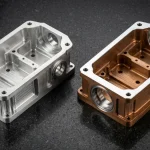
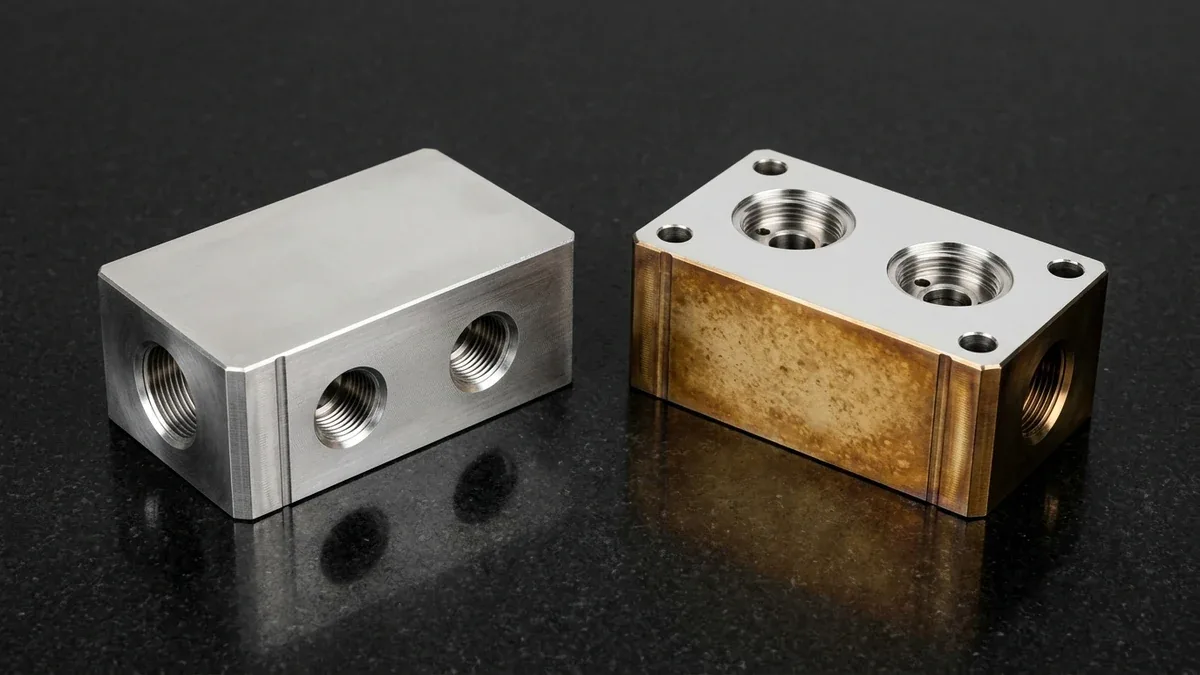
As shown in the manifold comparison below, aging 17-4 PH at 482°C (900°F) forms a characteristic copper-gold thermal oxide heat tint on unskimmed side walls, while post-aging CNC finish skimming restores a bright, flat top datum land and precision counterbored valve ports.
| 17-4 PH Condition | Aging Temp & Soak Time | Hardness (ASTM E18) | Linear Aging Contraction | Heat-Tint Oxide Appearance | Shop-Floor CNC Routing Strategy |
|---|---|---|---|---|---|
| Condition H900 | 482°C (900°F) × 1 hr | 40–44 HRC | −0.04% to −0.06% (−0.0005 mm/mm) | Straw to copper-gold tint | Rough Cond. A (+0.20 mm/side) → Age → Skim |
| Condition H925 | 496°C (925°F) × 4 hrs | 38–42 HRC | −0.04% to −0.06% (−0.0005 mm/mm) | Golden-brown to bronze tint | Rough Cond. A (+0.20 mm/side) → Age → Skim |
| Condition H1025 | 552°C (1,025°F) × 4 hrs | 35–38 HRC | −0.05% to −0.07% (−0.0006 mm/mm) | Dark purple-bronze oxide | Direct CNC pre-aged bar or two-stage skim |
| Condition H1075 | 579°C (1,075°F) × 4 hrs | 32–36 HRC | −0.06% to −0.08% (−0.0007 mm/mm) | Bluish-black oxide film | Direct CNC from pre-aged stock or skim |
| Condition H1150 | 621°C (1,150°F) × 4 hrs | 28–33 HRC | −0.09% to −0.12% (−0.0010 mm/mm) | Matte dark blue-gray scale | Direct finish CNC from pre-aged H1150 bar |
| Condition H1150M | 760°C (2h) + 621°C (4h) | 24–30 HRC | −0.10% to −0.12% (−0.0011 mm/mm) | Dark gray-black thermal film | Direct CNC for NACE MR0175 sour service |
📐 Shop-Floor Calculation: Orowan Shear Stress, 17-4 PH Aging Shrinkage & Skim Allowance
Governing Equations: Orowan dislocation bowing stress (Δτy), Taylor polycrystal yield increment (Δσy = M · Δτy), isothermal aging contraction (ΔL = εage · L0, where εage = −0.00050 mm/mm for H900), and pre-age bore diameter (Dpre-age) with radial stock (Sfinish = 0.15–0.25 mm/side) follow:
Δτy = 0.84 · G · b / (λ − 2r) | Δσy = M · Δτy | ΔL = εage · L0 | Dpre-age = Dnom − 2Sfinish
Worked Orowan & Taylor Check: In peak-aged 17-4 PH (G = 77,500 MPa, b = 0.248 nm) with spacing λ = 109.0 nm and radius r = 4.5 nm (λ−2r = 100.0 nm), Δτy = (0.84 × 77,500 × 0.248) / 100.0 = 161.45 MPa, giving tensile yield increment Δσy = 2.75 × 161.45 = 444.0 MPa.
Worked 150.000 mm Manifold Bore Spacing Contraction: Across a L0 = 150.000 mm (5.9055 in) manifold bore spacing (true position ⌖ ⌀0.015 mm), H900 aging (εage = −0.00050 mm/mm) shifts spacing by ΔL = −0.00050 × 150.000 mm = −0.075 mm (−0.0030 in) to 149.925 mm, requiring a pre-aging target of 150.075 mm (or −0.150 mm in H1150).
Pre-Aging Bore & Finish Skim Compensation: For ⌀25.000 mm H7 (+0.021 / −0.000 mm) valve bores, we rough-bore Condition A with Sfinish = 0.200 mm/side (within 0.15–0.25 mm/side) to Dpre-age = ⌀24.600 mm (0.9685 in). After H900 aging shrinks the bore by 0.012 mm to ⌀24.588 mm, VMC finish boring skims 0.211 mm/side to hit ⌀25.010 mm.
4. How Do You Control Residual Stress Warpage in 6061-T651 & 7075-T651 Aluminum?
Wrought heat-treatable aluminum alloys such as 6061 (Al-Mg-Si) and 7075 (Al-Zn-Mg-Cu) require rapid cold-water immersion quenching from 530°C (6061) or 475°C (7075) per AMS 2770 to trap Mg2Si and MgZn2 solutes in supersaturated solution. Because the exterior skin chills and contracts rapidly against the hot core, unstretched 6061-T6 and 7075-T6 plates lock in severe compressive skin and tensile core stresses.
When high-MRR pocket milling on 3-axis or 4-axis VMCs removes over 60% of plate volume, asymmetric stress release bows standard T6 plate by 0.25 to 0.80 mm. We eliminate bowing by specifying pre-stretched 6061-T651 and 7075-T651 plate—mechanically stretched 1.5% to 3.0% post-quench—paired with symmetric Op 1 / Op 2 flip-machining leaving 0.50 mm semi-finish stock.
For ultra-thin aerospace frames requiring intermediate thermal relaxation between roughing and finishing, engineers must respect the artificial aging temperature ceiling of each alloy series. While 6061-T651 (aged at 160°C–177°C for 8–18 hours) can be safely stress-relieved at 150°C–165°C (302°F–329°F) for 2 hours, 7075-T651 reaches peak strength at a much lower 120°C (250°F) artificial aging soak.
Consequently, any intermediate baking or stress-relief annealing on 7075-T651 must be strictly capped at ≤ 100°C–110°C (212°F–230°F)—or performed via 12 to 24 hours of unclamped ambient relaxation at 20°C before finish skimming. Baking 7075-T651 at 150°C–200°C rapidly coarsens metastable η′ (MgZn2) precipitates into incoherent η phase, destroying T6 yield strength.
5. Hard Milling & 5-Axis Machining of H1025 Impellers, Inconel 718 & C17200
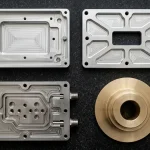
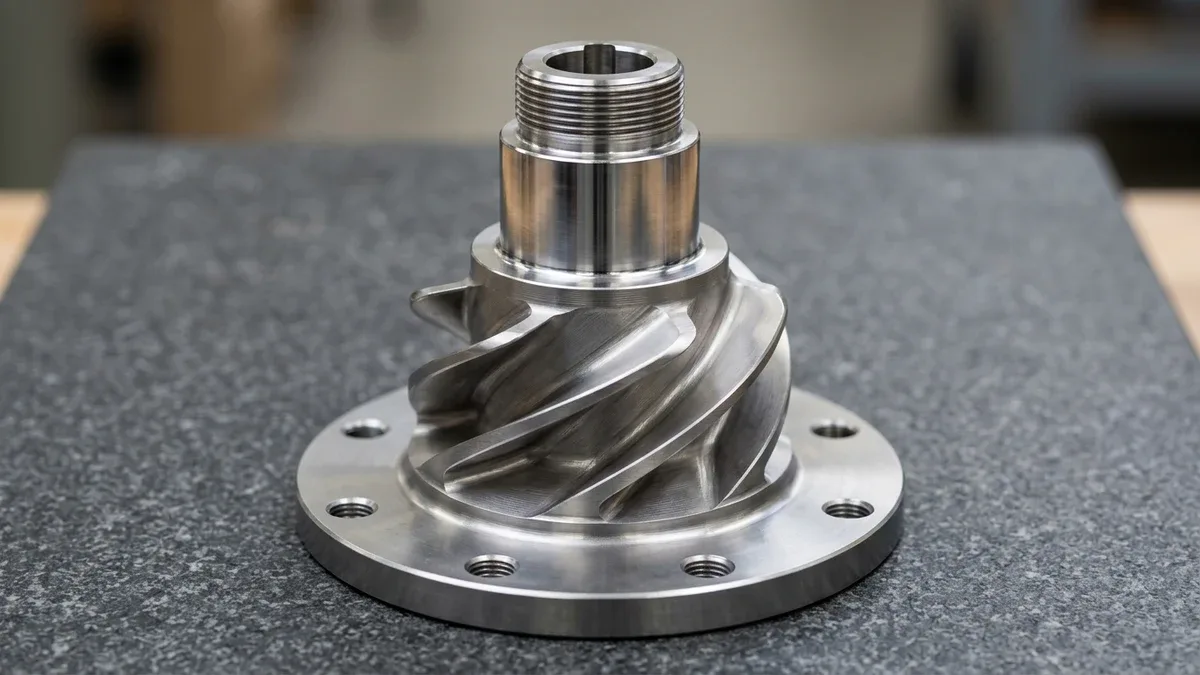
While 75% to 85% of prismatic housings and manifolds run on our 3-axis and 4-axis VMCs, complex multi-blade subsea pump impellers require simultaneous 5-axis CNC contouring and mill-turn integration. For 17-4 PH impeller hubs with integral flanged shafts, specifying Condition H1025 (35–38 HRC) or H1150 (28–33 HRC) ensures crisp chip breaking, as seen in the subsea impeller hub below.
When finish-milling peak-aged 17-4 PH H900 (40–44 HRC) or double-aged Inconel 718 (UNS N07718 per AMS 5663, aged at 720°C × 8 hrs and furnace cooled to 620°C × 8 hrs to 38–46 HRC via γ″ Ni3Nb precipitates), our 5-axis machinists pair conical shrink-fit holders with AlTiN solid-carbide end mills. Trochoidal toolpaths (ae ≤ 0.08D–0.10D) and 70-bar coolant prevent strain-hardening.
For non-magnetic subsea connectors, oilfield downhole sensors, and high-conductivity injection mold cores, we machine C17200 Beryllium Copper (Alloy 25 per ASTM B196 / ASTM B841). Aged at 315°C (600°F) for 2 to 3 hours to 38–44 HRC (350–400 HV), C17200 contracts by 0.15% to 0.20% during aging and machines cleanly with sharp, uncoated or ZrN-coated carbide tooling under flood coolant.
| Alloy & Temper State | Chip Formation Behavior | Tooling & Holder Strategy | Speed (Vc) & Radial Step (ae) | Tolerance & Surface Finish |
|---|---|---|---|---|
| 17-4 PH Condition A (≤ 36 HRC) | Gummy, stringy chips; built-up edge | Positive-rake PVD TiAlN carbide | 60–90 m/min; ae 0.25D | Leave 0.15–0.25 mm stock per side |
| 17-4 PH H1025 / H1150 (28–38 HRC) | Clean C-chips; low flank wear | Micro-grain AlTiN/TiSiN carbide | 55–80 m/min; ae 0.15D | ±0.010–0.020 mm; Ra ≤ 0.8 µm |
| 17-4 PH H900 (40–44 HRC) | High radial shear; abrasive wear | Shrink-fit holder + AlTiN end mill | 35–55 m/min; ae ≤ 0.10D | ±0.010 mm CNC; ±0.005 mm grind/EDM |
| Inconel 718 Aged (38–46 HRC) | Rapid work-hardening on dwell | PVD TiAlN carbide; 70-bar coolant | 30–50 m/min; ae 0.08D | ±0.015–0.025 mm; Ra ≤ 0.8 µm |
| C17200 CuBe TF00/TH04 (38–44 HRC) | Short curled chips; low BUE | Sharp ZrN/uncoated carbide; flood | 120–180 m/min; ae 0.15D | ±0.008–0.015 mm; Ra ≤ 0.4 µm |
| 6061-T651 & 7075-T651 Plate | Free-machining crisp evacuation | 3-flute high-helix ZrN/DLC carbide | 350–600 m/min; ae 0.35D | ±0.008–0.020 mm; Ra ≤ 0.4–0.8 µm |
6. GD&T Callouts, Metrology Verification & Ex-Factory Lead Times
To prevent DFM holds, never call out only “17-4 PH Stainless Steel” on a 2D drawing. Specify the complete thermal and surface sequence: “Material: 17-4 PH (UNS S17400) per AMS 5643; Age Harden to Condition H900 (40–44 HRC per ASTM E18); Finish Machine Critical Bores Post-Aging; Passivate per ASTM A967.” General uncalled tolerances default to ISO 2768-mK.
When specifying geometric tolerances on precipitation-hardened manifolds and shafts, define form, orientation, and location zones without a plus-or-minus sign: call out primary datum flatness within ⏥ 0.010 mm, bore perpendicularity within ⊥ 0.015 mm to Datum A, and manifold port location within ⌖ ⌀0.015 mm. Post-aging finish skimming regenerates Datum A before final bore sizing.
While nanoscale precipitates (ε-Cu, η′ MgZn2, γ″ Ni3Nb, and γ′ CuBe) govern underlying metallurgical physics, production lot qualification in our 20°C ± 1°C metrology room relies on direct chemical and mechanical verification using optical emission spectrometry (OES) alloy analyzers plus ASTM E18 Rockwell HRC and ASTM E384 Vickers HV hardness testers.
Dimensional and surface compliance after vacuum aging and ASTM A967 passivation is verified with Mitutoyo 3-point bore micrometers, Class ZZ GO/NO-GO pin gauges, ISO 1502 thread gauges, ISO 4287 contact stylus profilometers, and Zeiss bridge CMM inspection (available upon request).
All schedules quoted below represent our Ex-Factory Production & Inspection Turnaround at our in-house facility, which is strictly separated from 3 to 5 business days of international air freight transit (DHL, FedEx, or UPS):
- DFM Review & Custom Engineering Quote: Within 24 hours (24 to 48 hours for multi-stage vacuum-aged assemblies).
- Pre-Aged Stock CNC Prototypes (6061-T651, 7075-T651, Pre-Aged 17-4 PH H1150, C17200 TH04): 4 to 8 business days ex-factory.
- Two-Stage Vacuum-Aged + Finish-Skimmed/Ground + ASTM A967 Passivated Parts (17-4 PH H900/H1025, Inconel 718): 7 to 12 business days ex-factory.
- Low-to-Mid Volume Production Runs (10 to 1,000+ units): 7 to 30 business days ex-factory.
🔗 Related Metallurgy & CNC Engineering Guides
7. Technical Engineering FAQ
For compact Condition H1150 (28–33 HRC) or H1025 (35–38 HRC) components, we machine directly from pre-aged bar stock to save furnace lead time. For peak-aged H900 (40–44 HRC) manifolds requiring ±0.010 mm bore tolerances, we rough-machine Condition A leaving 0.20 mm stock, vacuum age, and finish-skim.
Aging 17-4 PH at 482°C (900°F) in air forms a thin golden-brown thermal oxide film depleted of free surface chromium. We remove this heat-tint scale via post-aging CNC finish skimming and nitric or citric acid passivation per ASTM A967 to restore full corrosion resistance.
T651 aluminum plate is mechanically stretched 1.5% to 3.0% immediately after solution water quenching to relieve internal compressive and tensile quench stresses. When deep pocket milling removes over 60% of plate volume, T651 prevents asymmetric bowing and holds flatness within 0.020 mm to 0.050 mm.
Yes, a 0.05% H900 aging contraction on an M6 or M8 pitch diameter is under 0.004 mm, sitting well inside ISO 1502 6H thread tolerances. Tapping or thread-milling in solution-annealed Condition A (28–34 HRC) prevents carbide tap breakage in 40–44 HRC H900 stainless steel.
Ready to Machine Precision 17-4 PH, Inconel 718, or 7075-T651 Components?
Upload your 3D CAD models (STEP, IGES, X_T) and 2D GD&T engineering drawings directly to our in-house engineering team. We provide a comprehensive DFM review—covering pre-aging stock allowances, vacuum aging tempers (H900 to H1150), ASTM A967 passivation, and bridge CMM inspection protocols—customized to your production batch requirements.
Upload 3D CAD for DFM & Custom Quote →