Lighting & Optical CNC Machining: Custom Lenses & Heatsinks
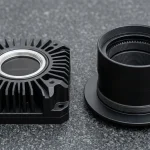
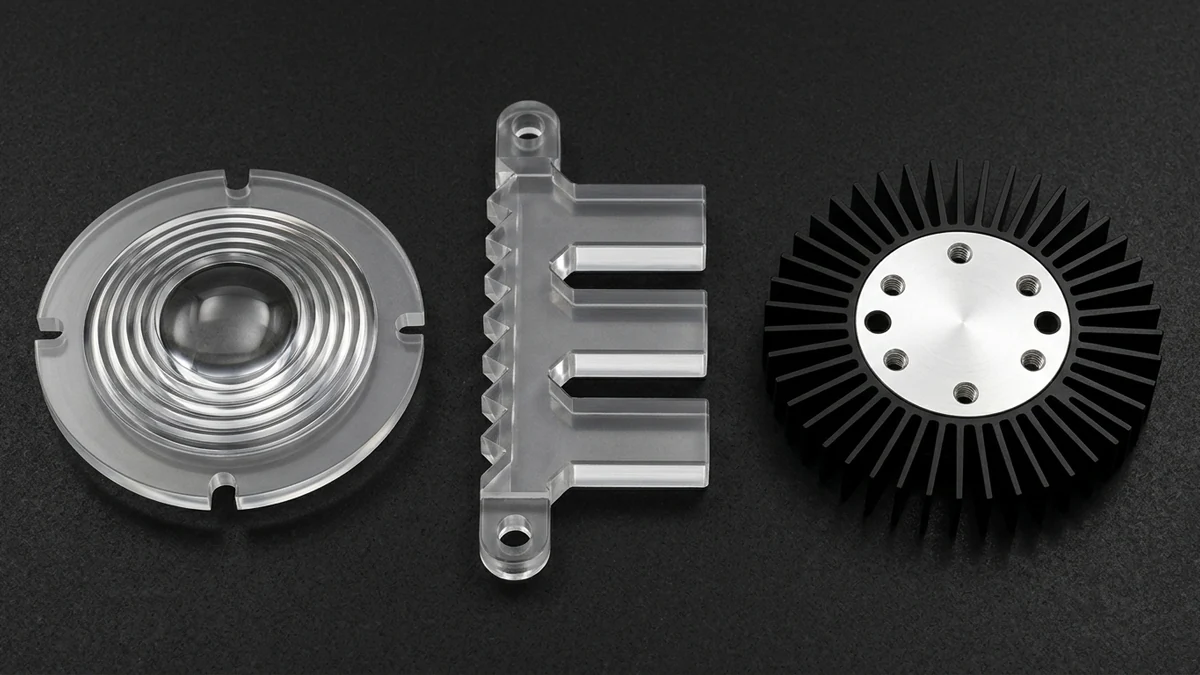
Our in-house shop delivers lighting & optical CNC machining via Single-Point Diamond Turning (SPDT), 3-axis/4-axis Computer Numerical Control (CNC) milling, and sheet metal fabrication. As shown in our optical-thermal trio, we machine Polymethyl Methacrylate (PMMA) Total Internal Reflection (TIR) lenses (Ra ≤ 0.02 µm / 0.8 µin), stepped light guides, and 6063-T5 Light-Emitting Diode (LED) heatsinks.
4-Stage Optical Photometry & Thermal Luminaire Lifecycle
Validate Illuminating Engineering Society (IES) beam distributions, Chip-on-Board (COB) junction temperatures, and IP68 ingress seals before cutting production molds. All schedules reflect Ex-Factory Production & Inspection Turnaround (separate from 3–5 business days DHL/FedEx/UPS air transit).
Optical Facet & Thermal DFM Review
Ex-Factory: Within 24 HoursDesign for Manufacturability (DFM) audit of TIR Fresnel undercut angles, diamond tool reach, heatsink fin-to-gap ratios, Metal-Core Printed Circuit Board (MCPCB) pad flatness, and AS568 O-ring gland squeeze.
- ✓ Diamond cutter & 5-axis clearance check
- ✓ Heatsink fin aspect-ratio verification
- ✓ Optical gating & extrusion bridge DFM
Goniophotometer & Thermal PoC
Ex-Factory: 4 – 8 Business DaysDirect SPDT turning and multi-axis milling of virgin cast PMMA lenses alongside 3-axis CNC milling of uncoated 6063-T5 heatsinks for darkroom IES photometry and thermocouple validation.
- ✓ 1 to 20 optical-grade PMMA lens prototypes
- ✓ Ra ≤ 0.02 µm (0.8 µin) SPI A-1 polish
- ✓ Bare Ra 0.4 µm (16 µin) COB pads
Anodized IP68 & Vapor-Polished Pilots
Ex-Factory: 7 – 12 Business DaysPilot luminaire builds (10–100 units) combining 110–120 °C annealed and vapor-polished PC lenses, MIL-A-8625 Type II/III anodized 6061-T6 housings, faceted reflectors, and powder-coated SPCC driver trays.
- ✓ 3.5–6.0 bar air-decay & water immersion test
- ✓ ASTM B117 salt-spray hard anodizing
- ✓ Pre-dispatch optical-to-heatsink fit-up
Optical Molding, HPDC & Extrusion
Ex-Factory: 12 – 35 Business DaysRapid aluminum bridge molds (12–18 business days) and hardened S136 (48–52 HRC) SPI A-1 optical molds on Fanuc Roboshot presses, plus 6063-T5 extrusion and A380 High-Pressure Die Casting (HPDC) in 18–35 business days.
- ✓ Clean all-electric optical PMMA/PC molding
- ✓ Liquid Silicone Rubber (LSR) micro-optics
- ✓ Custom 6063-T5 extrusion + post-CNC
Precision Lighting, Optical & Thermal Component Showcase
Secondary optics, passive COB thermal management, and architectural luminaire hardware paired with shop-floor machining processes—combining ISO 2768-mK structural fits with sub-micron optical surfaces.
 Diamond Optical CNC
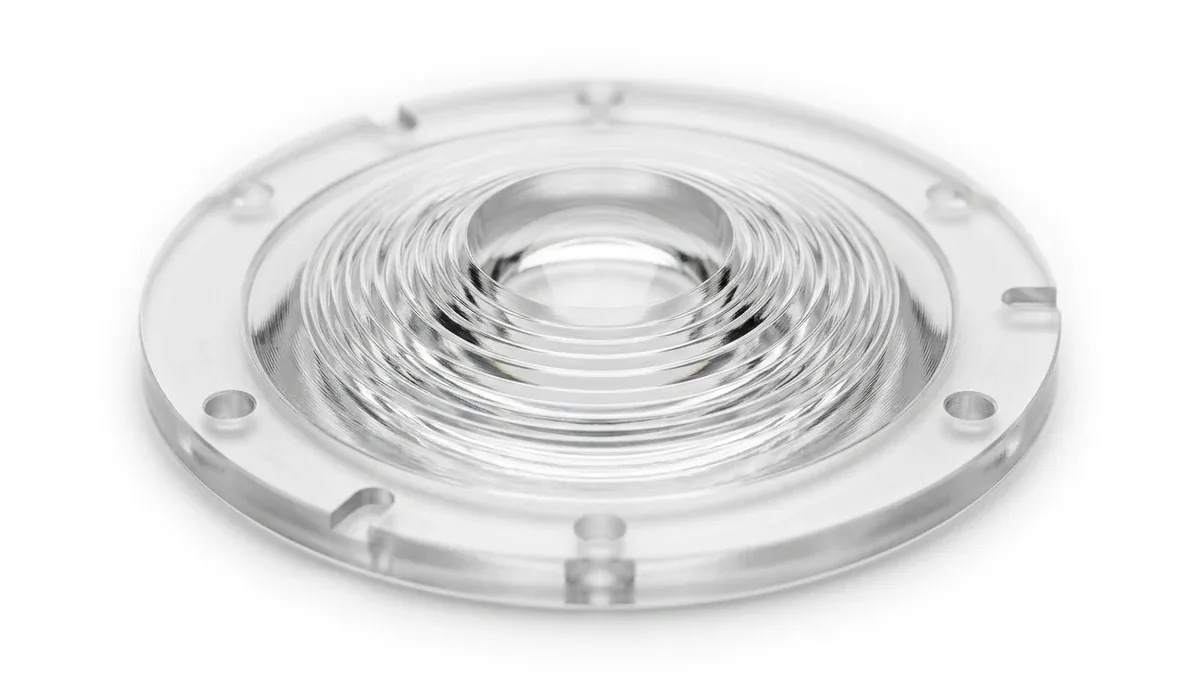
Optical PMMA TIR Collimator Lenses
Single-point diamond-turned cast PMMA collimator lenses featuring a central recessed hemispherical LED entry cavity, concentric stepped total-internal-reflection conical rings, and a slotted alignment flange.
 3-Axis Thermal VMC
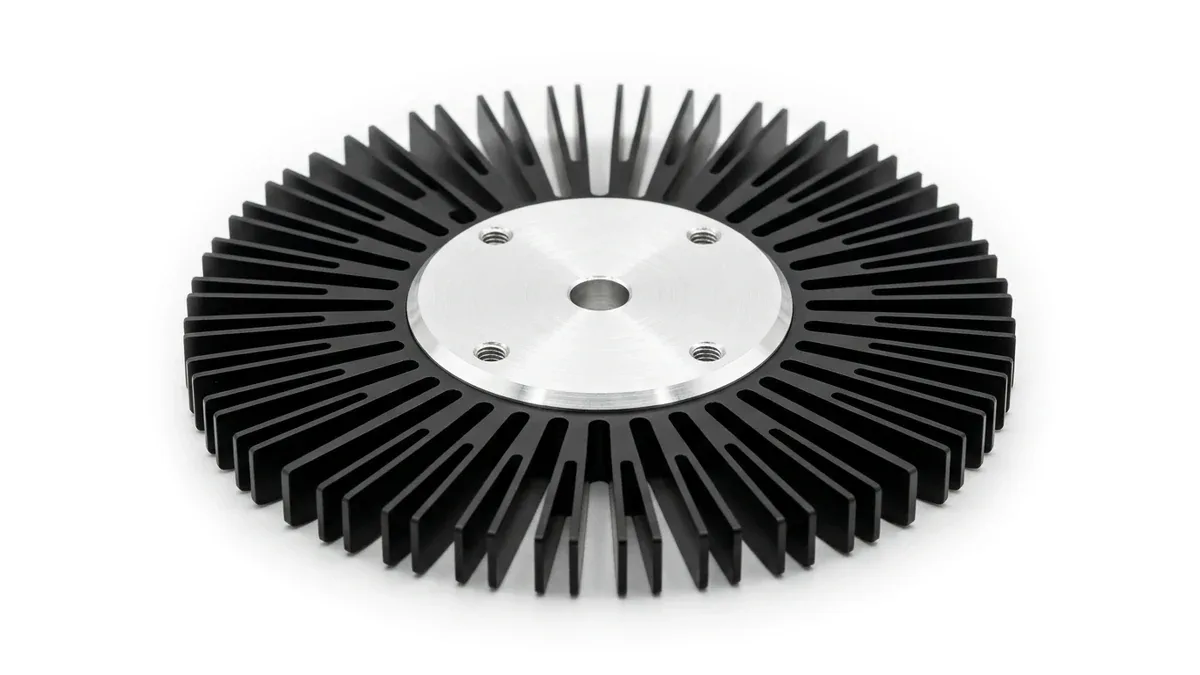
Radial Sunflower High-Bay LED Heatsinks
High-conductivity 6063-T5 (201 W/m·K) radial heatsinks machined on 3-axis Vertical Machining Centers (VMCs) with open-ended convection fins, matte-black anodized outer surfaces, and a bare fly-cut central COB pad.
 Reflectors & Baffles
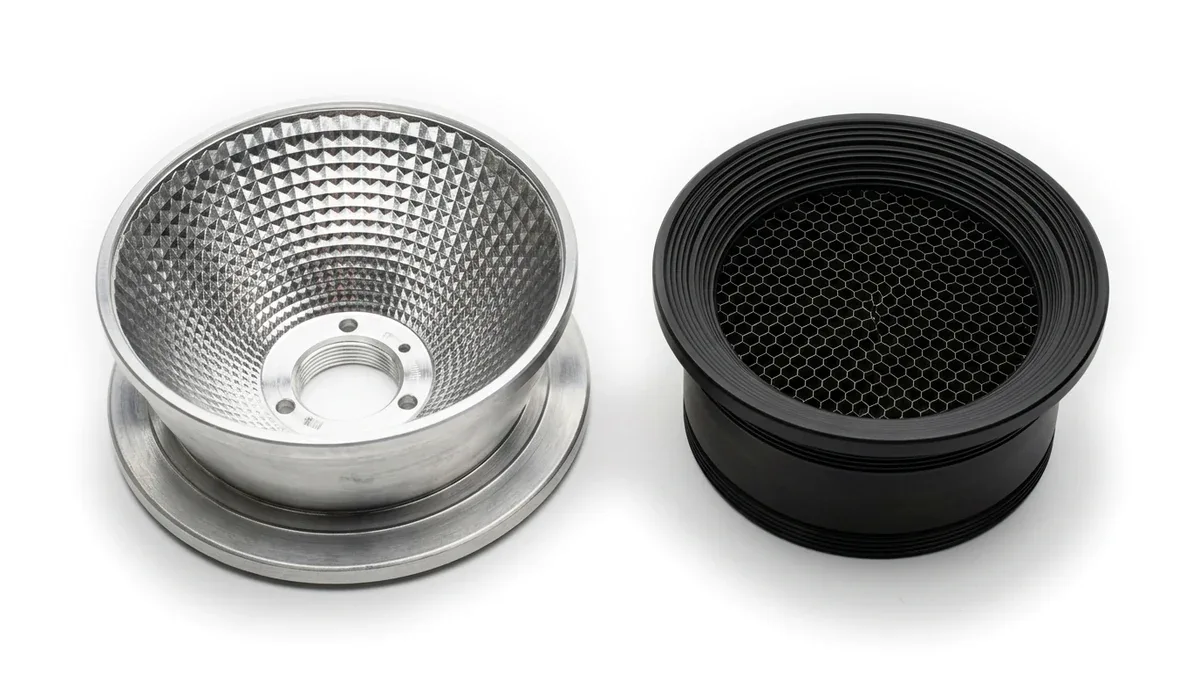
Faceted Reflector Cups & Honeycomb Baffles
CNC-turned and micro-milled 6061-T6 aluminum parabolic downlight reflector bowls featuring faceted beam-mixing inner geometry, paired with matte-black anodized honeycomb anti-glare snoot baffles for Unified Glare Rating (UGR < 16) control.
 IP68 Sealed Enclosures
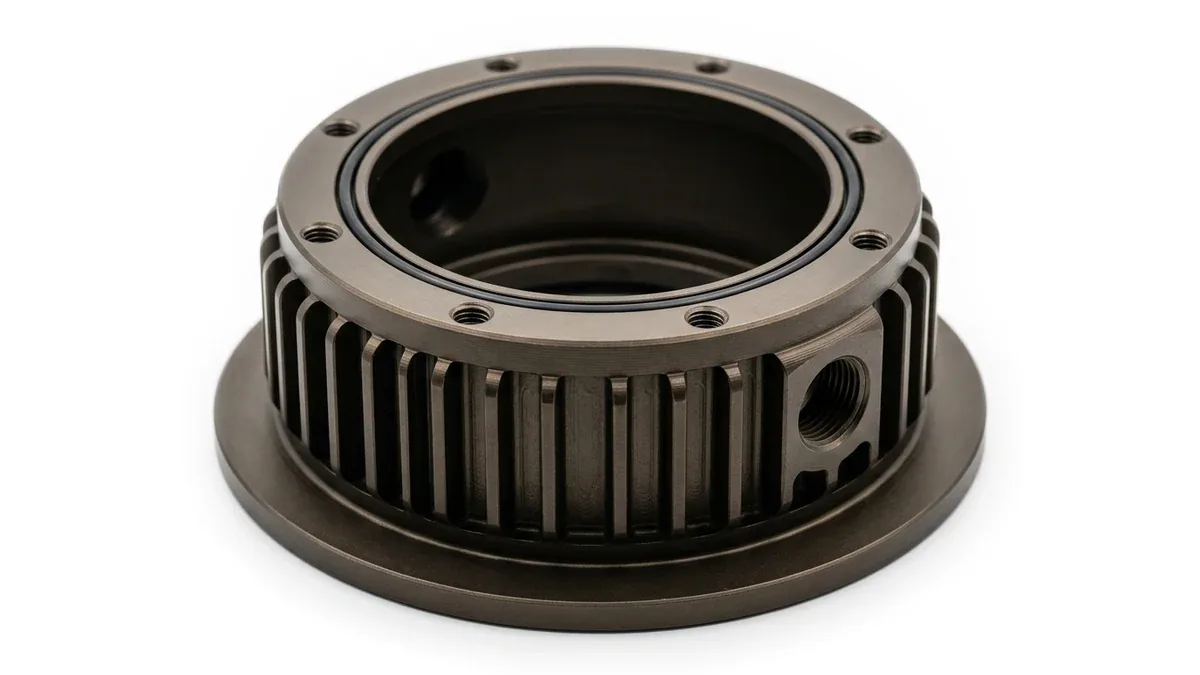
IP68 Architectural Floodlight & Marine Housings
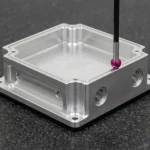
Heavy-duty 6061-T6 aluminum and 316L stainless steel outdoor floodlight bodies finished in bronze MIL-A-8625 Type III hardcoat, featuring a continuous closed-loop O-ring groove inside the bezel bolt circle and side cable-gland threads.
 Mill-Turn & Swiss CNC
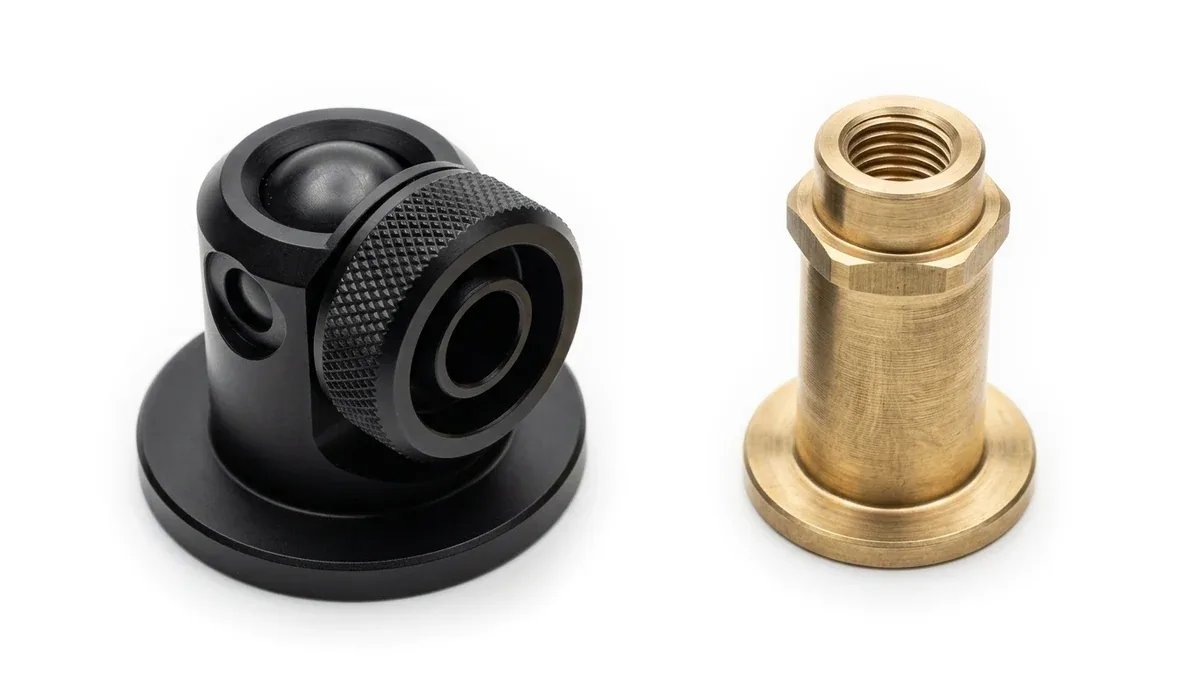
Track-Light Gimbal Swivels & Brass Standoffs
CNC mill-turned satin-black anodized 6061-T6 track-light 360° spherical gimbal swivels with diamond-knurled focus-locking rings and internal wire-pass bores, paired with STAR Swiss-turned C3604 brass flanged hex thermal standoffs.
 Sheet Metal & Linear Optics
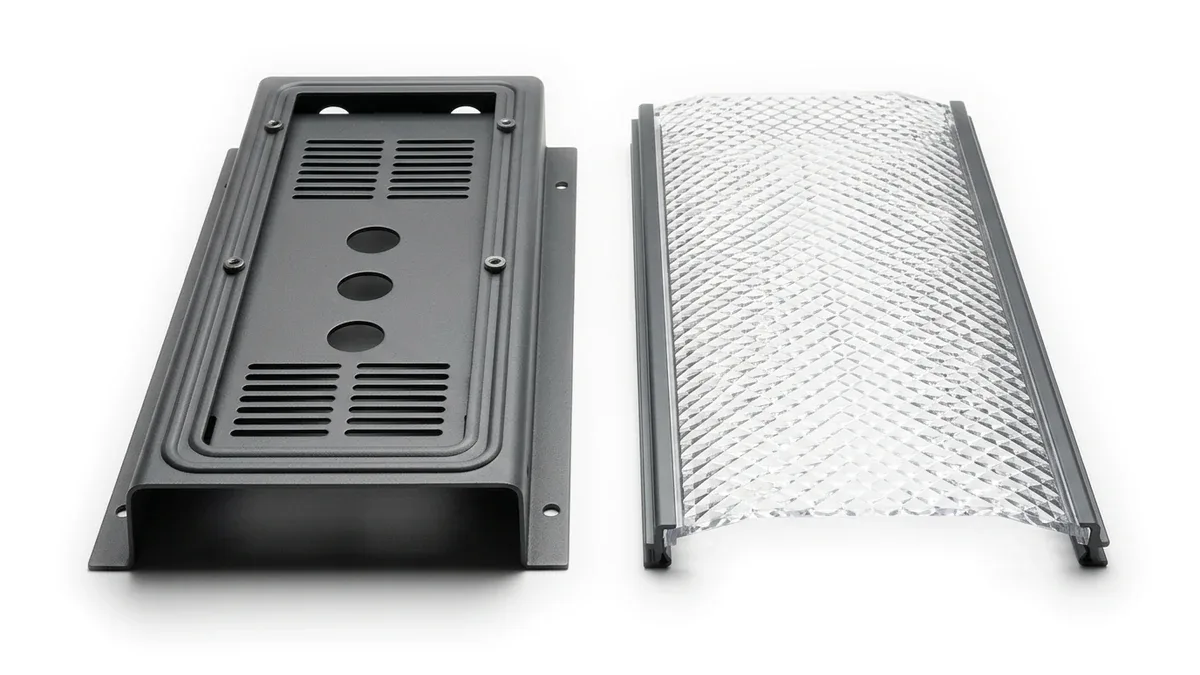
Sheet Metal Driver Trays & Linear Diffusers
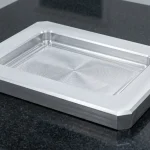
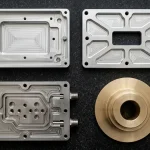
12 kW fiber-laser cut and 160-ton CNC press-brake bent 1.2 mm (0.047″, 18 Ga Steel) SPCC/SECC linear LED driver trays featuring cooling louvers, conduit knockouts, and self-clinching standoffs alongside snap-in micro-prismatic PC diffusers.
Why Do Machined Optical Lenses Craze or Lose Luminous Flux?
Machined optical lenses lose luminous flux when frosted cutter cusps (Ra 1.6–3.2 µm / 63–126 µin) scatter Total Internal Reflection rays, and craze when unannealed residual tensile stresses fracture under solvent vapor.
1. Virgin Cast PMMA Optical Track
Virgin cast PMMA lenses are machined at Vc = 200–350 m/min (fz = 0.03–0.06 mm/tooth under oil-free chilled air), annealed at 70–80 °C (158–176 °F), and finished via SPDT or #800–#5000 diamond buffing. Freeform wave-guides use simultaneous 5-axis CNC, avoiding flame or dichloromethane (DCM) vapor to prevent crazing and Fresnel rounding.
SPI A-1 (Ra ≤ 0.02 µm) · Avoid if Impact > IK06 or Temp > 85 °C2. Annealed Optical Polycarbonate Track
Polycarbonate (Tg ≈ 147 °C) delivers IK10 impact toughness and 135 °C (275 °F) heat deflection, yet cracks into spiderweb crazing if exposed directly to solvent vapor. In our TO-1200 forced-air ovens, every machined PC lens undergoes a mandatory 110–120 °C (230–248 °F) stress-relief cycle before controlled DCM vapor smoothing of internal light-pipe channels.
110–120 °C Anneal + DCM Vapor · Avoid Unstabilized PC Outdoors3. Clear SLA / PU vs. Optical LSR
Thermoset clear Stereolithography (SLA) photopolymers and vacuum-cast polyurethanes cannot be vapor-polished; we wet-sand (#800–#2000) and apply UV-resistant clear lacquer for early bezel mockups. Avoid clear SLA near hot COB emitters (> 60 °C) where photopolymers yellow—switch to cast PMMA/PC or platinum-cured Optical LSR (−40 °C to +150 °C).
#800–#2000 Wet Sand + UV Coat · LSR for High-Flux UV/Blue LEDsShop-Floor Failure Troubleshooting (Symptom → Root Cause → Action)
- Symptom: Delayed micro-fissure crazing around M3 mounting bosses on vapor-polished PC floodlight covers within 24 hours of assembly.
- Root Cause: Aggressive drilling heat combined with skipping high-temperature annealing (or annealing at 70 °C PMMA settings well below PC’s 147 °C glass transition) left locked-in hoop tensile stress.
- Corrective Action: In our in-house machining practice, we peck-drill and thread-mill optical PC under chilled air mist, ramp parts to 115 °C in a programmable TO-1200 oven with slow controlled cooling, and re-verify bore clearances on a non-contact 2.5D Optical Video Measuring System (VMS) before DCM vapor exposure.
Illustrative Calculation: 80 W COB Pedestal Anodic Oxide Thermal Penalty
- Inputs (Illustrative Model): Thermal power Pth = 80 W across a 25 × 25 mm COB pad (Apad = 6.25 × 10⁻⁴ m²) on a 6063-T5 heatsink. Compare an unmasked 50 µm Type III oxide layer (tox = 5.0 × 10⁻⁵ m, porous kox = 1.2 W/m·K) + 150 µm grease gap (ktim = 3.0 W/m·K) against a post-anodize fly-cut bare pad (tox = 0, ⏥ 0.025 mm flatness, 40 µm grease layer).
- 1D Conduction Formula: Rth = t / (k × Apad) and ΔTinterface = Pth × (Rox + Rtim).
- Calculation: Unmasked Rox = (5.0 × 10⁻⁵) / (1.2 × 6.25 × 10⁻⁴) = 0.0667 K/W and Rtim = (1.5 × 10⁻⁴) / (3.0 × 6.25 × 10⁻⁴) = 0.0800 K/W → ΔTunmasked = 80 × 0.1467 = 11.7 °C (21.1 °F). Fly-cut bare pad Rtim,fly = (4.0 × 10⁻⁵) / (1.875 × 10⁻³) = 0.0213 K/W → ΔTflycut = 80 × 0.0213 = 1.7 °C (3.1 °F).
- Shop-Floor Takeaway: Fly-cutting the central 6063-T5 pedestal drops interface temperature rise by 10.0 °C (18.0 °F), preserving LED L70 lumen lifetime without increasing heatsink mass.
Direct In-House Lighting Facility vs. Order-Routing Marketplaces
Why luminaire hardware leads and optical engineers work directly with our integrated Shenzhen optical, thermal CNC, and sheet metal shop floor rather than fragmented online marketplaces.
| Engineering Vector | Crowdsourced Order-Routing Marketplaces | AS Prototypes (In-House Direct Facility) | Recommended Application / Impact |
|---|---|---|---|
| PMMA TIR Lens Clarity | General job shops mill extruded acrylic with standard carbide tools, leaving frosty Ra 1.6 µm cusps or flame-polished edge distortion. | Virgin Cast PMMA + SPDT / SPI A-1 Buff: 70–80 °C annealed cast blocks diamond-turned to Ra ≤ 0.02 µm (≥ 92% transmittance). | Best for darkroom IES goniophotometer beam validation without optical mold Non-Recurring Engineering (NRE). |
| Polycarbonate Crazing Control | Direct solvent fumigation or low-temp 70 °C baking fails to relieve PC stress (Tg ≈ 147 °C), causing spiderweb cracking. | Mandatory 110–120 °C Oven Annealing: Controlled TO-1200 stress-relief cycle before DCM vapor smoothing prevents crazing. | Best for IK10 vandal-resistant outdoor floodlight covers and complex internal light pipes. |
| COB Heatsink Thermal Pad | Full black anodizing across the entire heatsink coats the central MCPCB pad in insulating oxide, spiking LED junction temperature. | Silicone-Masked or Fly-Cut Bare Pedestal: Bare aluminum ⏥ 0.030 mm / 100 mm, Ra 0.4 µm pad paired with black-anodized outer fins (per 50%/50% anodic oxide masking DFM). | Best for high-wattage stadium, horticultural, and architectural COB downlight engines. |
| Optical-to-Chassis Fit-Up | Lenses, reflector bowls, heatsinks, and sheet metal trays split across separate vendors; Z-axis focal stack errors ruin beam cutoff. | Single-Roof Physical Trial Assembly: Optics, reflectors, gaskets, and heatsinks are test-fitted together before shipment. | Best for multi-material architectural luminaires requiring tight LED-to-optic focal lock. |
| Optical Metrology Safety | Contact Coordinate Measuring Machine (CMM) probes dragged across clear polymer lenses leave micro-scratches on optical apertures. | Split Non-Contact / CMM Protocol: 2.5D Optical VMS for clear optics & sheet metal; Zeiss CMM strictly on metal housings. | Best for preserving scratch-free SPI A-1 optical surfaces alongside First Article Inspection (FAI) reports. |
| Tooling & Scaling Economics | Opaque platform markups on hand-polishing and disconnected handoffs when moving from CNC prototypes to production molds. | Custom Quoted per CAD DFM: Direct transition from CNC PoC to in-house Fanuc Roboshot S136 optical injection molding. | Best for hardware teams scaling seamlessly from 5 PoC units to 50,000+ molded luminaires. |
Lighting & Optical Material Selection & Tolerances Matrix
Verified refractive indices, visible transmittance, thermal conductivity, annealing protocols, and achievable in-house tolerances across optical polymers and luminaire metals (explore our full engineering materials library).
| Material Designation | Optical / Thermal Property | Annealing & Surface Protocol | Achievable Tolerance (mm / in) | Recommended Application / When to Choose |
|---|---|---|---|---|
| Optical Cast PMMA Virgin Cast Acrylic Block | n = 1.491 · ≥ 92% Transmittance · ~85 °C Max Service | 70–80 °C Anneal + SPDT or #800–#5000 Wet Sand & Diamond Buff (SPI A-1, Ra ≤ 0.02 µm) | ±0.015 mm (±0.0006″)General: ISO 2768-mK | Best for UV-stable TIR collimator lenses, Fresnel optics, and edge-lit light guides; avoid under IK10 impact loads. |
| Optical Polycarbonate (PC) UV-Stabilized Optical Grade | n = 1.586 · 88%–89% Transmittance · 135 °C HDT (0.45 MPa) | Mandatory 110–120 °C Anneal + Controlled DCM Vapor Polish + Anti-UV Hardcoat | ±0.020 mm (±0.0008″)General: ISO 2768-mK | Best for IK10 impact-resistant floodlight covers, automotive lenses, and deep internal light pipes. |
| Optical Silicone (LSR) Platinum-Cured LIM Grade | n ≈ 1.41 · ~94% Transmittance · −40 °C to +150 °C | Flash-Free Hardened S136 (48–52 HRC) SPI A-1 Liquid Injection Molding; Non-Yellowing | ISO 3302-1 Class M1/M2Flexible Self-Sealing | Best for bridge/production micro-lens arrays, high-flux UV/blue COB silicone optics, and integrated IP68 lens-gaskets. |
| Aluminum 6063-T5 / 1070 High-Conductivity Thermal Billet | k = 201 W/m·K (6063-T5) · 226 W/m·K (1070) | MIL-A-8625 Type II Matte Black Fins + Silicone-Masked or Fly-Cut Ra 0.4 µm COB Pad | ±0.015 mm (±0.0006″)Pad Flatness: ⏥ 0.030 mm | Best for passive radial sunflower heatsinks, high-bay LED coolers, and custom extruded linear profiles. |
| Aluminum 6061-T6 Structural & Reflector Billet | 310 MPa (45.0 ksi) UTS · k = 167 W/m·K | 150–165 °C Stress Relief; Optical Bright Dip / PVD Reflector or Type III Hardcoat (450–550 HV0.05) | ±0.010 mm (±0.0004″)General: ISO 2768-mK | Best for faceted parabolic reflector bowls, honeycomb anti-glare snoots, and IP68 outdoor floodlight housings. |
| Brass C3604 & SS 316L Architectural & Submersible Metals | 380 MPa (C3604) · 515 MPa (316L Marine Grade) | Diamond Knurling on C3604; ASTM A967 Passivation (~0.002 µm) or ASTM B912 Electropolishing on 316L | ±0.010 mm CNC · ±0.005 mm SwissSwiss Bar ≤ Ø32 mm | Best for museum track-light swivel gimbals, hex thermal standoffs, and coastal/pool submersible bezels. |
| SPCC / SECC & Al 5052-H32 1.0–2.0 mm Stock Sheet Gauges | DIN 6935 Cold Bending · R_in ≥ 1.0t (Avoid 6061-T6 Sharp Bends) | High-Reflectance (> 90%) Matte White or Architectural Charcoal Electrostatic Powder Coat (60–120 µm) | Cut: ±0.10–±0.20 mm · Bent: ±0.20–±0.40 mmBend Angle: ±0.5°–±1.0° | Best for commercial recessed troffer pans, louvered LED driver trays, and linear pendant chassis. |
Empirical Quality Verification & Optical-Thermal Inspection
Inside our 20 °C ± 1 °C climate-controlled laboratory, we strictly separate non-contact optical inspection of scratch-sensitive polymers from tactile CMM probing of metallic thermal housings.
Non-Contact 2.5D VMS & Comparator
Clear PMMA/PC lenses, Fresnel tooth peaks, and thin sheet metal driver trays are inspected without physical stylus contact on our 2.5D Optical Video Measuring Systems (±0.003 mm) and ESSON EP-1 telecentric profile projectors.
- ✓ Scratch-free non-contact lens aperture check
- ✓ Mitutoyo SJ-210 Ra check on witness coupons
- ✓ Photometric test-jig mating fit verification
Fly-Cut COB Pedestal Metrology
High-density COB arrays require uniform thermal paste compression. After black anodizing, we verify bare central mounting pedestals to ⏥ 0.030 mm flatness per 100 mm and ISO 4287 Ra 0.4 µm (16 µin) surface finish.
- ✓ TESA Micro-Hite 700 & Zeiss CMM flatness check
- ✓ Calibrated go/no-go plug gauges on M2.5/M3 holes
- ✓ Masked grounding & thermal contact zones
IP68 Gland & Pressure-Decay Test
Outdoor floodlights undergo thermal breathing cycles that draw moisture past poorly machined seals. We mill continuous closed-loop AS568 O-ring grooves (15%–25% squeeze, 65%–85% fill) inside the perimeter fastener circle.
- ✓ 3.5–6.0 bar air-decay & water-bubble leak test
- ✓ ASTM B117 neutral salt-spray Type III hardcoat
- ✓ Die-cast CNC skim ≤ 0.3–0.6 mm (zero skin breach)
Zeiss CMM & Ballooned FAI Reports
Machined aluminum heatsinks, reflector mounting datums, and stainless steel marine bezels are verified on our Zeiss Contura / PRISMO CMM, backed by ballooned FAI and Mill Test Reports (MTRs) upon request.
- ✓ Geometric Dimensioning and Tolerancing (GD&T) checks
- ✓ Sodick 1-rough + 3–4 skim wire Electrical Discharge Machining (EDM) inserts
- ✓ Raw metal MTR & virgin optical resin lot reports
Technical Engineering FAQ: Optical Lens & Lighting Machining
Direct shop-floor answers on diamond-turned cast PMMA TIR lenses, selective COB heatsink anodize masking, 110–120 °C polycarbonate annealing, and calibrated ex-factory lead times.
We cut virgin cast PMMA blocks via monocrystalline Single-Point Diamond Turning (SPDT) or #800–#5000 wet sanding and diamond buffing to SPI A-1 clarity (Ra ≤ 0.02 µm / 0.8 µin). A 70–80 °C stress-relief anneal avoids flame or DCM vapor polishing, preventing solvent crazing and Fresnel edge rounding.
While MIL-A-8625 Type II black anodizing boosts radiative cooling across outer 6063-T5 fins (201 W/m·K), porous anodic oxide insulates high-flux LED substrates. We silicone-mask or fly-cut the central COB pad to bare aluminum (⏥ 0.030 mm / 0.0012″ flatness, Ra 0.4 µm / 16 µin) to minimize junction thermal resistance.
Because machined polycarbonate (Tg ≈ 147 °C) retains residual tensile stress that cracks under solvent exposure, we execute a mandatory 110–120 °C (230–248 °F) oven anneal before controlled dichloromethane (DCM) vapor polishing. For outdoor architectural luminaires, we machine UV-stabilized optical polycarbonate grades and apply protective UV-resistant hardcoats.
Following a 24-hour DFM review, diamond-turned PMMA lenses and bare CNC heatsinks complete in 4–8 business days ex-factory, while anodized IP68 housings and sheet metal trays take 7–12 business days. Rapid optical molds require 12–35 business days ex-factory, strictly separate from 3–5 days DHL/FedEx/UPS air transit.
- → Single-Point Diamond Turning (SPDT) & Optical Machining Guide
- → CNC Machining Cast Acrylic (PMMA): Annealing & Polishing DFM
- → Achieving Optical-Grade Surface Finishes in Plastic Machining
- → Precision Aluminum Parabolic Reflector Prototyping Workflow
- → Optical Polycarbonate Injection Molding: Drying & Stress Control
- → IP67/IP68 Sealed Billet Enclosures & Selective Masking DFM
- → Complimentary CAD Design for Manufacturability (DFM) Review
- → Explore All Custom Precision Hardware Industry Solutions
Ready to Prototype or Scale Your Lighting & Optical Hardware?
Upload your 3D CAD models (STEP, IGES, X_T, or SolidWorks) and 2D optical/mechanical tolerance drawings for a comprehensive manufacturability review, datum-locking strategy, and custom production quotation.