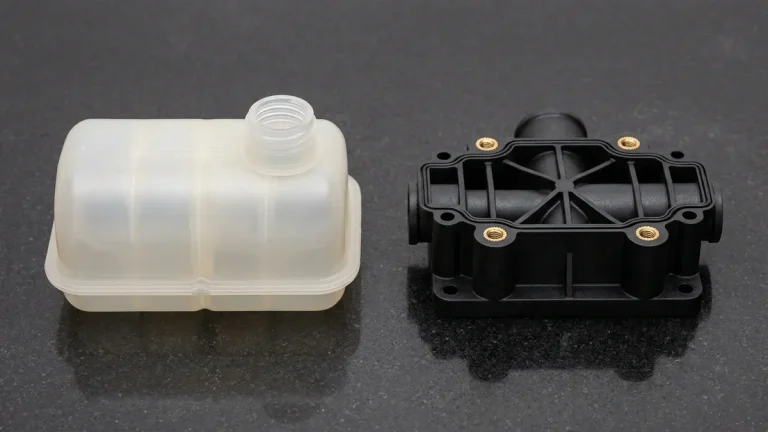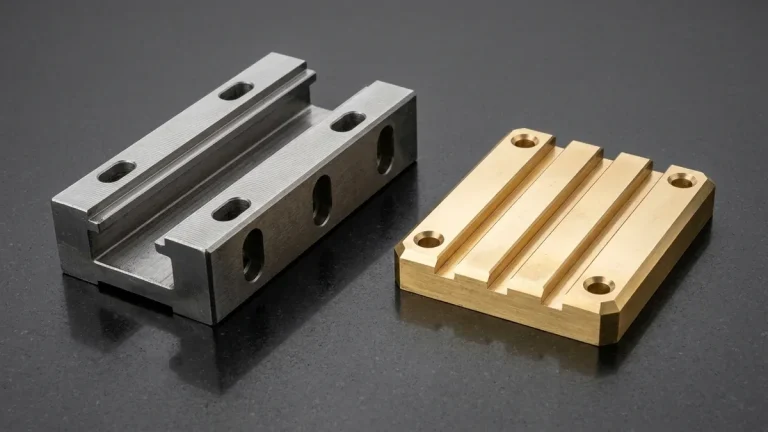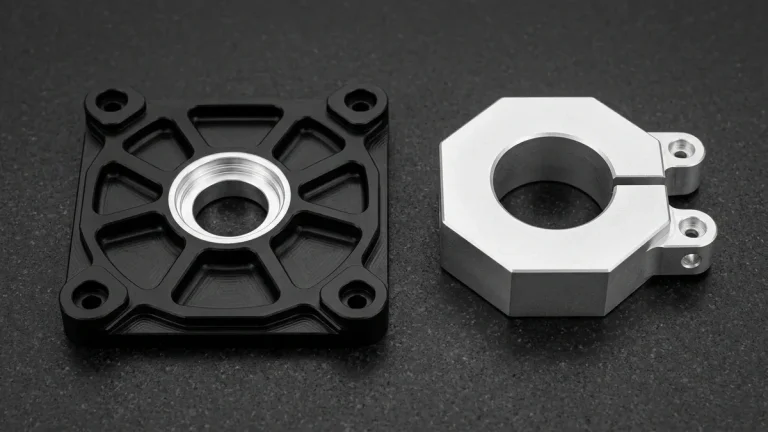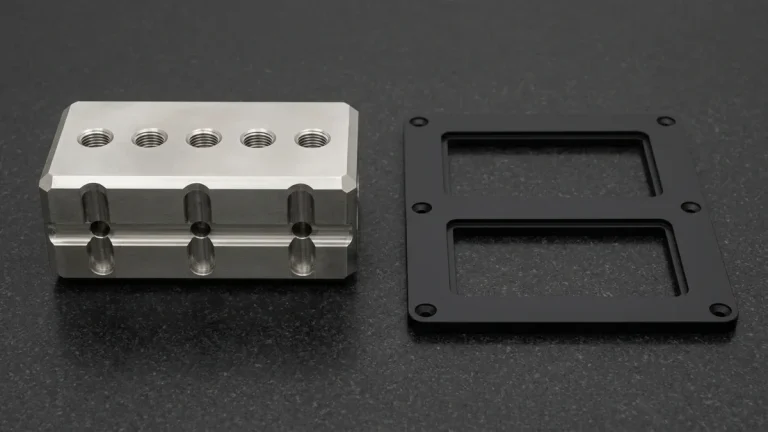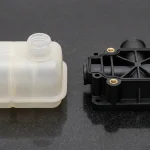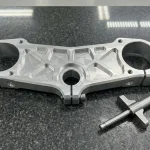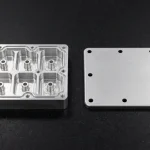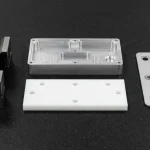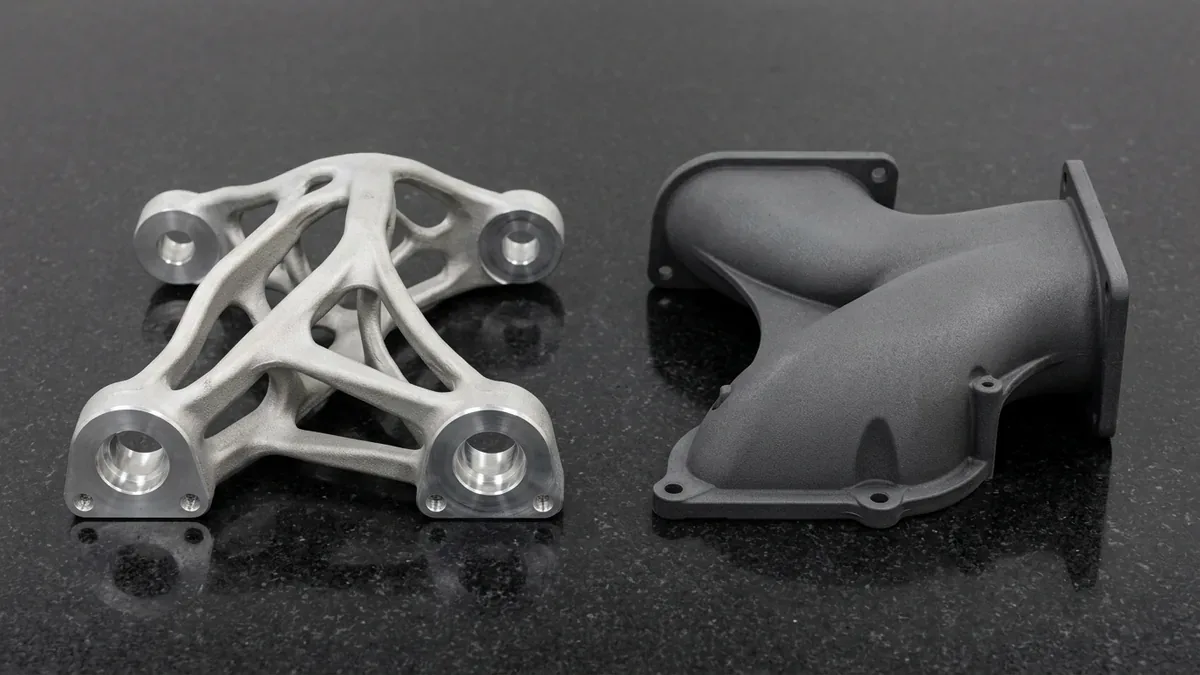
Automotive OEMs and tier-one suppliers face intense pressure to compress development timelines and reduce vehicle curb weights. Consequently, engineering teams are aggressively adopting industrial 3D printing in automotive manufacturing. Additive manufacturing transforms digital CAD concepts into functional chassis components within days without hard tooling delays. Therefore, physical wind tunnel testing, packaging trials, and crash simulations occur weeks earlier than traditional tooling permits.
Beyond early-stage styling models, additive manufacturing now produces structural metal brackets, custom assembly tooling, and end-use hypercar parts. Understanding the interplay between powder bed fusion, resin stereolithography, and structural plastics is vital for automotive engineers.
1. Generative Design and Metal Additive Lightweighting
Every kilogram removed from an electric vehicle chassis extends driving range and boosts vehicle dynamic handling. Specifically, industrial metal 3D printing services deploy Direct Metal Laser Sintering (DMLS) using automotive alloys like AlSi10Mg and Ti-6Al-4V. Laser optical scanners melt fine metal powders layer by layer under high-purity argon atmospheres.
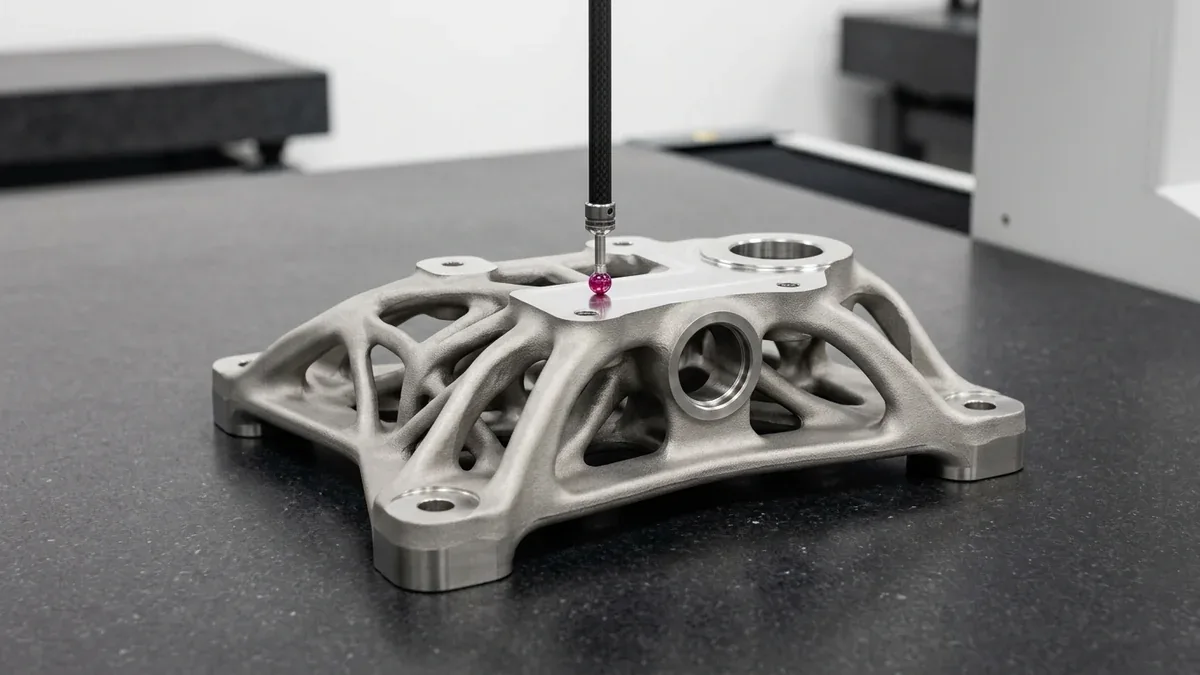
Consequently, generative design algorithms strip away unstressed material, creating organic internal lattice geometries. Traditional CNC milling cannot access these hollow internal cavities. However, DMLS builds internal fluid channels directly into brake calipers and battery cooling jackets. As a result, automotive structural components achieve up to 45% weight reduction while increasing structural stiffness.
Furthermore, consolidated additive manufacturing replaces multi-piece welded brackets with a single monolithic print. This geometric consolidation eliminates fastener failure risks and reduces vehicle assembly labor on the factory floor.
2. Additive Technologies Across the Automotive Ecosystem
Automotive design programs select distinct additive processes depending on structural load, thermal exposure, and surface finish needs. To illustrate, review the engineering parameter matrix below.
| Additive Technology | Standard Engineering Material | Dimensional Accuracy | Thermal & Yield Limits | Key Automotive Application |
|---|---|---|---|---|
| DMLS / SLM (Metal) | AlSi10Mg Aluminum, Ti-6Al-4V | ±0.1 mm to ±0.2 mm | Yield > 850 MPa (Ti), 160°C (Al) | Suspension uprights, turbo manifolds, motor housings |
| SLS (Powder Bed) | PA12 Nylon, Glass-Filled Nylon | ±0.2 mm to ±0.3 mm | HDT 175°C (Glass-filled PA12) | HVAC ducting, fluid reservoirs, wire harness clips |
| SLA (Photopolymer) | ABS-Like Resin, Clear Optical Acrylic | ±0.05 mm to ±0.1 mm | Smooth Ra 0.8 μm, HDT 65°C | Headlight light pipes, dashboard fascia, styling grilles |
| FDM / FFF (Extrusion) | Carbon-Fiber PEEK, Polycarbonate | ±0.3 mm | HDT > 250°C (PEEK) | Assembly line ergonomic jigs, drill guides, inspection nests |
3. Rapid Production Tooling and Low-Volume Manufacturing
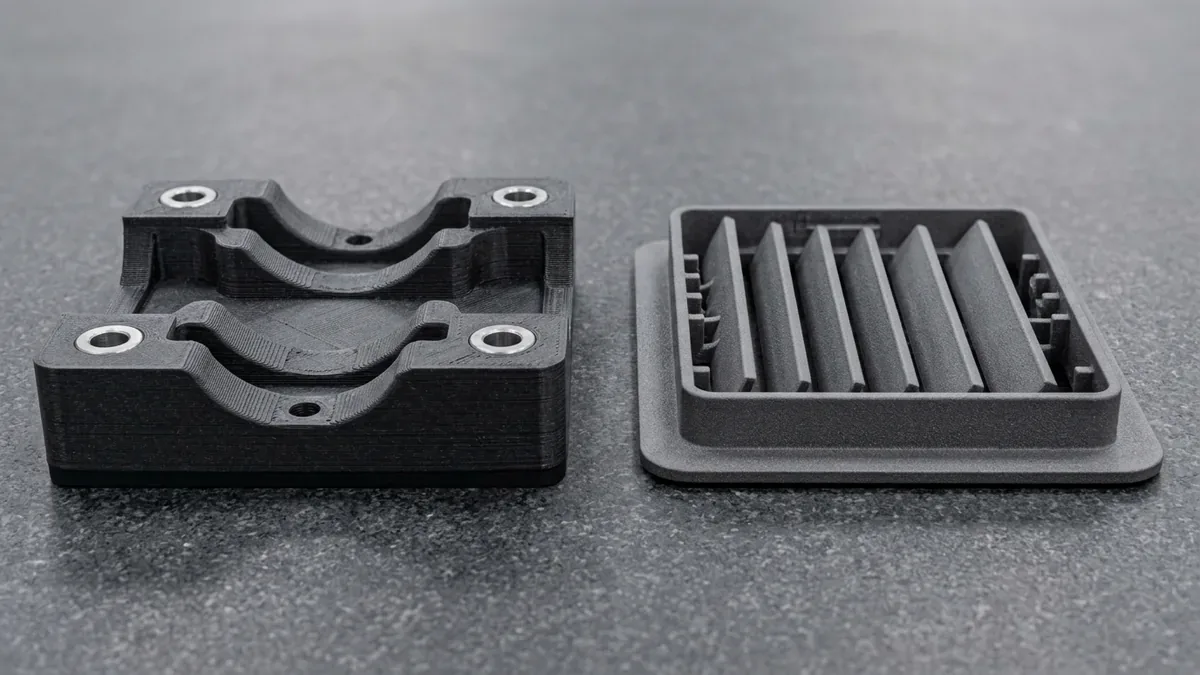
Automotive assembly lines require hundreds of custom jigs, nesting fixtures, and robotic end-effectors. Traditionally, machining heavy steel assembly aids required four to eight weeks of CNC shop time.
Conversely, additive manufacturing builds durable, lightweight composite fixtures in days rather than weeks. Robotic arms move faster with lighter 3D-printed carbon fiber end-effectors. Consequently, line cycle times decrease while operator ergonomics improve dramatically.
Moreover, additive manufacturing serves niche hypercars and heritage vehicle restorations. Stamping steel body panels requires substantial capital investment in heavy steel stamping dies. In contrast, 3D printing builds custom components on demand without tooling amortization. Thus, our specialized automotive prototype manufacturing team supplies critical components for limited-run production.
To examine the economic trade-offs between additive manufacturing and traditional hard tooling, review the comparison below.
| Project Parameter | Additive Manufacturing (3D Printing) | Traditional Tooling (Stamping & Molding) | Production Advantage |
|---|---|---|---|
| Tooling Investment (NRE) | Zero Tooling NRE (Direct CAD Build) | High Capital Tooling Investment per Die | Zero capital risk for pre-series pilot runs |
| First Article Turnaround | 4 to 8 Business Days (Ex-Factory) | 6 to 12 weeks tooling fabrication | Fast crash test and ergonomic validation |
| Design Iteration Flexibility | Instant digital file updates | Costly CNC tool welding & EDM rework | Continuous design optimization without scrap |
| Economic Break-Even Volume | 1 to 500 units per program | 10,000+ units for volume production | Optimal for special editions and motorsport |
In summary, integrating industrial 3D printing across vehicle development accelerates innovation cycles while lowering prototype expenditures.
4. Technical Engineering FAQ
DMLS metal 3D printing enables topology optimization and internal lattice cores. Consequently, engineers place structural metal only along direct stress vectors, shedding up to 45% of total part mass.
Selective laser sintering with carbon-filled nylon and high-temp FDM provide high stiffness and impact resistance. Therefore, assembly fixtures are printed quickly, resisting repeated factory floor impacts without marring painted panels.
Yes. Industrial materials like DMLS aluminum, titanium alloys, and carbon-fiber PEEK operate reliably above 200 degrees Celsius. Thus, additive components survive intense under-hood thermal cycles effortlessly.
Accelerate Hardware Validation with Industrial 3D Printing & Hybrid CNC
Bridge additive design freedom with precision CNC datum finishing and polyurethane vacuum casting. Upload your 3D CAD assemblies (STEP/IGES/STL) to evaluate material selection, functional tolerances, and batch unit economics.
Request an Additive & Prototyping DFM Analysis