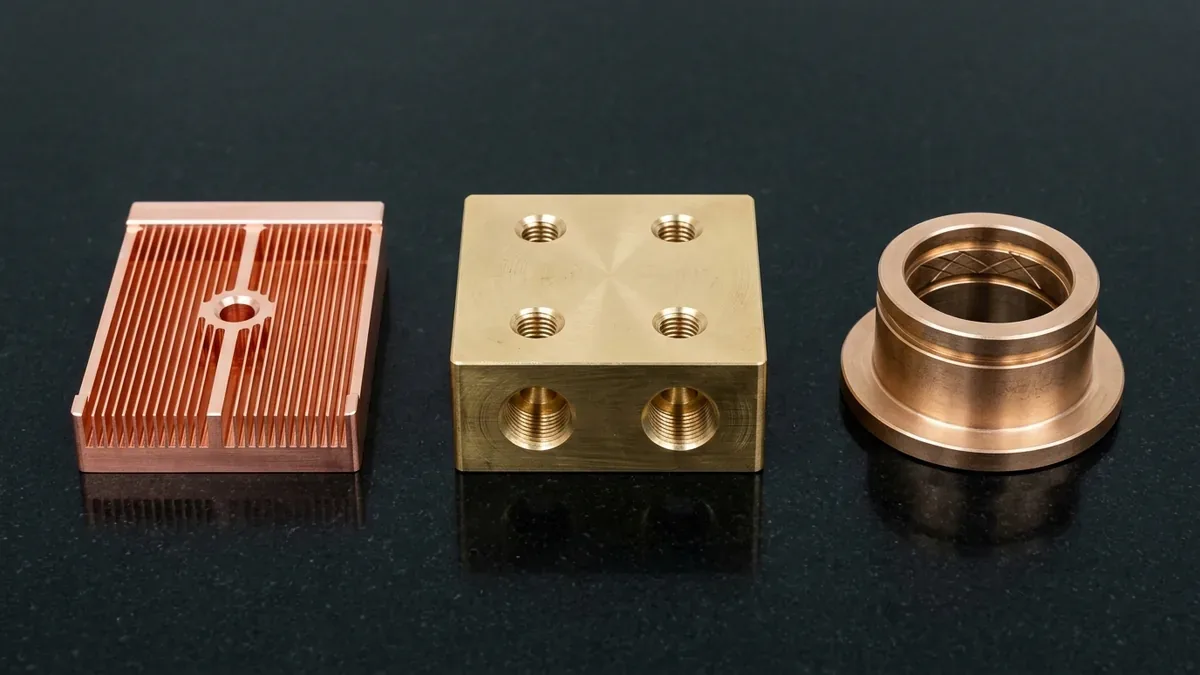
In the realm of non-ferrous engineering materials, the trio collectively known as the “red metals”—copper, brass, and bronze—forms the cornerstone of modern electrical power systems, fluid handling, thermal management, and precision mechanical assemblies. Distinctive for their reddish-golden warm aesthetic, these three metals share exceptional corrosion resistance, non-magnetic properties, and superior acoustic resonance. In precision manufacturing, mastering brass vs bronze vs copper machinability ensures repeatable dimensional stability and predictable production scaling.
However, from the standpoint of mechanical design and CNC manufacturing, copper, brass, and bronze are worlds apart. While unalloyed copper reigns supreme in electrical conductivity and thermal heat transfer, its gummy ductility poses severe challenges during chip breaking and hole tapping.
Conversely, brass alloyed with zinc and lead delivers benchmark 100% machinability and tight ±0.010 mm (±0.0004″) dimensional precision, but risks catastrophic dezincification in marine environments. Bronze, bolstered by tin, aluminum, or silicon, provides rock-solid wear resistance and extreme yield strength under massive bearing loads, yet demands high-rigidity CNC tooling to combat aggressive work-hardening.
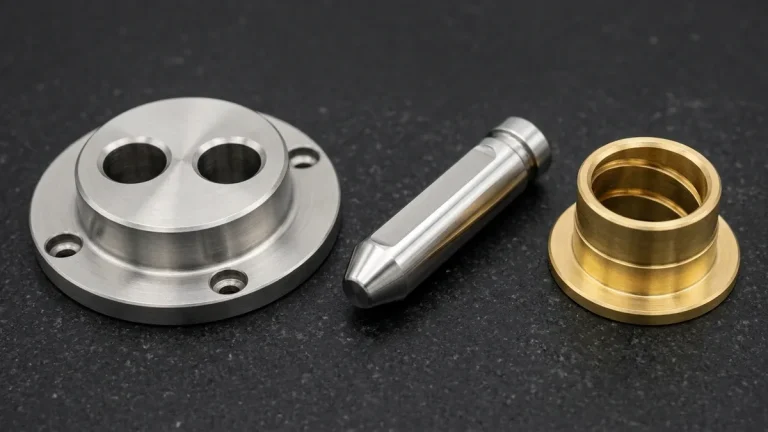
At AS Prototypes, our multi-axis CNC milling, turning, and swiss-machining cells fabricate thousands of precision red metal components every month. From pure C10100 oxygen-free electronic copper busbars to high-strength C95400 aluminum bronze marine bushings and C36000 free-cutting brass valve blocks, we optimize tooling and cutting parameters for every alloy grade. Below is our definitive engineering guide to the metallurgical foundations, physical properties, CNC machinability, and design trade-offs of brass, bronze, and copper.
- 1. Metallurgical Taxonomy: Pure Metal vs. Engineered Alloys
- 2. Physical & Mechanical Property Comparison
- 3. CNC Machinability & Tooling Dynamics: The Real Difference
- 4. Corrosion Resistance & Environmental Behavior
- 5. Engineering Case Study: High-Power Liquid-Cooled EV Inverter Subsystem
- 6. Design for Manufacturability (DFM) Rules for Red Metals
- 7. Technical Engineering FAQ
1. Metallurgical Taxonomy: Pure Metal vs. Engineered Alloys
Understanding the operational behavior of the red metals begins at the atomic lattice and alloying level:
- Pure Copper (Unalloyed Chemical Element, Symbol: Cu):
- Crystal Structure: Face-Centered Cubic (FCC) lattice, granting extreme ductility and malleability.
- Elemental Purity: Commercial engineering grades contain 99.90% to 99.99% pure copper. Common designations include C11000 (Electrolytic Tough Pitch, ETP) containing trace oxygen (0.02%–0.04%), and C10100 / C10200 (Oxygen-Free Electronic / High Conductivity, OFE/OFHC) with zero oxygen, making it immune to hydrogen embrittlement during brazing.
- Thermal & Electrical Benchmark: Copper serves as the global international standard for electrical conductivity (100% IACS ≈ 58.0 MS/m) and exhibits exceptional thermal conductivity (k ≈ 391–401 W/(m · K)).
- Brass (Copper-Zinc Binary & Multi-Element Alloys):
- Primary Alloying Mechanism: Zinc (Zn, typically 15%–40%) dissolves into copper via solid-solution strengthening. Alloys with < 35% Zn exhibit an α-phase FCC structure (ductile cold-working brass like C26000 Cartridge Brass); alloys with 36%–45% Zn form a dual-phase α+β’ structure (stronger, suited for hot-forging and extrusion like C36000 Free-Cutting Brass).
- Machinability Enhancers: Standard free-cutting brass (UNS C36000) incorporates 2.5% to 3.7% elemental lead (Pb). Because lead is insoluble in the brass matrix, it precipitates as microscopic globular inclusions that act as internal chip breakers and built-in solid lubricants, reducing tool friction to absolute minimums.
- Specialty Brass: Naval Brass (C46400) contains 1% tin (Sn), which inhibits dezincification in saltwater and industrial brackish environments.
- Bronze (Copper-Tin, Copper-Aluminum, and Multi-Element Alloys):
- Historical vs. Modern Definition: Historically, bronze referred exclusively to copper alloyed with tin (Sn, typically 6%–12%). In modern industrial engineering, “bronze” encompasses any copper alloy where zinc is not the primary secondary element.
- Phosphor Bronze (C51000 / C54400): Copper alloyed with 4%–9% Sn and deoxidized with 0.03%–0.35% phosphorus. Phosphorus increases fatigue resistance, spring rate, and wear resistance, making it the premier material for electrical switch contacts, bellows, and leaf springs.
- Bearing Bronze / SAE 660 (C93200): Continuous-cast alloy (83% Cu, 7% Sn, 7% Pb, 3% Zn). Engineered specifically for journal bearings, thrust washers, and bushings operating under moderate loads and high boundary lubrication.
- Aluminum Bronze (C95400 / C63000): High-strength alloy containing 9%–11% Al, plus iron and nickel. Achieves tensile strengths surpassing 650–780 MPa—comparable to structural medium-carbon steels—with total immunity to cavitation erosion and marine bio-fouling.
2. Physical & Mechanical Property Comparison
Selecting the optimal red metal requires evaluating strict physical trade-offs. The table below provides a comprehensive, engineering-verified comparison of mechanical and physical parameters:
Comprehensive Technical Comparison: Brass vs. Bronze vs. Copper
| Alloy Family & Grade | Nominal Composition | Tensile Yield Strength (MPa) | Hardness (Rockwell / Brinell) | Electrical Conductivity (% IACS) | Thermal Conductivity (W/m·K) | Machinability Index (%) |
|---|---|---|---|---|---|---|
| Pure Copper (C11000 ETP) | 99.90% Cu, 0.04% O | 69 – 290 (Annealed / Hard) | HRF 40 – 85 | 101% | 391 – 401 | 20% (Gummy, long stringy chips) |
| Oxygen-Free Copper (C10100 OFE) | 99.99% Cu | 65 – 280 (Annealed / Hard) | HRF 35 – 80 | 101% | 398 – 401 | 20% (High ductility, low burr control) |
| Free-Cutting Brass (C36000) | 61.5% Cu, 35.5% Zn, 3.0% Pb | 150 – 310 | HRB 55 – 78 | 26% – 28% | 115 | 100% (Industry Reference Standard) |
| Naval Brass (C46400) | 60% Cu, 39.25% Zn, 0.75% Sn | 170 – 380 | HRB 60 – 82 | 26% | 116 | 30% (Tin addition resists dezincification) |
| Bearing Bronze / SAE 660 (C93200) | 83% Cu, 7% Sn, 7% Pb, 3% Zn | 125 – 165 | HB 65 – 75 | 12% | 59 | 70% (Lead particles promote chip breaking) |
| Aluminum Bronze (C95400) | 85% Cu, 11% Al, 4% Fe | 240 – 380 | HB 150 – 190 (HRB 85+) | 13% | 38 – 42 | 60% (High toughness, work-hardening) |
| Phosphor Bronze (C51000) | 95% Cu, 5% Sn, 0.2% P | 190 – 550 (Spring Temper) | HRB 68 – 95 | 15% | 69 | 20% (High elasticity, spring back) |
3. CNC Machinability & Tooling Dynamics: The Real Difference
From the machinist’s perspective, transitioning between copper, brass, and bronze requires fundamentally different tool geometries, spindle feeds, and lubrication regimes:
1. Copper Machining Dynamics — Taming the “Gumminess”
- The Challenge: Pure copper is extremely ductile and soft (HB < 60). During cutting, the chip adheres tenaciously to the tool rake face, rapidly forming a massive Built-Up Edge (BUE) that shears unevenly, leaving severe torn burrs and rough gouges. Long, stringy chips easily tangle around rotating spindles.
- Tooling Strategy:
- Deploy polished, uncoated ultrafine micro-grain carbide or polycrystalline diamond (PCD) / monocrystalline diamond (SCD) tooling. Coated tools (like TiN or AlTiN) can react chemically or increase friction with copper.
- Incorporate high positive rake angles (γ = 15° to 20°) and sharp cutting edges (rβ < 5 μm) to slice cleanly rather than plow.
- Maintain high cutting speeds (Vc = 250–400 m/min) paired with high-pressure flood coolant or synthetic ester MQL to blast away chips and freeze the shearing zone.
2. Brass Machining Dynamics — The High-Speed Gold Standard
- The Advantage: Free-cutting brass C36000 is the undisputed benchmark of subtractive manufacturing, rated at 100% Machinability. The insoluble lead phase micro-fractures chips into tiny needle-like flakes that clear effortlessly without bird-nesting.
- Tooling Strategy:
- Because brass is free-shearing, excessive positive rake angles can cause the tool to “grab” or self-feed aggressively into the workpiece, pulling slender parts out of collets. Use neutral or slightly negative rake angles (γ = 0° to 5°).
- Utilize high-speed spindles (12,000–24,000 RPM) and aggressive table feeds (Vf > 3000 mm/min). Tool wear is virtually non-existent, and mirror finishes (Ra < 0.4 μm) are readily attained directly from the cut.
3. Bronze Machining Dynamics — Conquering Work-Hardening & Abrasiveness
- The Challenge: High-strength bronzes (especially aluminum bronze and phosphor bronze) exhibit high toughness and rapid work-hardening tendencies. If a cutting tool rubs even momentarily, the surface hardness can jump by 40%, dulling standard HSS tooling within minutes. Furthermore, aluminum and iron intermetallic phases are highly abrasive.
- Tooling Strategy:
- Mandate tough, micro-grain tungsten carbide inserts coated with AlCrN or TiAlN to resist high thermal loads and abrasive flank wear.
- Maintain positive, continuous chip loads (fz ≥ 0.08 mm/tooth) to ensure the cutting edge always bites beneath the previous pass’s work-hardened deformation zone. Never take ultra-light “dusting” passes with dull tools.
- Ensure heavy, rigid workholding to counteract high radial cutting forces.
4. Corrosion Resistance & Environmental Behavior
Each red metal reacts differently to atmospheric, fluid, and chemical environments:
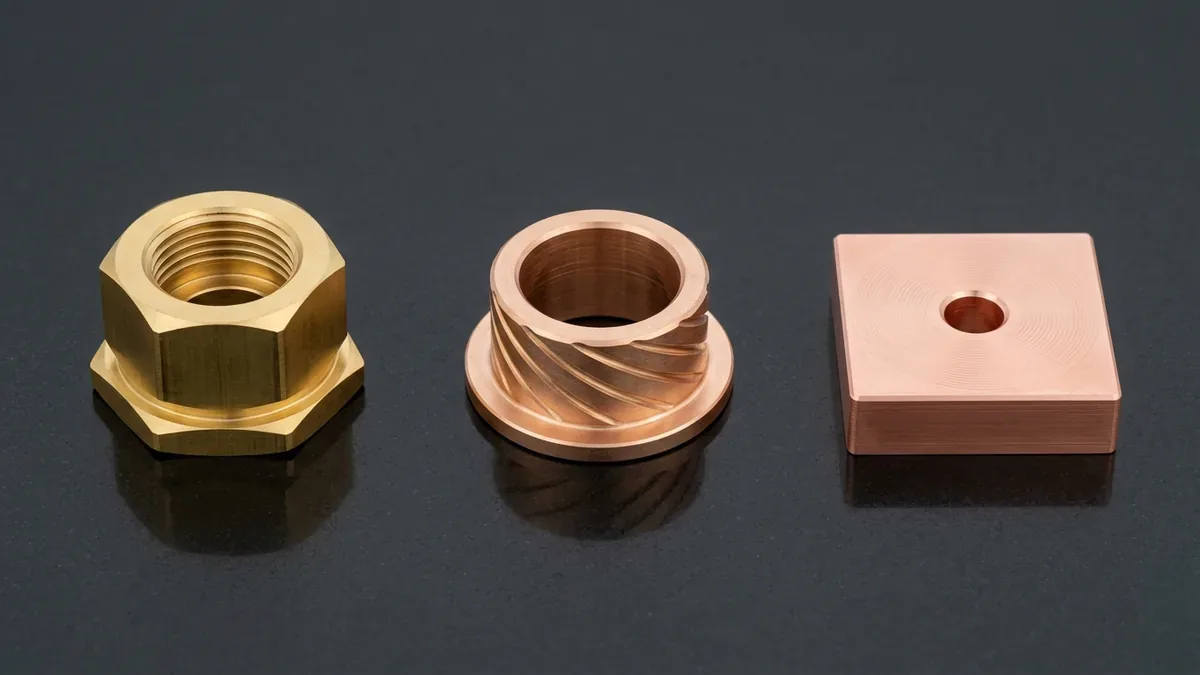
- Atmospheric Patina Formation: All three metals oxidize naturally. Pure copper transitions from bright salmon-pink to chocolate brown, eventually forming a protective carbonate/sulfate green patina (Cu2CO3(OH)2) that seals the core metal against atmospheric corrosion for centuries.
- Marine & Seawater Resistance: Bronze is the undisputed champion of marine engineering. Aluminum bronze and phosphor bronze form self-healing, impermeable oxide films that resist pitting, crevice corrosion, and biological bio-fouling in stagnant and flowing seawater. Standard brass, by contrast, suffers dezincification in marine environments—a selective leaching process where zinc dissolves, leaving behind a porous, brittle, mechanically useless sponge of copper. Only specialized tin-bearing Naval Brass (C46400) or lead-free DZR brasses should ever be specified for marine service.
- Galvanic Compatibility: Because copper, brass, and bronze share adjacent positions on the galvanic series (anodic index ≈ -0.35 V), they can be mated directly to one another in fluid systems without initiating galvanic corrosion. However, coupling any red metal directly to aluminum or zinc in an electrolyte triggers rapid sacrificial galvanic decay of the aluminum.
5. Engineering Case Study: High-Power Liquid-Cooled EV Inverter Subsystem
To see how multi-material red metal selection functions in high-precision engineering, consider a high-power electric vehicle (EV) inverter project manufactured at AS Prototypes:
The Engineering Challenge
A tier-1 automotive client needed to prototype a 800V SiC (Silicon Carbide) power inverter module. The assembly required three distinct physical functions: (1) dissipating 1,200 W of localized heat flux from the semiconductor power switches, (2) transmitting 400 A of continuous current through compact terminal studs with tight M6 threading, and (3) supporting a high-speed planetary gear pivot shaft subject to continuous oscillation and vibration.
The Multi-Alloy AS Prototypes Solution
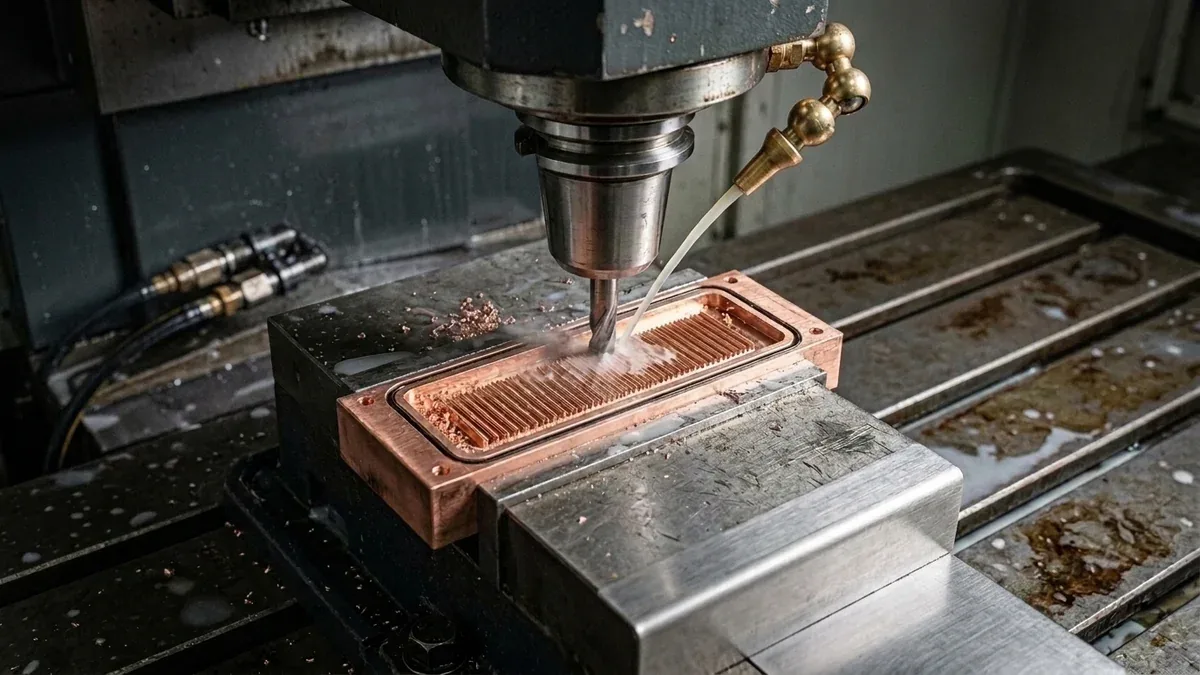
- Heat Sink Cold Plate → Pure Copper C11000 ETP: The liquid cold plate was CNC-milled from solid C11000 copper billets on our high-speed 3-axis CNC vertical machining center (VMC). Featuring 72 micro-channels (0.6 mm fin width × 8.0 mm depth), the extreme thermal conductivity (391 W/(m · K)) ensured rapid junction heat extraction. Machined with polycrystalline diamond (PCD) cutters and MQL, fin walls achieved Ra ≤ 0.35 μm without deburring defects.
- High-Current Electrical Terminals → Free-Cutting Brass C36000: The high-current terminal studs and busbar clamp blocks were manufactured on our Citizen Swiss lathe from C36000 brass. Brass provided sufficient electrical conductivity (28% IACS) for the short current path while delivering perfect 6g thread class compliance, high torque resistance during assembly, and zero galling.
- Pivot Shaft Bushing → Aluminum Bronze C95400: The oscillating pivot shaft was fitted with precision-turned C95400 aluminum bronze sleeve bushings. With yield strength exceeding 310 MPa and superior boundary sliding lubricity, the bushings eliminated all galling and passed a rigorous 1,000-hour dynamic wear qualification without lubricant failure.
Outcome: By precisely assigning each red metal to its optimal physical domain rather than attempting a compromised single-material approach, the client achieved a 22% weight reduction, superior thermal dissipation, and zero field failures during automotive endurance road testing.
6. Design for Manufacturability (DFM) Rules for Red Metals
To maximize manufacturing yields and optimize component costs, design engineers should incorporate these DFM principles into their CAD models:
- Avoid Pure Copper for Purely Structural Parts: Never specify pure copper unless extreme electrical conductivity or thermal dissipation is mandatory. If you need a corrosion-resistant bracket or fluid fitting, C36000 brass or C93200 bronze offers 3 × higher rigidity, cuts machining cycle times by up to 65%, and slashes tooling costs.
- Design for Non-Lead Compliance (RoHS & REACH): Standard free-cutting brass (C36000) and bearing bronze (C93200) contain intentional lead additions. For medical devices, consumer electronics, and potable water systems bound for European or North American markets, specify verified lead-free alternatives like C27450 / Eco Brass (C69300) or bismuth-bearing bronzes.
- Provide Generous Tool Clearances for Copper Blind Holes: Tapping blind holes in pure copper is notorious for tap binding. Ensure drilled tap hole depths extend at least 2.5 × to 3 × thread pitch deeper than the required full-thread depth, and specify cold-forming (roll) taps rather than cutting taps whenever wall thickness allows.
- Account for Workpiece Elastic Deflection: Thin-walled copper and phosphor bronze components flex under heavy clamping pressure. Specify clamping flats or datum fixturing tabs in CAD to allow vacuum or soft-jaw support during precision CNC milling.
Navigating the nuances of red metals requires an uncompromising blend of metallurgical knowledge, specialized CNC cutting strategies, and verified alloy verification. At AS Prototypes, our quality assurance lab utilizes portable XRF spectrometers (Figure 2) to verify raw material chemical certs before the first cut is taken. Whether you need prototype copper liquid cold plates, production runs of brass valves, or heavy-duty bronze marine bushings, our engineering team delivers repeatable precision.
7. Technical Engineering FAQ
Pure copper (such as C10100 OFHC or C11000 ETP) is an unalloyed elemental metal prized for 100% IACS electrical and thermal conductivity (~398 W/m·K). Brass is a binary alloy of copper and zinc (typically 15% to 40% Zn, such as C36000 or C26000) engineered for superior machinability and acoustic/fittings performance. Bronze is a copper alloy primarily alloyed with tin, aluminum, silicon, or phosphor (such as C93200 bearing bronze or C63000 aluminum bronze) for high wear resistance, low friction, and marine corrosion durability.
C36000 free-cutting brass serves as the 100% machinability baseline because microscopic dispersed lead particles shear chips into tiny, brittle fragments that evacuate instantly with minimal cutting force and tool wear. Conversely, pure C101/C110 copper is extremely ductile and gummy; it smears against the tool rake face to form severe Built-Up Edge (BUE) and stringy bird's-nest chips unless cut with razor-sharp, high-positive-rake polished carbide or PCD diamond tooling.
For low-friction rotary sleeve bushings and thrust washers operating against hardened steel shafts, SAE 660 / C93200 bearing bronze or C54400 phosphor bronze provides superior conformability and anti-seizure lubricity. For high-stress structural marine shafts, valve stems, and aerospace landing-gear bushings exposed to saltwater cavitation, C63000 nickel-aluminum bronze delivers tensile strengths exceeding 750 MPa (108 ksi)—comparable to medium-carbon steel.
Machining C10100 oxygen-free copper for RF waveguides, vacuum anodes, and high-heat-flux cold plates requires uncoated, mirror-polished carbide or polycrystalline diamond (PCD) / monocrystalline diamond (SCD) end mills with a steep 15°–20° positive rake angle and high helix (45°). Maintaining high surface speeds (Vc = 200 to 350 m/min) with pressurized flood coolant or MQL prevents thermal softening and copper adhesion along micro-fin channels.
Partner with Our Precision CNC Machining & Engineering Team
Eliminate tool deflection, residual stress distortion, and tolerance stack-up risks before production begins. Upload your 3D CAD files (STEP/IGES) and 2D GD&T drawings for a comprehensive shop-floor DFM review and custom quotation.
Upload 3D CAD for Engineering DFM & RFQ