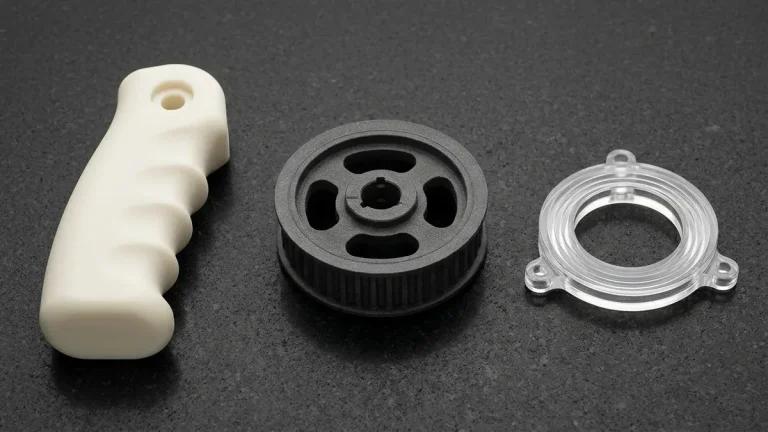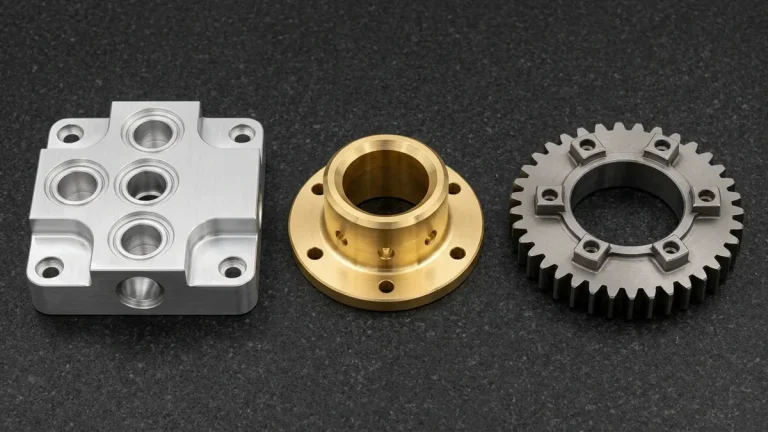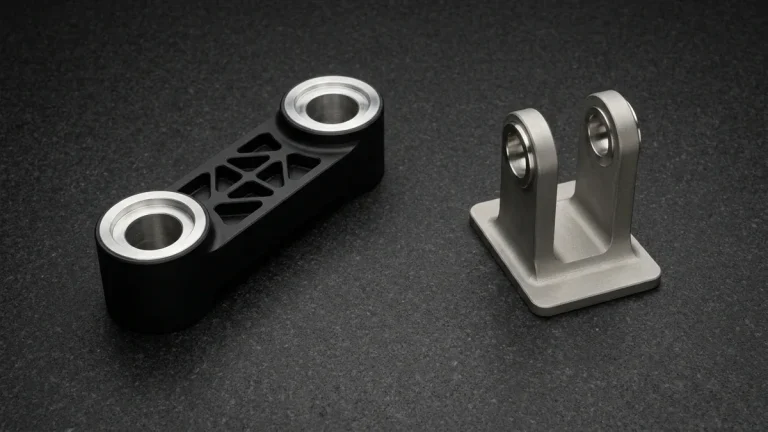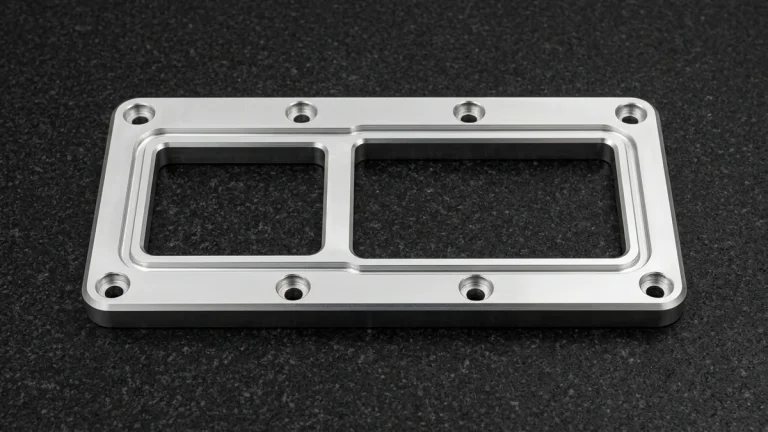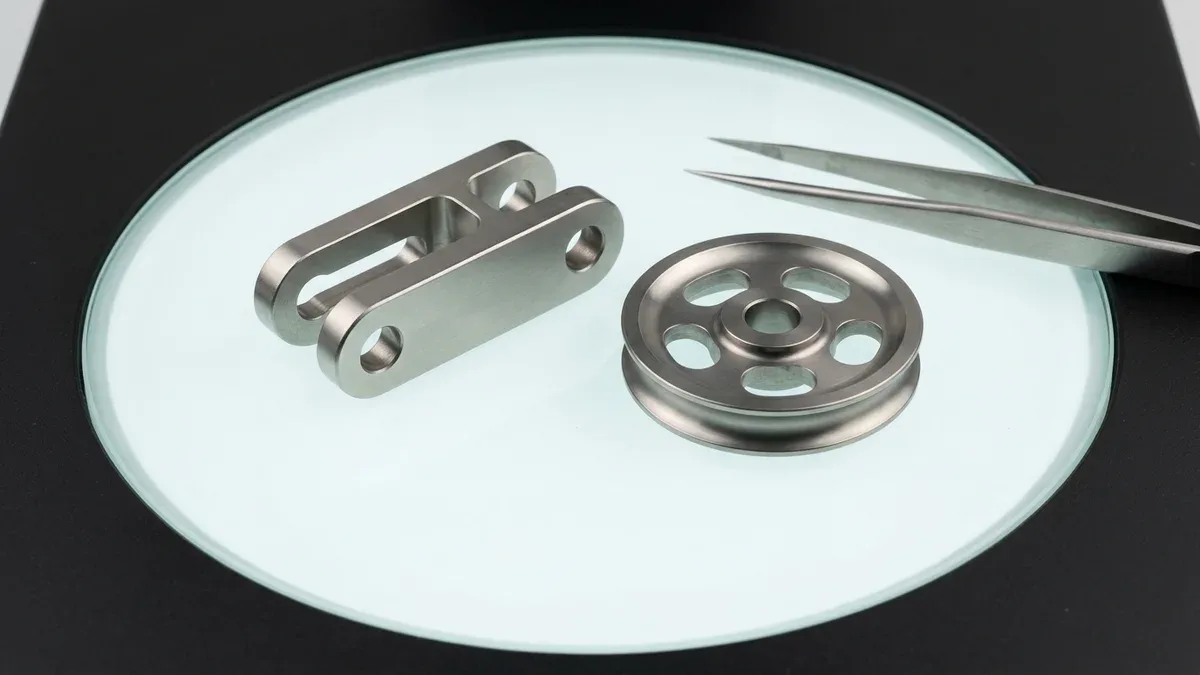
Surgical Robot Part Manufacturing is the ultra-precision fabrication of miniature mechanical linkages, distal wrist clevises, tendon guide pulleys, endoscopic cannulas, and electrosurgical insulators for Minimally Invasive Surgery (MIS) platforms. Executing these sub-millimeter assemblies requires combining sliding-headstock Swiss-type Computer Numerical Control (CNC) turning, multi-skim Wire Electrical Discharge Machining (EDM), and micro-milling within ±0.005 mm (±0.0002 in.) dimensional envelopes.
Unlike industrial robotic arms driven by direct-mounted harmonic gearheads, surgical telemanipulators pass through 5 mm to 12 mm (0.197 in. to 0.472 in.) abdominal trocars and actuate distal jaws via braided tungsten cables. Any concentricity runout, pitch-circle error, or thermal recast burr inside a 4 mm pulley groove immediately induces cable slack, hysteresis, or strand fraying.
This engineering guide establishes Design for Manufacturability (DFM) rules, alloy heat-treatment sequences, multi-skim EDM surface integrity standards, and First Article Inspection (FAI) protocols using Coordinate Measuring Machine (CMM) and Vision Measuring System (VMS) metrology. Every machining parameter reflects verified shop-floor capabilities across our in-house CNC machining facility and inspection lab.
Executive Summary & Engineering Takeaways (BLUF)
- Medical-Grade Alloy Matrix: Specify precipitation-hardening 17-4PH Condition H900 (40–44 HRC, ≥ 1,170 MPa yield) for high-load wrist clevises, ASTM F136 Ti-6Al-4V ELI (Grade 23) for lightweight sterile adapters, 316L for electropolished cannula tubes, and annealed PEEK / PPSU for dielectric wrist insulation.
- Process-Matched Tolerance Architecture: Hold ±0.005 mm (±0.0002 in.) and coaxiality ◎ 0.005 mm on pivot pins, clevis bores, and tendon grooves via Star Swiss-type turning and Sodick 4-skim Wire EDM, while assigning ISO 2768-mK to non-mating structural housings.
- Zero-Recast Multi-Skim EDM Protocol: Never accept single-cut rough Wire EDM on cable-contacting surfaces; mandate 1 Rough Cut + 3 to 4 Skim Cuts with Ø0.10 mm brass wire to strip the brittle thermal white layer below 1–2 µm and achieve Ra 0.2–0.4 µm (8–16 µin).
- Dimensional-Safe Surface Finishing: Apply ASTM A967 citric or nitric passivation (~0.002 µm passive film, zero masking required) for precision bearing journals, and reserve ASTM B912 electropolishing (5–15 µm [0.005–0.015 mm] stock dissolution per surface to Ra 0.1–0.2 µm) for exterior cannula shafts.
- Verified Ex-Factory Turnaround Ladder: Quotation and DFM feedback are delivered Within 24 Hours; Ex-Factory production and inspection turnaround is 4 ~ 8 Business Days for bare machined prototypes, 7 ~ 12 Business Days for passivated or electropolished parts, and 7 ~ 30 Business Days for pilot runs (separated from 3 ~ 5 Days Air Transit).
Article Engineering Navigation
- 1. Kinematic Architecture of Surgical Robots: Why Do Wristed End-Effectors Demand ±0.005 mm (±0.0002″) Micro-Tolerances?
- 2. Material Selection for Autoclave & Electrosurgical Duty: 17-4PH H900, 316L, Ti-6Al-4V ELI & PEEK/PPSU
- 3. How Do Swiss-Type CNC Turning and Multi-Skim Wire EDM Fabricate Micro-Clevis Links & Tendon Pulleys?
- 4. Precision Tube Slotting, Deep-Hole Gundrilling & Deburring for Endoscopic Cannulas and Trocar Sleeves
- 5. Surface Passivation (ASTM A967), Electropolishing (ASTM B912), Failure Troubleshooting & Metrology
- 6. Prototyping to Low-Volume Production: DFM Rules & When NOT to Use 3D Printed Resins or Single-Cut EDM
- 7. Technical Engineering FAQ
1. Kinematic Architecture of Surgical Robots: Why Do Wristed End-Effectors Demand ±0.005 mm (±0.0002″) Micro-Tolerances?
Wristed surgical robot end-effectors require ±0.005 mm (±0.0002 in.) micro-tolerances because remote-center-of-motion (RCM) telemanipulators transmit 3-DOF pitch, yaw, and grip forces through Ø0.35 mm to Ø0.60 mm (0.014 in. to 0.024 in.) tensioned cables over Ø3.0 mm to Ø5.0 mm (0.118 in. to 0.197 in.) idler pulleys.
When a surgeon commands a 0.2 mm suture needle movement at the master console, the proximal actuator drive pack pulls antagonistic tungsten cables across a 350 mm to 550 mm (13.78 in. to 21.65 in.) instrument shaft. Any cumulative radial clearance across the clevis pins directly translates into lost motion and deadband backlash.
Furthermore, surgical instruments must fit entirely inside an Ø8.0 mm (0.315 in.) or Ø5.0 mm (0.197 in.) endoscopic cannula lumen. That radial constraint forces mechanical engineers to design twin-ear clevis yokes with wall thicknesses between 0.45 mm and 0.80 mm (0.018 in. and 0.031 in.) and bearing bore diameters under Ø2.00 mm (0.079 in.).
Because each articulated wrist stacks two to three serial clevis joints between the distal shaft collar and the needle-driver jaws, minor geometric deviations compound rapidly. A 0.015 mm perpendicularity error on the proximal clevis ear tilts the intermediate pulley axis, forcing the braided cable to ride up the groove sidewall and spike friction.
Capstan Friction Mechanics & Groove Profile Geometry in Cable-Driven Wrists
Even when a tendon guide pulley rotates freely on its pivot pin, transient sliding occurs whenever rapid direction reversals accelerate the braided 7×19 tungsten cable. According to Euler-Eytelwein capstan mechanics, tension loss across a curved guide surface increases exponentially with wrap angle (α) and surface friction coefficient (µ).
If a poorly machined pulley groove exhibits turning feed ridges of Ra 1.6 µm (63 µin), boundary friction spikes to µ ≈ 0.18, causing stick-slip tension hysteresis between the master console torque sensor and the distal jaw tip. Polishing the groove raceway to Ra 0.2 µm (8 µin) cuts friction in half.
Groove radius sizing is equally critical for cable fatigue life. Our shop-floor DFM standard sets the toroidal pulley groove radius to R = 0.53 × dc to 0.58 × dc (e.g., R 0.25 mm for Ø0.45 mm cable) with a 30° to 45° flared throat supporting 120° of the cable circumference without pinching strands.
Functional Breakdown of the Four Core Surgical Instrument Sub-Assemblies
To prevent tolerance over-specification on non-mating surfaces while locking down critical kinematic datums, our in-house engineering team partitions custom medical device and surgical robotics hardware into four distinct mechanical sub-assemblies based on contact stress, sterilization exposure, and dielectric isolation requirements:
- Distal Wrist Clevis Links & Fenestrated Jaws: Articulating 17-4PH H900 stainless steel yokes featuring twin coaxial Ø1.20 mm to Ø2.00 mm H7 (+0.010/0 mm) pivot pin bores, perpendicular thrust faces, and micro-milled diamond serrations for grasping suture needles without slippage.
- Micro-Grooved Tendon Guide Pulleys & Capstans: Miniature rotating sheaves (Ø3.0 mm to Ø6.0 mm OD) with full-radius R 0.22 mm to R 0.35 mm toroidal grooves held to Ra 0.2 µm (8 µin) and Total Indicator Reading (TIR) runout below 0.005 mm (0.0002 in.).
- Slotted Endoscopic Cannulas & Trocar Sleeves: Slender 316L stainless steel tubular shafts (length-to-diameter ratio L/D > 35:1) featuring stress-relieved distal articulation slots, concentric internal flushing lumens, and proximal alignment keyways.
- Sterile Drape Adapters & Electrosurgical Insulators: Proximal Ti-6Al-4V ELI kinematic coupling flanges that mate the sterile barrier to the robotic carriage, paired with high-dielectric PEEK or PPSU wrist inserts isolating 300 V to 1,500 V monopolar cautery current.
Datum Hierarchy & Geometric Dimensioning and Tolerancing (GD&T) Strategy
Establishing a functional Geometric Dimensioning and Tolerancing (GD&T) datum reference frame is essential before generating CNC toolpaths. On a distal wrist clevis link, assigning the outer cylindrical stem as Datum A, the proximal axial shoulder as Datum B, and the anti-rotation flat as Datum C aligns inspection directly with assembly kinematics.
Conversely, referencing twin clevis pin bores to a milled outer profile creates datum transfer error between the Swiss lathe and the Wire EDM fixture. General ISO 2768-mK tolerances and worst-case vs. Root-Sum-Square (RSS) stack-up follow our CNC machining tolerances guide, while H7/h5 bearing fits follow our press-fit tolerance guide.
Controlling Axial Float Across Multi-Link Serial Surgical Wrists
In a three-link serial surgical wrist (comprising the proximal shaft collar, intermediate pitch clevis, and dual yaw-grip jaws), axial clearance between mating clevis ears and pulley hubs directly dictates lateral jaw play. If each of the three joints permits 0.030 mm of axial float, cumulative lateral play reaches 0.090 mm.
To hold total distal jaw lateral play below 0.025 mm (0.0010 in.), our engineers control individual clevis slot widths to +0.008 / -0.000 mm via 4-skim Wire EDM and lap the mating pulley hub thickness to -0.003 / -0.008 mm, locking three-joint axial clearance to ≤ 0.014 mm across the wrist.
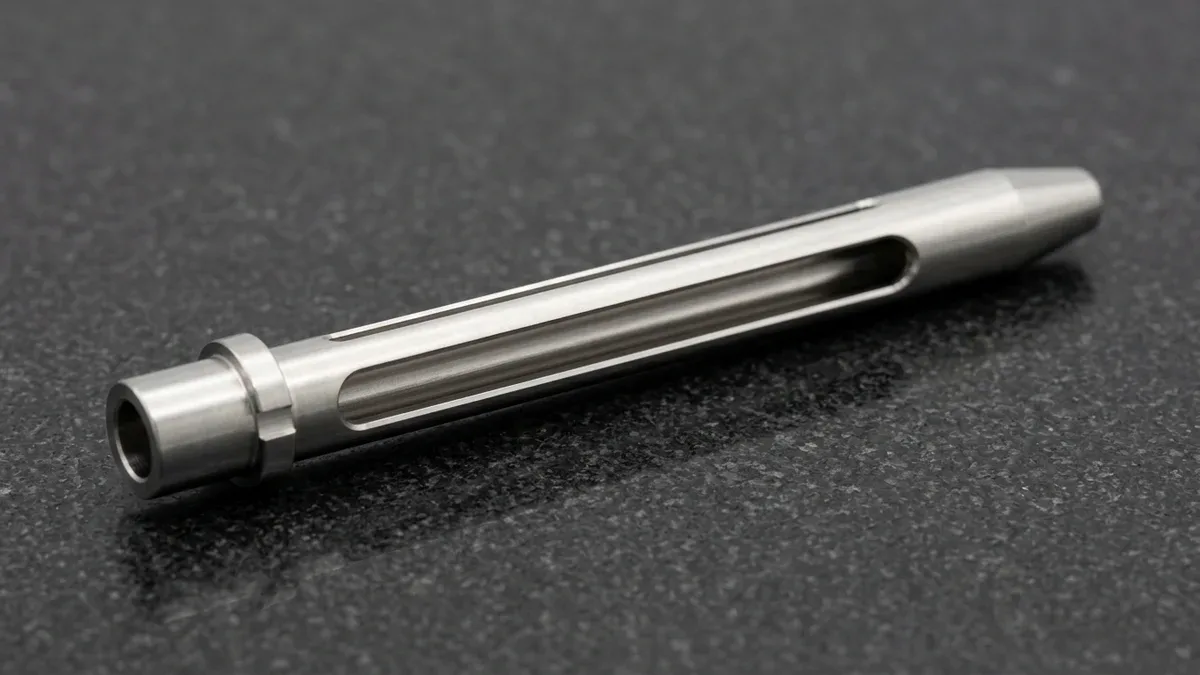
Long-aspect-ratio endoscopic cannula sleeves present an immediate workholding and stress-relief challenge before reaching the distal wrist. The macro inspection view below shows a Swiss-turned and electropolished 316L stainless steel slotted surgical cannula sleeve on our granite inspection plate, displaying radiused viewing slots, a stepped proximal collar, and a conical tip.
2. Material Selection for Autoclave & Electrosurgical Duty: 17-4PH H900, 316L, Ti-6Al-4V ELI & PEEK/PPSU
Selecting materials for surgical robot part manufacturing requires balancing Hertzian contact stress (≥ 1,170 MPa yield in 17-4PH H900) against 134°C (273°F) steam autoclave sterilization and 18–22 kV/mm electrosurgical breakdown voltages. Choosing unhardened stainless grades or moisture-sensitive polymers triggers premature groove brinelling, galling, or dielectric arcing during clinical cycling.
A frequent failure in early surgical wrist prototypes is machining clevis yokes and cable pulleys from annealed 304 or 316L austenitic stainless steel. With a yield strength of only 205 MPa to 290 MPa (29.7 ksi to 42.1 ksi), 316L suffers plastic groove indentation and galling under 80 N to 180 N tungsten cable preload.
When a Ø0.45 mm braided tungsten cable wraps 90° around a Ø4.0 mm pulley under 150 N of tension, localized contact stress exceeds 650 MPa (94 ksi). Only precipitation-hardened martensitic stainless steels or hardened bearing alloys prevent brinelling of the pulley raceway over multi-use clinical lifespans.
At the same time, reusable surgical instruments undergo hospital decontamination cycles consisting of pH 10.5 alkaline enzymatic detergent washes, ultrasonic cavitation, and 18-minute steam autoclaving at 134°C (273°F) and 2.1 bar (30.5 psi). Standard high-carbon tool steels or unpassivated 420 martensitic grades rapidly suffer pitting corrosion and rust staining under this regime.
Shop-Floor Heat-Treatment & Machining Sequence for 17-4PH (UNS S17400)
To prevent micro-grooves from deforming under cable tension while resisting steam oxidation, load-bearing wrist clevises, needle-driver jaws, and pulleys are manufactured from martensitic precipitation-hardening 17-4PH stainless steel using a controlled three-stage thermal and machining sequence in our shop:
- Rough & Semi-Finish in Condition A: Our in-house CNC machining facility machines raw bar stock in solution-annealed Condition A (~30–34 HRC), leaving a uniform 0.10 mm to 0.15 mm (0.004 in. to 0.006 in.) semi-finish stock allowance on all critical datum faces and clevis ear slots.
- Vacuum Precipitation-Age to H900 or H1025: Parts undergo vacuum aging at 482°C (900°F) for 60 minutes (Condition H900) to achieve 40–44 HRC and ≥ 1,170 MPa (170 ksi) yield strength, or at 552°C (1,025°F) for 4 hours (Condition H1025, 35–38 HRC) when elevated fracture toughness is prioritized.
- Finish-Skim by Wire EDM & Swiss Turning Post-Aging: Because precipitation aging induces a predictable volumetric contraction of 0.0004 to 0.0006 mm/mm (0.04% to 0.06%), final H7 pin bores and ±0.005 mm clevis slots are finish-skimmed by Wire EDM or finish-turned with AlTiN-coated carbide tooling after heat treatment.
For ultra-high-stress needle drivers or micro-shears where even 1,170 MPa yield strength is marginal, engineers also specify precipitation-hardening Custom 455 (UNS S45500) or Custom 465 (UNS S46500) aged to H950 (47–51 HRC, ≥ 1,550 MPa yield strength), paired with through-hardened 440C stainless steel pivot pins (56–58 HRC).
Austenitic 316L vs. ASTM F136 Ti-6Al-4V ELI vs. Dielectric Polymers
While 17-4PH dominates the high-stress distal wrist, tubular cannula shafts and flush ports rely on vacuum-melted 316L stainless steel (≤ 0.03% carbon). Its low carbon content prevents chromium-carbide sensitization along laser-welded collars and allows mirror-bright ASTM B912 electropolishing without intergranular pitting.
For proximal robotic arm carriages, sterile barrier adapters, and non-magnetic harmonic housings, ASTM F136 Ti-6Al-4V ELI (Extra Low Interstitial Grade 23 titanium, oxygen ≤ 0.13%) delivers an 825 MPa (120 ksi) yield strength at 4.43 g/cm³—cutting structural mass by 43% compared to stainless steel to maximize servo bandwidth.
In monopolar and bipolar electrosurgical instruments (such as fenestrated bipolar forceps or cautery hooks), the metallic jaw must be electrically isolated from the stainless clevis body. We machine these micro-insulator spacers and pulley bushings from stress-relieved medical-grade polyetheretherketone (PEEK, 18–22 kV/mm dielectric strength, 250°C continuous rating) or polyphenylsulfone (PPSU).
Where braided actuation cables route through curved internal channels inside the proximal housing, our engineers also machine low-friction virgin polytetrafluoroethylene (PTFE) guide tubes held to ISO 2768-c general tolerances to minimize dry sliding hysteresis before the cables enter the metallic shaft.
| Material Grade & Condition | Yield Strength (MPa) & Hardness | Density (g/cm³) & Elastic Modulus (GPa) | Shop-Floor Cutting Window (Vc & fz) | Achievable Tolerance (mm) & Finish (Ra µm) | Relative Unit Cost Ratio | Recommended Application / When to Choose |
|---|---|---|---|---|---|---|
| 17-4PH Condition H900 (UNS S17400) | ≥ 1,170 MPa (170 ksi) | 40–44 HRC | 7.75 g/cm³ | 197 GPa | Vc: 60–95 m/min | fz: 0.015–0.045 mm/tooth (AlTiN carbide) | ±0.005 mm | Ra 0.2–0.4 µm (4-skim EDM / Swiss) | 1.3x–1.6x vs. 316L | Best for distal wrist clevis links, needle-driver jaws, pivot pins, and high-load tungsten cable pulleys. |
| 316L Stainless Steel (UNS S31603) | 205–290 MPa (30–42 ksi) | 75–85 HRB | 7.99 g/cm³ | 193 GPa | Vc: 80–120 m/min | fz: 0.020–0.060 mm/tooth (70 bar thru-coolant) | ±0.010 mm | Ra 0.1–0.2 µm (ASTM B912 EP) | 1.0x (Baseline) | Best for slotted endoscopic cannula tubes, trocar sleeves, flushing manifolds, and laser-welded collars. |
| ASTM F136 Ti-6Al-4V ELI (Grade 23) | 795–860 MPa (115–125 ksi) | 30–34 HRC | 4.43 g/cm³ | 114 GPa | Vc: 45–65 m/min | fz: 0.020–0.050 mm/tooth (trochoidal climb) | ±0.010 mm | Ra 0.4 µm (micro-milled + passivated) | 2.2x–2.8x vs. 316L | Best for low-inertia robotic arm adapters, sterile drape couplings, and non-magnetic MRI-safe stages. |
| Medical PEEK (Unfilled Annealed) | 95–100 MPa (13.8–14.5 ksi) | 85 Shore D | 1.30 g/cm³ | 3.6–4.0 GPa | Vc: 180–280 m/min | fz: 0.030–0.080 mm/tooth (uncoated diamond/PCD) | ±0.015 mm | Ra 0.4–0.8 µm (air-blast cooled) | 1.8x–2.4x vs. 316L | Best for monopolar/bipolar electrosurgical jaw insulators, dielectric cable guides, and autoclave seals. |
| PPSU (Polyphenylsulfone) | 70 MPa (10.2 ksi) | 80 Shore D | 1.29 g/cm³ | 2.3 GPa | Vc: 150–240 m/min | fz: 0.040–0.090 mm/tooth (high-rake carbide) | ±0.025 mm | Ra 0.8 µm (dry/vortex air only) | 1.1x–1.4x vs. 316L | Best for impact-resistant proximal instrument housings, sterile latch levers, and color-coded flushing caps. |
When to Avoid Specific Alloys in Surgical End-Effectors
- Never pair unhardened 316L against 316L in sliding pivot pins: Austenitic stainless steel exhibits severe adhesive cold-welding (galling) under dry autoclave conditions; always maintain a hardness differential of ≥ 5–8 HRC by pairing a 17-4PH H900 clevis against a hardened 440C pin.
- Avoid Ti-6Al-4V ELI for thin-walled clevis ears under 0.60 mm (0.024 in.): Because titanium’s elastic modulus (114 GPa) is roughly 58% of stainless steel’s (197 GPa), thin titanium clevis ears deflect elastically under milling forces and spread apart under high cable clamping loads.
- Never use petroleum-based synthetic coolants on PEEK or PPSU: Amorphous PPSU undergoes environmental stress cracking when exposed to aromatic ester cutting fluids; machine medical polymers strictly with chilled compressed air or deionized water mist.
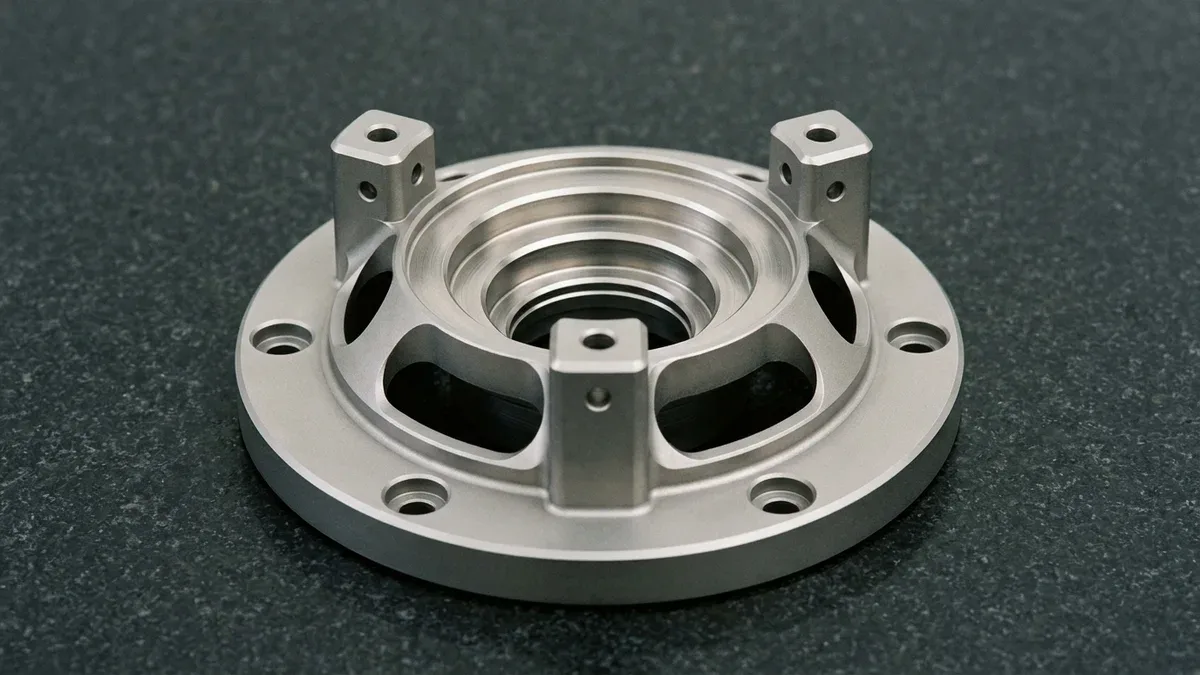
Rather than defaulting to expensive 5-axis trunnion setups for cylindrical adapter hubs, our shop floor executes 80% of surgical trocar adapter flanges and kinematic mounts on high-rigidity 3-axis and 4-axis CNC vertical machining centers, as shown in the Ti-6Al-4V ELI adapter flange with three axial standoff legs below.
3. How Do Swiss-Type CNC Turning and Multi-Skim Wire EDM Fabricate Micro-Clevis Links & Tendon Pulleys?
Fabricating micro-clevis links and tendon guide pulleys requires combining sliding-headstock Swiss-type CNC turning with 4-skim Wire EDM so that cylindrical bearing journals are turned within 2 mm of a tungsten carbide guide bushing before zero-cutting-force spark erosion cuts the thin clevis yoke slot.
Star Sliding-Headstock Swiss Turning for Sub-Millimeter Pulleys & Pins
On conventional fixed-headstock CNC lathes, turning a Ø1.50 mm (0.059 in.) pivot pin or a Ø4.00 mm (0.157 in.) tendon pulley with a 0.25 mm (0.010 in.) groove radius generates radial tool push-off that causes taper and chatter.
In our Star Swiss-type sliding-headstock lathes, centerless-ground bar stock (held to h6/h7 diameter tolerance) advances axially through a precision tungsten carbide guide bushing adjusted to a 0.003 mm to 0.005 mm radial clearance. The OD turning and micro-grooving tools cut within 1.0 mm to 2.0 mm (0.039 in. to 0.079 in.) of the bushing face.
Because cantilever beam deflection scales with the cube of overhang length (δ = F × L³ ÷ 3EI), reducing overhang from 20 mm on a conventional turret lathe to 1.5 mm on a Swiss guide bushing reduces radial deflection by a factor of over 2,300.
Furthermore, the synchronized sub-spindle grips the workpiece before cut-off to finish the backside bore, deburr the internal edge, and machine milled flats in a single clamping setup. This single-setup architecture holds pitch-groove coaxiality to ◎ 0.005 mm and bearing journal diameters to h5 (0 / -0.004 mm) without re-chucking errors.
Sodick Multi-Skim Wire EDM for Thin-Ear Clevis Slots & Fenestrated Jaws
Once a surgical wrist link’s cylindrical stem and coaxial Ø2.00 mm H7 (+0.010 / 0 mm) pivot bore are turned on the Swiss lathe, machining the 0.80 mm to 1.50 mm wide central clevis slot by conventional micro-end-milling risks bending the 0.50 mm thick ears inward or snapping Ø0.50 mm carbide end mills.
Even a sharp Ø0.80 mm carbide end mill cutting hardened 17-4PH H900 generates 8 N to 15 N of lateral cutting force, deflecting a 0.50 mm clevis ear by 0.018 mm and pushing burrs into the Ø2.00 mm pin bore. Instead, we transfer the blank onto a Sodick fine-wire EDM cell:
- Zero Mechanical Cutting Force: Material removal occurs purely through non-contact spark discharges across a 0.010 mm to 0.020 mm gap using Ø0.10 mm or Ø0.05 mm wire, keeping opposing 0.50 mm clevis ears parallel and perpendicular to the pivot bore axis within ⊥ 0.008 mm.
- Mandatory 4-Skim Thermal Recast Stripping: A single roughing pass leaves a 15 µm to 25 µm heat-affected white layer with tensile micro-cracks. Executing 1 Rough Cut + 3 to 4 High-Frequency Skim Cuts shaves off 0.035 mm, 0.012 mm, and 0.004 mm successively until recast depth is ≤ 1–2 µm and finish reaches Ra 0.2–0.4 µm.
- Internal Corner Radii & Jaw Serrations: Fine-wire EDM simultaneously cuts sinusoidal or pyramidal tissue-grasping teeth along fenestrated forceps jaws with internal root radii down to R 0.06 mm (0.0024 in.) and tooth pitch tolerances of ±0.005 mm (±0.0002 in.).
Step-by-Step Compound Routing Traveler: Synchronizing Swiss & EDM Datums
To prevent positional datum drift when transferring a 6 mm surgical wrist clevis from a Star Swiss lathe to a Sodick Wire EDM cell, our shop floor enforces a six-stage datum-synchronized manufacturing routing sequence across turning, vacuum aging, and spark erosion:
- Turn Primary Datums & Clocking Flat (Condition A): Turn the outer cylindrical stem (Datum A), face the proximal shoulder (Datum B), drill and bore the transverse Ø1.90 mm semi-finish pin hole, and live-mill a sacrificial 0.005 mm parallel clocking flat (Datum C) before sub-spindle cut-off.
- Vacuum-Age to Condition H900: Age the semi-finished blanks in a vacuum furnace at 482°C (900°F) for 60 minutes with argon gas quench to reach 40–44 HRC without surface oxidation scale.
- Wire-Cut Coaxial Pin Bore & Outer Profile: Clamp Datum A and Datum C inside a precision-ground wire-cut V-block pallet, optically probe the stem centerline within ±0.002 mm, and 4-skim wire-cut the Ø2.00 mm H7 (+0.010/0 mm) coaxial pin bore.
- Multi-Skim Central Clevis Yoke Slot: Index the precision pallet 90° and execute 1 rough pass plus 4 skim cuts across the central clevis slot, holding slot width to ±0.005 mm and inner ear thrust faces to ⊥ 0.008 mm without burrs entering the H7 pin bore.
- Micro-Deburr & Ultrasonically Degrease: Tumble in high-density ceramic micro-cones for 20 minutes to blend external wire exit transitions to R 0.05 mm, followed by multi-stage ultrasonic cleaning.
- Passivate per ASTM A967 & Execute VMS/CMM FAI: Passivate in citric acid, rinse in 15 MΩ·cm deionized water, and verify all critical dimensions at 20°C ± 1°C before protective barrier packaging.
High-Speed Tubular Pop-Hole EDM Drilling for Closed-Slot Wire Threading
When a surgical jaw or clevis link requires an enclosed internal tendon window or a precision H7 bore cut entirely after H900 hardening, threading a Ø0.10 mm Sodick EDM wire requires an initial through-hole. Drilling 44 HRC 17-4PH with a Ø0.30 mm solid carbide micro-drill risks drill breakage inside the part.
Instead, our Wire EDM cell uses a high-speed CNC small-hole (“pop-hole”) EDM drill with a rotating Ø0.25 mm tubular brass electrode and 60 bar deionized water flushing through the electrode core. This spark-drills a stress-free Ø0.30 mm wire-threading starter hole through 10 mm of hardened steel in under 15 seconds.
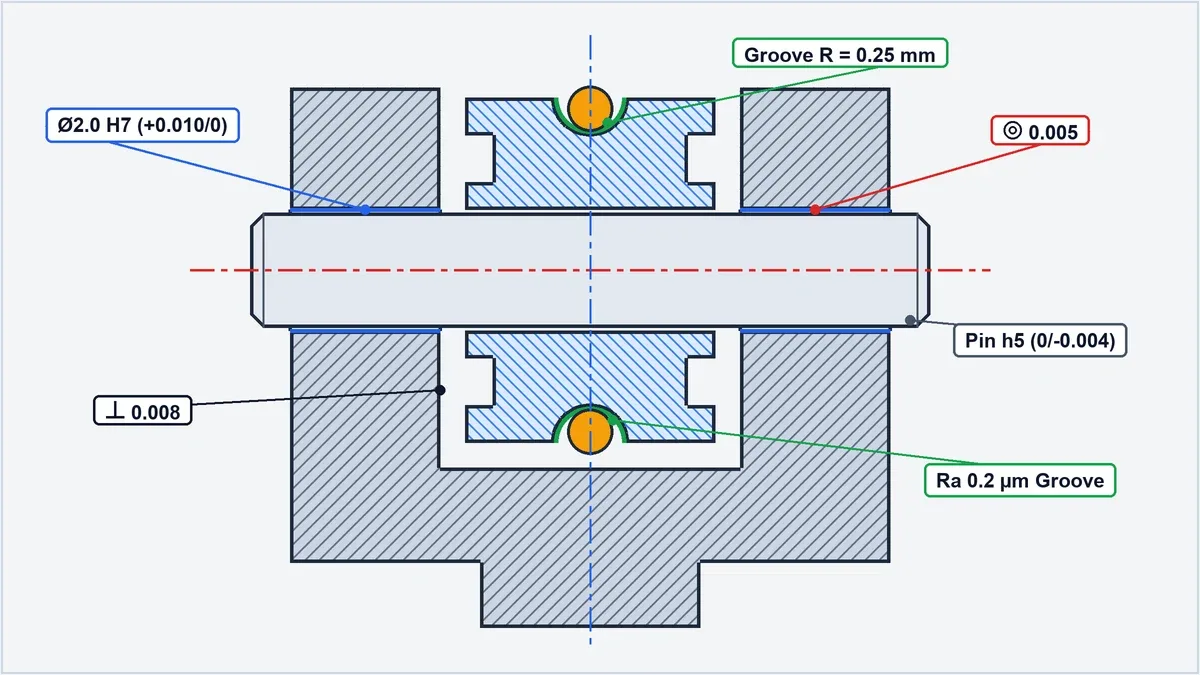
The 2D engineering cross-section schematic below details how the coaxial clevis ear bores (Ø2.0 H7), through-hardened pivot pin (h5), and grooved tendon pulley (Ra 0.2 µm groove, ◎ 0.005 mm coaxiality) stack together inside a surgical robot wrist joint.
Quantitative Derivation: Tendon Pulley Eccentricity, Capstan Efficiency & Deflection
To understand why surgical robotics hardware engineers reject ±0.025 mm (±0.001 in.) commercial pulley tolerances, consider the quantitative coupling between radial groove runout, tendon path slack, distal jaw tip positioning error, capstan friction transmission efficiency, and Swiss overhang deflection.
Step 1 — Input Geometry & Formulas: A wrist pulley of pitch radius Rp = 2.00 mm guides a 0.45 mm cable across a 90° bend to actuate a jaw of length Ldistal = 12.0 mm. Radial runout Δe induces cable slack ΔC = 2·Δe·sin(45°) = 1.4142·Δe:
Step 2 — Case A (2-Setup Lathe, Δe = 0.025 mm, Ra 1.6 µm, µ = 0.18): Slack reaches ΔC = 0.0354 mm, causing angular backlash Δθ = 0.0354 ÷ 2.00 = 0.0177 rad (1.01°) and tip wander ΔXtip = 12.0 × 0.0177 = 0.21 mm, while 180° (π rad) capstan efficiency drops to η = e−0.18π = 56.8%.
Step 3 — Case B (Star Swiss + 4-Skim EDM, Δe = 0.006 mm, Ra 0.2 µm, µ = 0.08): Slack drops to ΔC = 0.0085 mm, cutting backlash to Δθ = 0.00424 rad (0.24°) and tip error to ΔXtip = 0.05 mm (76% reduction), while 180° capstan efficiency rises to η = e−0.08π = 77.8%.
Step 4 — Swiss Overhang Deflection Check: Turning a Ø2.00 mm 17-4PH stem (E = 197 GPa, I = 0.7854 mm⁴, 3EI = 464,171 N·mm²) under F = 15 N radial force yields δ = 0.259 mm at L = 20 mm turret overhang versus δ = 0.00011 mm (0.11 µm) at L = 1.5 mm Swiss bushing overhang.
In multi-DOF wrists where a tendon wraps across three sequential idler pulleys before terminating at the distal grip capstan, these path errors sum in quadrature. Controlling single-pulley eccentricity below 0.006 mm ensures the total 3-pulley system hysteresis remains under 0.42° without requiring excessive motor pre-tension that accelerates bearing fatigue.
4. Precision Tube Slotting, Deep-Hole Gundrilling & Deburring for Endoscopic Cannulas and Trocar Sleeves
Manufacturing endoscopic cannulas, laparoscope outer sheaths, and robotic trocar sleeves requires maintaining ±0.015 mm (±0.0006 in.) concentricity and straightness under 0.05 mm per 100 mm across thin-walled 316L tubes with length-to-diameter (L/D) ratios exceeding 30:1 to 50:1.
Depending on whether the tubular instrument shaft starts from solid bar stock (for integrated proximal locating hubs) or cold-drawn seamless medical tubing, our in-house CNC machining facility executes two distinct workholding and bore-finishing protocols to eliminate wall collapse:
- Gundrilling & Honing for Integral Flanged Shafts: When a trocar sleeve or harmonic waveguide requires an integral thick-walled hub transitioning into a Ø4.50 mm bore over 220 mm length, we execute single-flute carbide gundrilling with 70 bar (1,015 psi) high-pressure oil filtration, followed by single-pass diamond honing to hold bore cylindricity within 0.008 mm.
- Mandrel-Supported 4-Axis Micro-Slotting for Thin-Wall Tubes: Cutting articulating flex-slots or bayonet locking windows into a Ø8.0 mm × 0.40 mm wall 316L tube causes radial collapse and exit burrs if unsupported. We slide a sacrificial snug-fit acetal (POM) or brass internal mandrel inside the lumen before cutting slots on a 4-axis Brother or Fanuc CNC center.
When micro-slotting thin-walled 316L cannula tubes to create compliant flex-hinges, residual cold-drawing stress in the raw tube often causes the slotted segment to banana-warp by 0.15 mm to 0.30 mm once one side of the tube wall is relieved.
Our shop floor prevents tubular warping by executing a vacuum stress-relief anneal on the raw seamless tubing prior to final centerless OD grinding, and sequencing symmetrical opposing slot cuts in alternating axial steps rather than cutting all slots along one side in a single pass.
Internal Cross-Hole Deburring & 3D Lollipop Cutter Edge Interpolation
Whenever a lateral flushing port or tendon routing window intersects the main longitudinal bore of a surgical shaft, conventional drilling pushes an inaccessible crescent burr into the internal lumen. If left unremoved, that internal burr scrapes the PTFE insulation off monopolar electrosurgical leads or snags braided tungsten tendons.
To eliminate internal intersection burrs completely, our CNC programmers run spherical undercutting “lollipop” micro-end mills (Ø0.40 mm to Ø0.80 mm ball diameter on a reduced neck) along a 3D helical interpolation path to machine a uniform 0.05 mm radius around both the outer and inner hole intersections.
After mechanical interpolation, the cannula lumen undergoes silicon-carbide micro-abrasive brush honing and 20× to 40× borescope inspection. For evacuating chips in deep pockets (L/D > 4:1) and relieving L³/D⁴ end-mill deflection in sharp internal corners, see our guides on deep and narrow cavity CNC machining and sharp internal corners in CNC machining.
Coaxial Pilot Shoulder Design for Laser-Welding Wrist Collars to 316L Tubes
Joining the hardened 17-4PH distal wrist housing to the thin-walled 316L cannula shaft requires a coaxial pilot joint that survives torsional loads and thermal welding shrinkage. We turn a 2.50 mm long stepped Ø7.00 mm spigot held to js6 (±0.0045 mm) on the clevis stem to mate with the honed Ø7.00 mm H7 (+0.015/0 mm) tube ID.
We also machine a 0.15 mm × 0.15 mm circumferential weld-relief step along the mating shoulder so that pulsed fiber laser seam welding fuses the joint under argon shielding without raising a proud weld bead above the Ø8.00 mm cannula outer diameter or distorting coaxiality beyond 0.012 mm TIR.
Micro-Milling High-Dielectric PEEK & PPSU Wrist Insulators
At the distal end of the cannula tube, electrosurgical robotic instruments house a miniature PEEK or PPSU insulator guide block that routes both the coaxial radio-frequency (RF) cautery lead and the stainless steel actuation cables without high-voltage electrical arcing across wet tissue.
Because a 12 mm × 8 mm PEEK insulator block contains Ø0.60 mm cable micro-bores separated by web walls as thin as 0.35 mm (0.014 in.), conventional flood-cooled carbide milling leaves fibrous plastic rollover burrs that trap sterilization debris or jam cables.
To produce zero-burr PEEK insulators, we thermal-anneal the extruded PEEK rod at 200°C (392°F) prior to machining, clamp the blank in custom step-relieved soft jaws, and run razor-sharp, uncoated polished carbide or polycrystalline diamond (PCD) micro-drills under cold compressed air blast.
In addition, drilling deep Ø0.60 mm tendon guide holes through 15 mm of PEEK requires peck-drilling increments of 0.5 × diameter (0.30 mm pecks) with full retract every three pecks. This prevents frictional heat buildup above PEEK’s 143°C (289°F) glass transition temperature, which otherwise causes bore shrinkage and ovality after tool withdrawal.
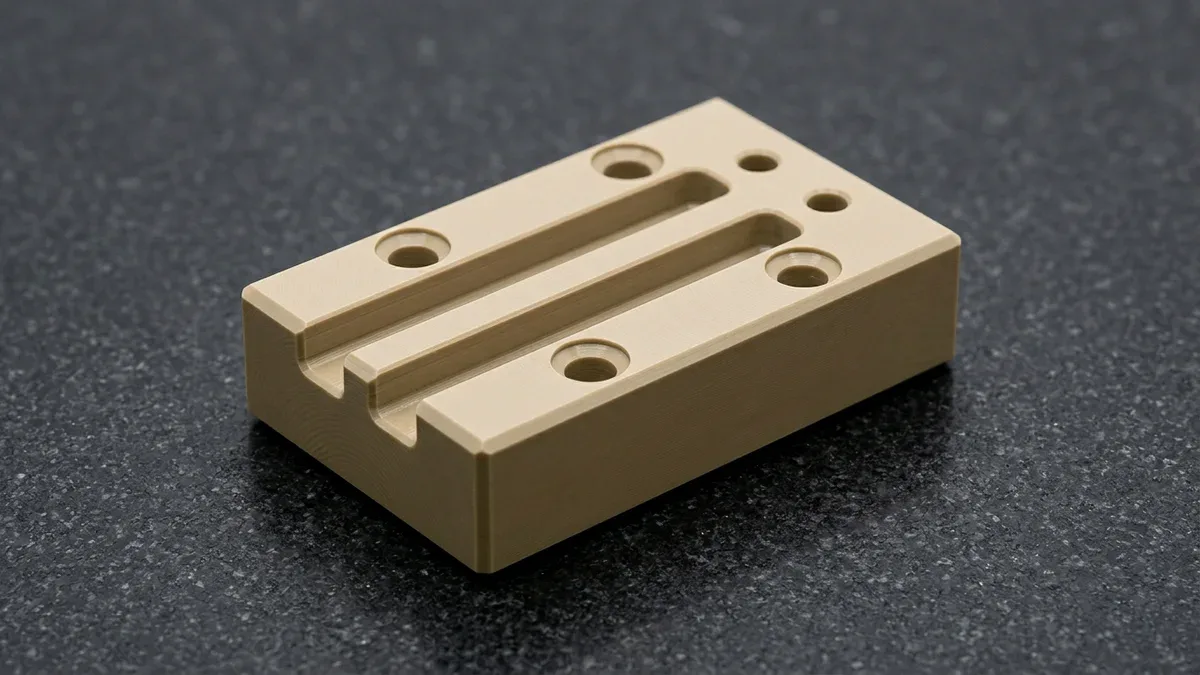
The macro inspection view below shows an annealed and 4-axis micro-milled warm beige PEEK electrosurgical wrist insulator guide block on our granite surface plate, displaying parallel tendon-routing channels with corner relief undercuts, axial cable micro-bores, and burr-free counterbored mounting holes.
5. Surface Passivation (ASTM A967), Electropolishing (ASTM B912), Failure Troubleshooting & Metrology
Post-machining surface finishing in surgical robot part manufacturing applies ASTM A967 citric or nitric passivation (~0.002 µm oxide film) and ASTM B912 electropolishing (5–15 µm [0.005–0.015 mm] stock removal per surface) to strip free iron, micro-deburr tendon raceways to Ra 0.1–0.2 µm, and preserve ±0.005 mm H7/h5 bearing fits.
ASTM A967 Passivation vs. ASTM B912 Electropolishing: Dimensional Allowance Rules
Mechanical engineers frequently specify both chemical passivation and electrochemical polishing on surgical stainless steel drawings without accounting for their radically different dimensional stock-removal behaviors, creating severe assembly interference or loose bearing fits if uncompensated during CNC programming:
- ASTM A967 Citric or Nitric Acid Passivation (Zero Dimensional Shift): Passivation dissolves exogenous free iron particles and forms an inert chromium-oxide (Cr2O3) passive film only ~0.002 µm (2 nm) thick. Because it removes zero base metal, ASTM A967 passivation requires no masking on ±0.005 mm H7 clevis bores or h5 pivot pins.
- ASTM B912 Electropolishing (5–15 µm [0.005–0.015 mm] Stock Dissolution Per Side): Electropolishing immerses the 316L or 17-4PH part as an anode in a heated phosphoric-sulfuric electrolyte, leveling surface peaks down to Ra 0.1–0.2 µm (4–8 µin). Because it dissolves 5–15 µm (0.005–0.015 mm) per surface, H7 bores require silicone plug masking or pre-compensated CNC offsets.
- Non-Reflective PVD / DLC & Autoclave-Safe Laser UDI Marking: For distal jaws operated under bright laparoscopic Xenon or LED illumination, glare blinds the endoscopic camera. We apply matte bead-blasting (Ra 0.8–1.2 µm) or biocompatible black Diamond-Like Carbon (DLC) coatings, paired with ultrashort-pulse picosecond laser Unique Device Identification (UDI) marking that resists 134°C steam corrosion.
Ultrasonic Deionized Water Cleaning & Hydrocarbon Residue Stripping
Even a properly passivated surgical clevis link will fail biological reactivity and cytotoxicity screening during clinical validation if sulfurized gundrilling oils, water-soluble coolant emulsifiers, or brass Wire EDM copper-zinc ions remain trapped inside Ø0.50 mm capillary blind holes and internal thread roots.
To guarantee hydrocarbon-free surfaces, our post-machining cleaning protocol routes all surgical robot components through vacuum hydrocarbon vapor degreasing, followed by dual-frequency (40 kHz and 120 kHz) heated alkaline ultrasonic cavitation to flush sub-millimeter micro-bores without inducing surface cavitation erosion.
After ultrasonic detergent washing, components pass through three cascading deionized (DI) water rinse tanks maintained at a resistivity of ≥ 15 MΩ·cm, followed by filtered hot-air vacuum drying and clean lint-free double-bagged protective barrier packaging prior to shipment.
Shop-Floor Failure Troubleshooting: Tendon Cable Fraying & Clevis Binding
When surgical robotics R&D teams experience premature tungsten cable breakage, joint hysteresis, or dielectric breakdown during 10,000-cycle benchtop endurance testing, the root cause almost always traces back to four preventable shop-floor machining and post-processing defects:
- Symptom — Tungsten Cable Strand Fraying After < 800 Articulation Cycles:
Root Cause: Single-cut Wire EDM left a 20 µm brittle recast white layer inside the clevis cable exit window, or lathe grooving left a 0.015 mm feather burr on the pulley rim.
Corrective Action: Mandate 4-skim Wire EDM (Ra ≤ 0.3 µm) combined with centrifugal ceramic micro-media tumbling to blend groove transitions to a smooth R 0.05 mm radius. - Symptom — Stick-Slip Friction or Seizure in Clevis Pivot Pins After Autoclaving:
Root Cause: Residual water-soluble coolant or EDM dielectric brass ions trapped inside blind M1.2 threads or Ø1.5 mm bores oxidized during 134°C steam sterilization.
Corrective Action: Enforce multi-stage ultrasonic cleaning in heated alkaline detergent followed by cascading deionized (DI) water rinses (resistivity ≥ 15 MΩ·cm) and vacuum drying immediately after ASTM A967 passivation. - Symptom — Twin Clevis Ears Pinching the Pulley Hub During Assembly:
Root Cause: Machining the central clevis slot from cold-drawn bar stock released asymmetric residual rolling stresses, causing the 0.50 mm thick ears to bow inward by 0.020 mm.
Corrective Action: Perform a sub-critical thermal stress-relief cycle after roughing the outer profile, and cut the final slot width and inner thrust faces exclusively via zero-force multi-skim Wire EDM. - Symptom — High-Frequency Cautery Arcing Across the Distal Wrist Joint:
Root Cause: Microscopic conductive brass EDM wire residue or stainless steel tumbling media embedded into the soft surface of a PEEK insulator block during shared deburring.
Corrective Action: Segregate PEEK/PPSU polymer machining and deburring into dedicated non-metallic fixtures, using virgin ceramic media and ultrasonic isopropyl alcohol / DI water cleaning.
Hybrid Optical VMS & Zeiss Bridge CMM Metrology at 20°C ± 1°C
Verifying ±0.005 mm tolerances on a 6 mm surgical wrist link cannot be accomplished with hand calipers or standard Ø1.5 mm CMM ruby styli alone. In our temperature-controlled 20°C ± 1°C (68°F ± 1.8°F) inspection lab, we pair two complementary metrology platforms (for full GD&T datum-locking methodology, see our CMM precision metrology & GD&T verification guide):
- Non-Contact 2.5D Optical Vision Measuring System (VMS) & Pin Gauges: Used for sub-millimeter pulley groove radii (R 0.25 mm), jaw tooth profiles, and 0.40 mm thin-wall PEEK insulators where tactile probe force would deflect the part, supplemented by Class ZZ tungsten carbide go/no-go pin gauges in 0.001 mm increments.
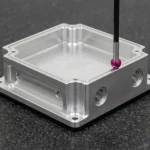
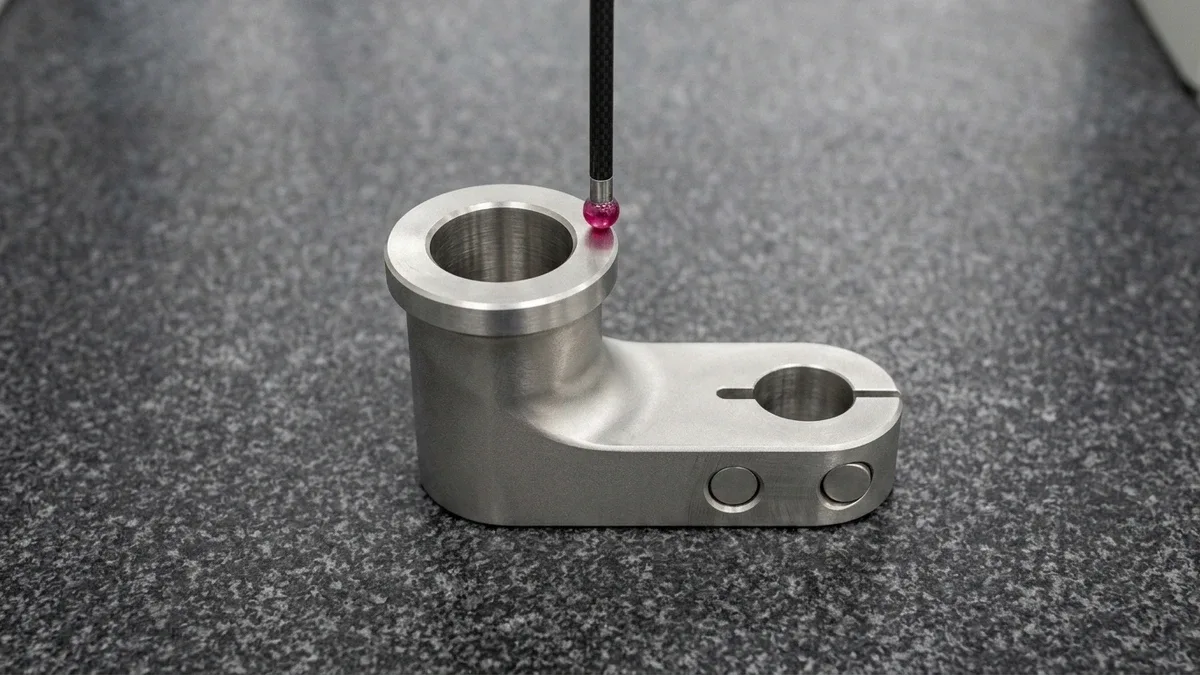
- Zeiss Contura Bridge CMM with Vertical Ruby Stylus: Used for rigid, bead-blasted and ASTM A967 passivated 17-4PH surgical manipulator arm split-clamp transition adapters and mounting blocks to verify top datum flatness, bore cylindricity, and orthogonal perpendicularity (⊥ 0.008 mm), as shown in the vertical ruby probe contact setup below.
6. Prototyping to Low-Volume Production: DFM Rules & When NOT to Use 3D Printed Resins or Single-Cut EDM
Scaling a surgical robot instrument from R&D benchtop validation to 50–1,000+ unit pre-clinical and commercial pilot batches requires matching each geometric feature to the most repeatable process across our robotics & automation machining, high-rigidity 3/4-axis VMC, 5-axis CNC machining, Swiss turning, and Wire EDM cells.
During early prototyping (1 to 15 assemblies), engineering changes to pulley groove depth or clevis pin diameter occur frequently. Rather than investing in expensive multi-cavity stamping or metal injection molding (MIM) hard tooling that requires 8 to 12 weeks and suffers from sintered porosity, CNC Swiss turning plus Wire EDM delivers wrought-metal strength in 4 ~ 8 business days.
As batch volumes scale to 100–1,000+ units per quarter, our shop floor transitions from single-part vise clamping to custom multi-station EDM fixtures (cutting 12 to 20 clevis blanks simultaneously in a single wire threading setup) and bar-fed Star Swiss lathes running lights-out with automated in-process tool-wear offset compensation.
| Manufacturing Process | Dimensional & GD&T Capability (mm) | Minimum Feature / Wall Limit (mm) | As-Machined Surface Roughness (Ra µm) | Ex-Factory Production Turnaround* | Recommended Application / When to Choose |
|---|---|---|---|---|---|
| Star Swiss-Type CNC Turning + Live Micro-Milling | ±0.005 mm diameter | ◎ 0.005 mm coaxiality | Ø0.80 mm pin OD | 0.18 mm groove width | Ra 0.2–0.4 µm (8–16 µin) | 4 ~ 8 Business Days (Bare) | 7 ~ 12 Business Days (Passivated) | Best for tendon guide pulleys, h5 pivot pins, capstan spools, and slender shafts with L/D > 8:1. |
| Sodick 4-Skim Fine-Wire EDM (Ø0.05–0.10 mm Wire) | ±0.005 mm profile | ⊥ 0.008 mm slot walls | R 0.06 mm internal corner | 0.40 mm ear wall | Ra 0.2–0.4 µm (recast ≤ 1–2 µm) | 4 ~ 8 Business Days (Bare) | 7 ~ 12 Business Days (Passivated) | Best for hardened 17-4PH H900 clevis yoke slots, fenestrated jaw serrations, and zero-burr flexures. |
| 3/4-Axis VMC with Rotary Indexer (Shop Workhorse) | ±0.010 mm critical | ISO 2768-mK general | 0.50 mm metal wall | 0.35 mm PEEK web | Ra 0.4–0.8 µm (16–32 µin) | 4 ~ 8 Business Days (Prototypes) | 7 ~ 30 Business Days (Batch) | Best for 80% of surgical arm clamp blocks, trocar adapter flanges, and PEEK/PPSU insulator blocks. |
| 5-Axis Simultaneous & 3+2 Indexed CNC Milling | ±0.010 mm multi-datum compound bores | 0.60 mm contoured titanium wall | Ra 0.4–0.8 µm (16–32 µin) | 7 ~ 12 Business Days (Finished) | 15 ~ 30 Business Days (Batch) | Best for sculpted distal jaw backs, compound-angle tendon exit tunnels, and multi-face sterile housings. |
*Note: All turnaround intervals denote Ex-Factory Production & Inspection Turnaround (including in-house heat treatment, surface passivation/electropolishing, and CMM/VMS inspection) and are strictly separated from 3 ~ 5 Business Days international air transit via DHL, FedEx, or UPS.
Actionable DFM Checklist for Surgical Robotics Hardware Engineers
- Provide Unobstructed Line-of-Sight for Wire EDM Slots: Wire EDM requires a continuous through-path for the taut brass wire. Never design a blind-bottom clevis slot with square internal corners; either open the slot base with a Ø1.0 mm starter hole or specify a minimum R 0.25 mm fillet for micro-end-milling.
- Standardize Coaxial Clevis Pin Bores for Single-Pass Line Reaming / EDM: Design opposing twin clevis ears with identical bore diameters (e.g., coaxial Ø1.50 mm H7 on both ears) rather than stepped bores from opposite sides, allowing a single wire threading or single-setup carbide reamer pass to lock coaxiality within 0.005 mm.
- Specify Explicit Edge-Break Callouts on Tendon Exit Holes: Replace vague notes like “Break all sharp edges” with an explicit callout of 0.05 mm to 0.10 mm × 45° chamfer or R 0.08 mm blend, zero burrs permitted under 20× stereo magnification at every cable entry and exit port.
- Avoid 3+2 or 5-Axis Callouts When 4-Axis Indexing Suffices: If a cylindrical surgical shaft or trocar collar only contains radial cross-holes and flats around a single rotary axis, design features orthogonal to the shaft centerline so they run on high-rigidity 4-axis indexers at 25%–35% lower unit cost.
- Design Sacrificial Wrench Flats or Holding Tabs on Sculpted Jaws: Distal forceps jaws with curved outer profiles lack parallel clamping surfaces for second-operation Wire EDM. Adding a temporary 3.0 mm × 3.0 mm sacrificial datum tab at the proximal stem allows rigid EDM fixturing before the tab is wire-cut off in the final pass.
Engineering Decision Tree: Selecting the Optimal Process by Geometry & Batch Scale
- Priority 1 — Sub-Millimeter Rotational Pulleys, Pins & Capstans (10 to 5,000+ pcs): Route directly to Star Swiss-type CNC turning with guide-bushing support and sub-spindle backside finishing to lock ◎ 0.005 mm coaxiality and Ra 0.2 µm groove finish in a single cycle.
- Priority 2 — Hardened 17-4PH H900 Clevis Yokes & Serrated Jaws (1 to 1,000+ pcs): Combine Swiss turning + Vacuum H900 aging + Sodick 4-skim Wire EDM rather than attempting fragile micro-end-milling or costly MIM hard tooling.
- Priority 3 — Prismatic Arm Clamps, Trocar Adapters & PEEK Insulators: Machine on 3-axis and 4-axis CNC vertical machining centers with custom soft jaws and rotary collet indexers, reserving simultaneous 5-axis milling strictly for compound-angle tendon tunnels and sculpted organic jaw backs.
When NOT to Use 3D Printed Photopolymer Resins or Single-Cut EDM
During early kinematic architecture sprints, teams sometimes attempt to 3D print wrist clevises and tendon pulleys using stereolithography (SLA) resins or direct metal laser sintering (DMLS). Engineers should strictly avoid this shortcut for functional cable-driven tests: SLA resins creep under 100 N of continuous cable tension within hours, losing all pre-tension.
Similarly, raw DMLS metal 3D printed wrist links retain Ra 6–12 µm partially melted powder granules inside internal tendon tunnels that cannot be reached by mechanical polishing. Those abrasive sinter peaks act like a file against braided tungsten cables, severing strands in under 50 articulation cycles unless all functional bores and grooves are post-machined.
🔗 Related Medical & Precision Robotics Engineering Guides
- Robotics Prototyping & Precision Manufacturing Guide — Structural actuator housings, harmonic drive mounts, and multi-axis arm links.
- Custom Machining Medical Parts — Material traceability, burr-free machining protocols, and biocompatible alloy selection.
- 3 Truths of Medical Device Machining — Cost drivers, tolerance stack-up traps, and DFM strategies for surgical instrumentation.
- 17-4PH Stainless Steel Machining Guide — Condition A vs. H900/H1025 precipitation hardening and thermal shrinkage control.
7. Technical Engineering FAQ
Swiss-type CNC turning and 4-skim Wire EDM routinely hold ±0.005 mm (±0.0002 in.) on pivot pin journals, clevis ear slots, and tendon pulley grooves. Non-critical structural housings follow ISO 2768-mK general tolerances to balance multi-axis machining cycle times and unit production costs.
Single-cut rough Wire EDM leaves a 15–25 µm thermal recast white layer with micro-cracks that flake off and fray braided tungsten actuation cables. Executing one rough cut plus three to four high-frequency skim cuts reduces recast depth below 1–2 µm and achieves Ra 0.2–0.4 µm.
ASTM A967 nitric or citric acid passivation forms a ~0.002 µm chromium-oxide conversion film that causes zero measurable dimensional shift on ±0.005 mm bores. Conversely, ASTM B912 electropolishing dissolves 5–15 µm of surface metal per side, requiring pre-process stock allowances or masking on H7/h6 fits.
Choose 17-4PH H900 stainless steel (≥ 1,170 MPa yield strength, 40–44 HRC) for high-load wrist clevises and jaws requiring maximum contact wear resistance against tungsten cables. Select ASTM F136 Ti-6Al-4V ELI (4.43 g/cm³ density) when minimizing distal arm inertia or magnetic resonance susceptibility is critical.
Ready to Manufacture Precision Surgical Robot Components?
Upload your 3D CAD models (STEP/IGES) and 2D tolerance drawings for a complimentary DFM review, Swiss turning and multi-skim Wire EDM process routing, datum-locking metrology planning, and a custom production quotation from our in-house engineering team.
Upload 3D CAD for DFM & Quote →